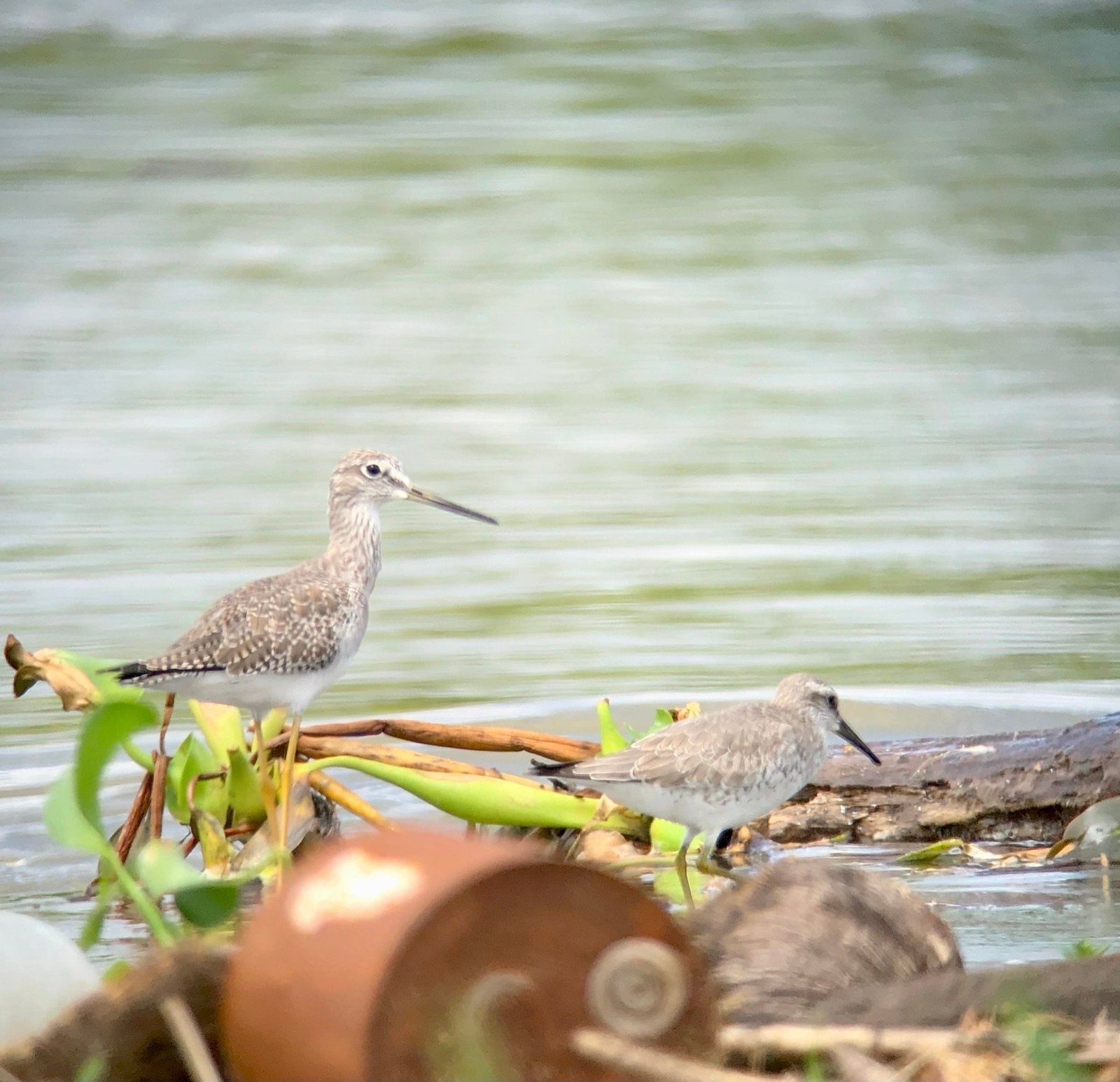
Family Scolopacidae
Greater Yellowlegs
Tringa melanoleuca
In Spanish: Patiamarillo Mayor (Correlimos Grande, Pijije, Zarceta)
- Migrant
A tall, loud-voiced wader that winters on Costa Rican wetlands
The Greater Yellowlegs is a migrant shorebird, marked M on the official Costa Rican bird list. It is a winter visitor and does not breed here, so every bird you meet has travelled a long way.
It breeds in the boreal bogs and marshes of Canada and Alaska, then winters from the southern United States through Central America and the West Indies to South America. A Costa Rican field guide calls it scarce and possibly overlooked, which makes a good sighting feel earned.
For a beginning birder it is a rewarding wader to learn. Long bright yellow legs and a loud whistled call make it easier to know than many of its relatives, and on trips it has turned up inland as well as on the coast.
How to find it
Look for shallow, still water such as marshes, lagoons, salt ponds and flooded fields, and scan for a tall wader with bright legs. Watch for sudden dashes and side-to-side bill sweeps, which give away a feeding bird. Listen for the loud three-note whistle, and for sharp alarm calls when birds are disturbed. Check small groups carefully, since one trip compared a single Greater with a flock of Lesser Yellowlegs at a marsh near San Vito. Where wet habitat is scarce, as near Turrialba, the bird is rare, so a good wetland is worth your patience.
How to recognise it
Look for long, bright yellow legs and a long, thin, dark bill. The bill is longer than the head and often tilts slightly upward. At the base it often looks gray, and it is longer and thicker than the bill of the Lesser Yellowlegs.
The back is gray-brown with fine pale spotting. The underparts are white, with dark streaks on the neck and breast. The rump is white.
In flight, the white rump and tail stand out against darker wings. A Costa Rican field guide puts the Greater at about Willet size with a stouter bill, while the Lesser is about dowitcher size.
What it sounds like
Behaviour and diet
The Greater Yellowlegs feeds by walking and wading, often dashing after prey and sweeping its bill from side to side. It often hunts by running through shallow water after small fish, and in migration and winter it takes fish such as minnows. On the breeding grounds it eats mostly insects.
The Lesser Yellowlegs picks at the surface more calmly. The Greater is usually found alone or in small groups.
Where it lives
Outside the breeding season it uses fresh and brackish shallow water: coastal mudflats, estuaries, mangroves, salt ponds, lagoons, flooded fields and inland marshes. A Costa Rican field guide describes the habitat as lakes, marshes, salt ponds and coastal lagoons, and says it is rarely seen on open mudflats and beaches.
In Costa Rica it has been recorded on both coasts and inland, from the Guanacaste wetlands to the Osa Peninsula and the southern zone near San Vito.
When to see it
A Costa Rican field guide lists late January to March on both coasts, and probably also August to October. A Turrialba birding blog says both yellowlegs are only rarely found through the summer months.
Similar birds
The Lesser Yellowlegs is smaller, with a shorter, straight, thin bill about as long as its head. The Greater's bill is longer and thicker. Calls help: the Greater gives three or four loud notes, while the Lesser gives a softer, shorter call of about two notes. Birders near Turrialba heard a pair give what seemed a two-note call, so use size and bill together with voice.
Names and lore in Costa Rica
The official Costa Rican list gives the Spanish name Patiamarillo Mayor, with local alternates Correlimos Grande, Pijije and Zarceta. Pijije and Zarceta are also used for the Lesser Yellowlegs, so they do not tell the two apart.
Status and conservation
The official Costa Rican bird list marks the Greater Yellowlegs as M, a migrant and winter visitor that does not breed in the country.
How we know this 19 sources, each read on the date shown
- Lista Oficial de las Aves de Costa Rica (AOCR) read 2026-11-04
https://listaoficialavesdecostarica.wordpress.com/lista-oficial/lista-oficial-online/ - Alvarado Quesada 2006, Journal of Heron Biology and Conservation read 2026-11-04
https://www.heronconservation.org/media/JHBC/vol04/art02/resources/alvarado_quesada-2006a.pdf - Flickr (photo tag page) read 2026-11-04
https://www.flickr.com/photos/tags/pitotoy/ - Explore Costa Rica blog read 2026-11-04
https://explorecr.blogspot.com/2012/04/colorado-de-abangares.html - Wikipedia read 2026-11-04
https://en.wikipedia.org/wiki/Greater_yellowlegs - BirdLookup read 2026-11-04
https://www.birdlookup.com/birds/greater-yellowlegs - Birdfact read 2026-11-04
https://www.birdfact.com/birds/greater-yellowlegs - Featherscan read 2026-11-04
https://www.featherscan.com/birds/greater-yellowlegs - Audubon Field Guide read 2026-11-04
https://www.audubon.org/field-guide/bird/greater-yellowlegs - Birds and Blooms read 2026-11-04
https://www.birdsandblooms.com/birding/bird-species/ducks-and-geese/greater-vs-lesser-yellowlegs/ - Bird Identifier read 2026-11-04
https://birdidentifier.com/encyclopedia/greater-yellowlegs/greater-yellowlegs-identification-guide - Birds of Costa Rica (Princeton field guide, text on dokumen.pub) read 2026-11-04
https://dokumen.pub/birds-of-costa-rica-9780691243351.html - Birds for Beer (Turrialba, Costa Rica) read 2026-11-04
https://birdsforbeer.com/2018/11/01/yellowlegs-but-which-one/ - Field Guides Birding Tours, Costa Rica 2015 trip list read 2026-11-04
https://fieldguides.com/triplists/cr115.html - Exotic Birding, Palo Verde checklist read 2026-11-04
https://www.exoticbirding.com/costarica/paloverde/checklist.html - Birding the Americas Trip Report Repository read 2026-11-04
https://maybank.tripod.com/CentralAmerica/CostaRica/CostaRica-11-2000.htm - Costa Rica Trip Report 2019 (Ghent University site) read 2026-11-04
https://users.ugent.be/~hmatheve/hm/COSTARICA19.html - PlanetScott lifelist read 2026-11-04
http://www.planetscott.com/speciesdetail/3006/greater-yellowlegs-(tringa-melanoleuca) - Field Guides Birding Tours, Costa Rica trip list read 2026-11-04
http://fieldguides.com/triplists/cos12.html