Family Scolopacidae
Willet
Tringa semipalmata
In Spanish: Pigüilo
- Migrant
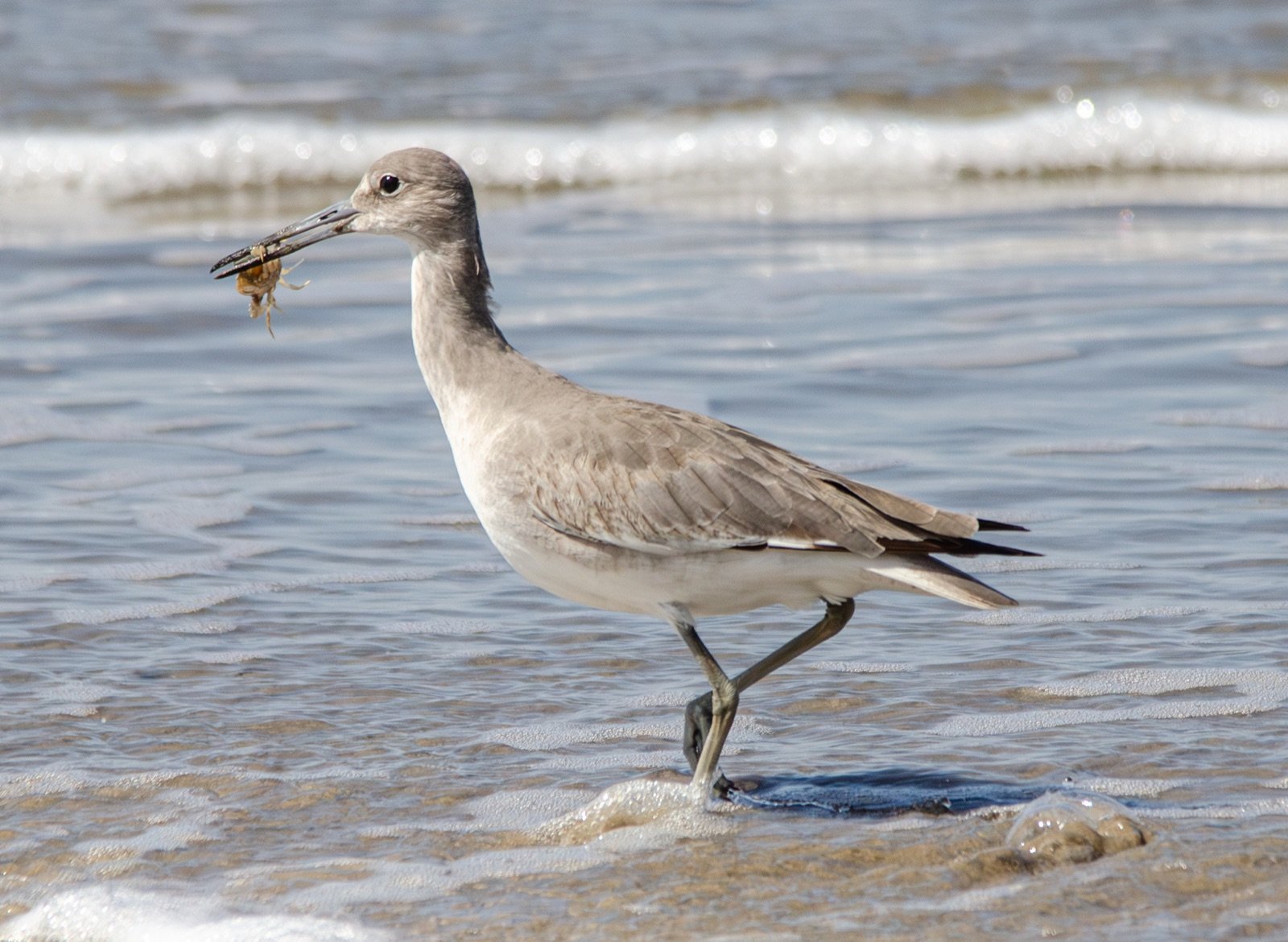
Plain gray shorebird that flashes bold black and white wings in flight.
The Willet looks plain gray-brown on the ground, then takes off and shows a bold black and white wing pattern. In Costa Rica it is mainly a winter visitor, with reports from the Pacific coast around the Tárcoles River.
Costa Ricans call it pigüilo. It is named for its loud, ringing call, and that call plus the wing flash make it a good first shorebird to learn on a coastal morning.
Groups have found it along the Tárcoles River and at the Estero Mata de Limón lagoon, so on a trip we build along the central Pacific coast it is a bird worth scanning for.
How to find it
Head for the Pacific coast, where the Tárcoles River mouth and the Estero Mata de Limón lagoon have both produced Willets. Check beaches, mudflats and river mouths at low tide, when birds feed on crabs. Scan through the gulls and terns, because a couple can sit among them. Wait for a bird to fly so the black and white wing pattern shows. Listen for the ringing pill-will-willet, which often gives the bird away before you see it.
How to recognise it
On the ground a Willet looks plain gray-brown, which is why it is easy to overlook. Look for these marks:
Gray legs, thick and blue-gray.
A thick, straight bill, heavier than a yellowlegs'.
A bold black and white wing pattern in flight.
A Field Guides group on the Tárcoles River described the birds as drab and fairly large, which fits the Western Willet. That form is about 10% larger than the Eastern, and in flight it looks more like a godwit, with longer wings and a more drawn-out rear end. The Eastern bird looks stockier with a shorter bill. In winter plumage the two look almost the same, and birds on the Pacific coast of Middle America are most likely the larger western form.
What it sounds like
Behaviour and diet
Willets are often seen feeding on crabs at low tide. They probe mud, sand and shallow water for invertebrates, so the tide line is the place to watch them work.
A Willet looks plain until it flies, and then it flashes its wings. It is noisy and easy to find on coastal beaches.
They can also hide in mixed company. A Field Guides group found a couple while sorting through gulls and terns at the Estero Mata de Limón lagoon, a good reminder to scan the whole flock rather than only the obvious birds.
Where it lives
In the non-breeding season Willets use coastal beaches, salt marshes, mudflats and rocky shores. In Costa Rica the reports come from the Pacific side: the Tárcoles River and its coastal area, the Estero Mata de Limón lagoon near Tárcoles, and Manuel Antonio, where one has been photographed.
It has even reached remote Isla del Coco, where the Costa Rican rare bird committee (AOCR) holds its first photographic record.
When to see it
The Willet is mainly a winter visitor to Costa Rica, but a few birds stay through the summer; a single adult was seen near the Tárcoles River mouth on a summer trip. On the Pacific coast it is described as abundant during passage, from August to September and from late March to late May.
Similar birds
Greater Yellowlegs is the bird to check against. The Willet has thick blue-gray legs and a heavier bill, and it shows bold black and white wing stripes in flight, which yellowlegs lack. Reports of Eastern Willets on the Pacific coast are mostly doubtful, since the two forms look almost the same in winter plumage.
Names and lore in Costa Rica
Costa Ricans call the Willet pigüilo. The Spanish list of Costa Rican birds also gives the general Spanish name playero aliblanco.
Status and conservation
The AOCR lists the Willet (Pigüilo) as M, a migrant in Costa Rica, and in 2026 it was split into Saltmarsh Willet and Prairie Willet.
Photography tips
Watch a feeding bird at low tide on a beach or river mouth, then be ready when it lifts off, because the black and white wing pattern is the picture. A March 2016 photo from the Tárcoles coastal area shows the Pacific side suits it.
How we know this 14 sources, each read on the date shown
- Field Guides Birding Tours read 2026-11-04
https://fieldguides.com/triplists/cos24.html - Field Guides Birding Tours read 2026-11-04
https://fieldguides.com/triplists/cos17.html - All About Birds (Cornell Lab) read 2026-11-04
https://www.allaboutbirds.org/guide/Willet/overview - Everyday Earth read 2026-11-04
https://everydayearth.ai/species/willet - Birds of the World (Cornell Lab) read 2026-11-04
https://birdsoftheworld.org/bow/species/willet2/cur/introduction - Field Guides trip list, Summer Costa Rica 2023 read 2026-11-04
https://fieldguides.com/triplists/cos23b.html - Wikipedia (Aves de Costa Rica) read 2026-11-04
https://es.wikipedia.org/wiki/Aves_de_Costa_Rica - World Bird Photos read 2026-11-04
https://www.worldbirdphotos.com/photo/willet-tringa-semipalmatus-costa-rica/ - AOCR Lista Oficial read 2026-11-04
https://listaoficialavesdecostarica.wordpress.com/2017/04/28/isla-del-coco-primer-comprobante-de-tringa-semipalmata/ - Birdfinding.info read 2026-11-04
https://birdfinding.info/eastern-willet/ - Birdfact read 2026-11-04
https://www.birdfact.com/birds/willet - Birds of North America read 2026-11-04
https://www.birds-of-north-america.net/Willet.html - National Wildlife Foundation read 2026-11-04
https://nwlfd.org/species/willet - Ecosistemas de Costa Rica read 2026-11-04
https://ecosistemasdecostarica.blogspot.com/2012/08/aves.html