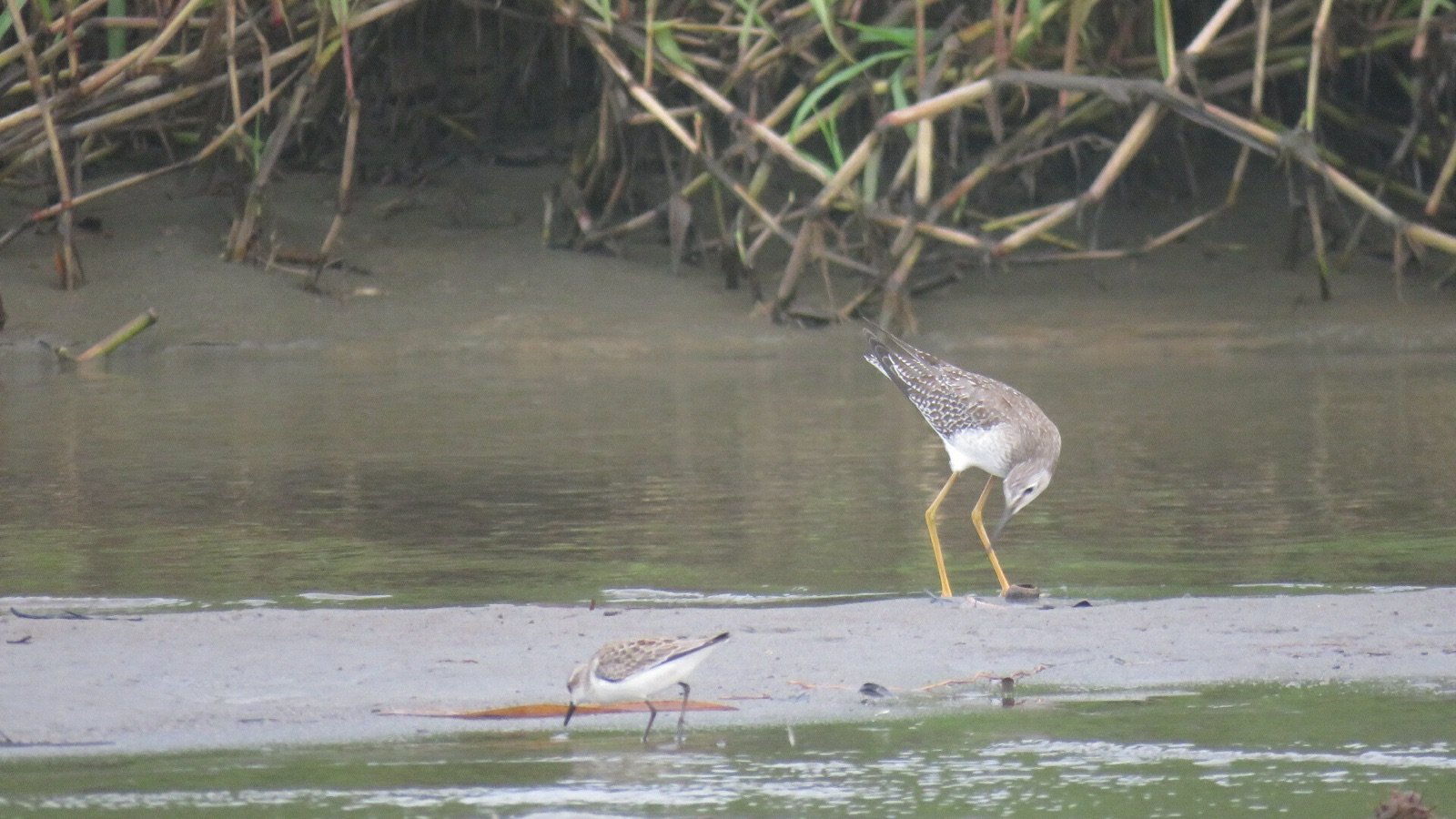
Family Scolopacidae
Lesser Yellowlegs
Tringa flavipes
In Spanish: Patiamarillo Menor (Pijije, Zarceta)
- Migrant
A common migrant wader of Costa Rica's ponds, lagoons and marshes.
The Lesser Yellowlegs is a shorebird that passes through Costa Rica on migration. It is common to locally abundant in autumn, from August to mid-October, and in spring, from March to early May.
On trips we build, wetlands are where guests meet it. A tour counted at least 22 in the San Joaquin Marsh near San Vito, and roadside wetlands in the Bebedero area of Guanacaste have held dozens of yellowlegs.
For a beginning birder it is also a classic identification lesson: telling it from its larger cousin, the Greater Yellowlegs, by size, bill and voice.
How to find it
Start with wetlands during the migration windows. Scan the edges of shallow ponds, lagoons, marshes and muddy ground, where it wades and feeds. Roadside wetlands in the Bebedero area of Guanacaste can be fantastic during migration, and a flooded field on the approach to Caño Negro held Lesser Yellowlegs on one tour. Check small lagoons for birds stirring the water. When a yellowlegs calls, listen for two lower, faster notes, which point to Lesser. Look through any flock for a larger, longer-billed bird, which may be a Greater Yellowlegs. Do not count on one site on one day: a visit to Chomes in August found Greater around the pools but no Lesser.
How to recognise it
Look first at size. The Lesser Yellowlegs looks much like the Greater Yellowlegs but is clearly smaller, especially in the bill. Across its range it is 25 to 30 percent shorter than Greater.
The bill is thin and straight and only slightly longer than the head. It is blackish, at most with a faint olive-brown tint at the base, and always dark, straight and sharp-tipped. The Greater has a slightly upturned, blunt-tipped bill that can look grayish at the base outside the breeding season.
The Latin name flavipes means yellow-footed, and the legs are the feature the English name points to. Young Lesser Yellowlegs less often have spots on the belly than young Greater.
What it sounds like
Behaviour and diet
It feeds in shallow water, and across its range it usually walks fast and erratically, picking up food as it goes. It forages with a high-stepping gait and neck stretched out, jabbing quickly at prey, and often scythes its bill back and forth in the water to stir it up. Its diet includes flies, beetles, mayflies, small fish, crustaceans, worms, molluscs, spiders and seeds. It is almost wholly a meat eater, and it sometimes feeds at night. At Bebedero, yellowlegs fed alongside Least Sandpipers that were also flying overhead.
Where it lives
In Costa Rica it is found at salt pans, riverbanks, streams, ponds, lakes and lagoons: open shallows and muddy ground.
Records come from many parts of the country. A photo shows an adult at Isla Damas near Quepos, birders have had close views on muddy ground at Angostura near Turrialba, and others have found it at Colorado on the Caribbean side near Tortuguero. It is also recorded on Isla del Coco, more than 500 km offshore, with an irregular status there.
When to see it
It is common to locally abundant in autumn, from August to mid-October, and in spring, from March to early May. Both yellowlegs are rarely seen in the summer months. A tracked bird flying north from Colombia was first detected over Costa Rica on 1 May and reached Tennessee on 2 May, after a nonstop flight of about 4,800 km.
Similar birds
The Greater Yellowlegs is the main look-alike. It is larger with a longer bill, gives 3 to 4 more ringing notes, and is the less common of the two here. The Solitary Sandpiper is smaller than the Lesser Yellowlegs, with a dark rump, a more obvious eye ring and greenish legs.
Names and lore in Costa Rica
Costa Ricans know this bird as Patiamarillo Menor. Other names listed for it are Pijije and Zarceta, and Pijije is also used for the Greater Yellowlegs. The Greater is called Patiamarillo Mayor, so the names themselves help tell the two apart. The Latin name Tringa goes back to a name used by an Italian naturalist in 1599.
Status and conservation
The AOCR official list marks it as M, a migrant, and it is a common one in Costa Rica.
Photography tips
Muddy ground can give close views, as birders found at Angostura near Turrialba and at Colorado near Tortuguero. Watch the shallow edges of lagoons, where birds stir the water with sideways sweeps of the bill.
How we know this 21 sources, each read on the date shown
- Aves de Costa Rica read 2026-11-04
https://www.avesdecostarica.com/Tringa-flavipes.html - Birds of the World (Cornell) read 2026-11-04
https://birdsoftheworld.org/bow/species/lesyel/cur/identification?lang=es - Birds for Beer (Turrialba) read 2026-11-04
https://birdsforbeer.com/2018/11/01/yellowlegs-but-which-one/ - AOCR Lista Oficial read 2026-11-04
https://listaoficialavesdecostarica.wordpress.com/lista-oficial/lista-oficial-online/ - Audubon read 2026-11-04
https://www.audubon.org/news/almost-impossible-mission-of-studying-lesser-yellowlegs - Birda read 2026-11-04
https://app.birda.org/species-guide/6791/Lesser_Yellowlegs - Field Guides Birding Tours read 2026-11-04
https://fieldguides.com/triplists/cr115.html - Birding Craft read 2026-11-04
https://birdingcraft.com/wordpress/category/dry-forest/ - Flickr (pitotoy tag) read 2026-11-04
https://www.flickr.com/photos/tags/pitotoy/ - Universidad Icesi read 2026-11-04
https://www.icesi.edu.co/6927-el-vuelo-de-un-ave-desde-colombia-hacia-tennessee/ - Exotic Birding read 2026-11-04
https://www.exoticbirding.com/costarica/paloverde/checklist.html - Visit Costa Rica read 2026-11-04
https://www.visitcostarica.com/where-to-go/protected-areas/palo-verde-national-park - Birding Craft read 2026-11-04
https://birdingcraft.com/wordpress/category/mangroves/feed/ - iNaturalist Cocos Island checklist read 2026-11-04
https://mexico.inaturalist.org/check_lists/562042-Birds-of-Cocos-Island---Aves-de-la-Isla-del-Coco - Field Guides tour list, Costa Rica 2020 read 2026-11-05
https://fieldguides.com/triplists/cr220.html - Birding Craft read 2026-11-05
http://birdingcraft.com/wordpress/2012/08/ - Birds of the World read 2026-11-05
https://birdsoftheworld.org/bow/species/lesyel/cur/sounds - Boreal Songbird Initiative read 2026-11-05
https://www.borealbirds.org/bird/lesser-yellowlegs - Wikipedia read 2026-11-05
https://en.wikipedia.org/wiki/Lesser_yellowlegs - Swartz Entrover bird page read 2026-11-05
https://www.swartzentrover.com/cotor/photos/hiking/birds/birdpages/LesserYellowlegs.htm - Birdlist.org read 2026-11-05
https://www.birdlist.org/aves/aves_de_costa_rica.htm