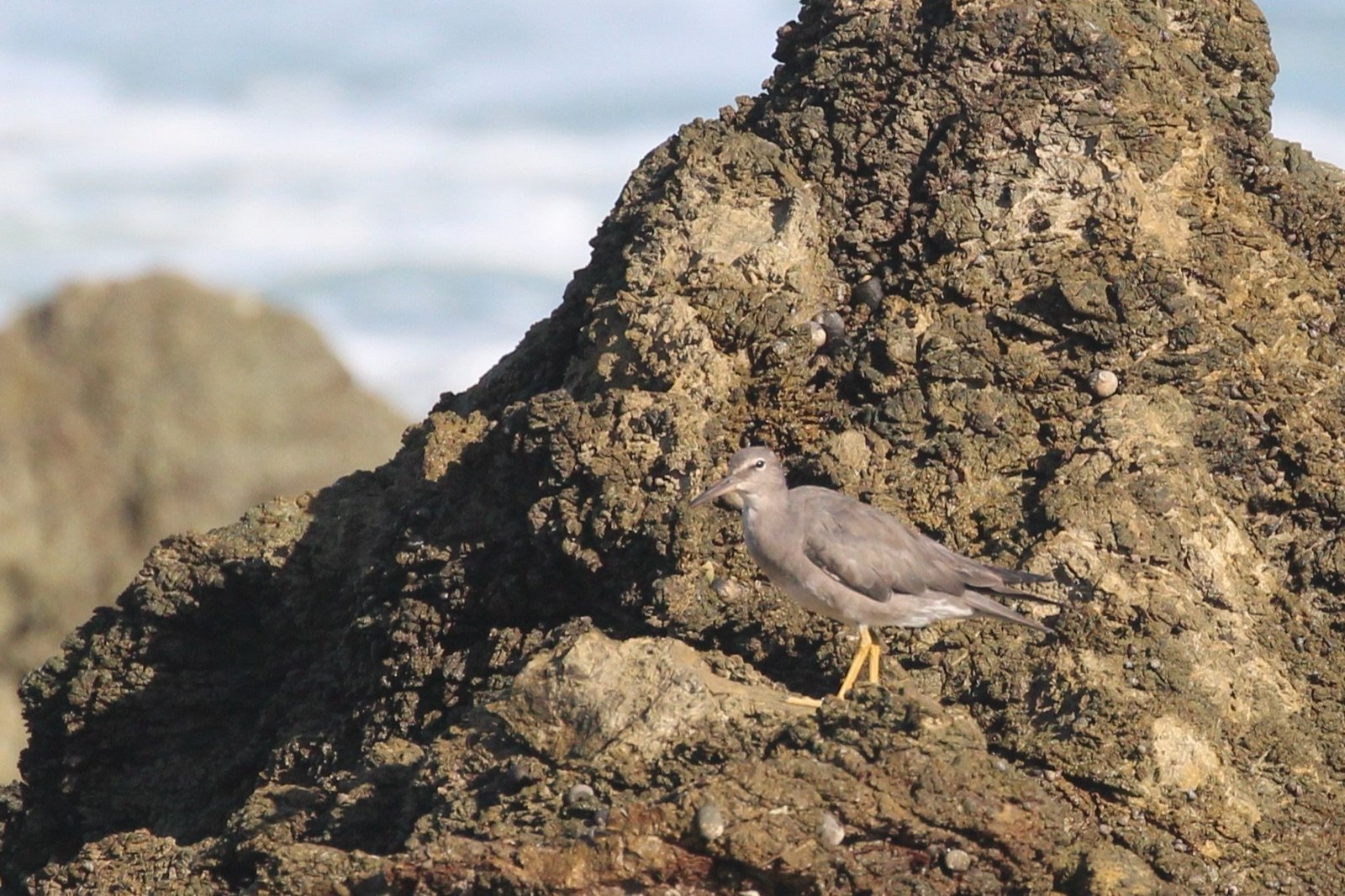
Family Scolopacidae
Wandering Tattler
Tringa incana
In Spanish: Correlimos Vagabundo
- Migrant
A tail-bobbing loner of rocky Pacific shores, here as a migrant visitor.
The Wandering Tattler (Correlimos Vagabundo) is a migrant visitor to Costa Rica, and you look for it on rocky shoreline, not on open sand. Picture a single plain gray shorebird working wet rocks at the water's edge.
It breeds far to the north and reaches Costa Rica near the southern end of a Pacific wintering range that runs from California down to Ecuador. A Costa Rica birding guide calls it rather rare and local here, so it rewards patient scanning of the right kind of rock.
On a Pacific coast trip we build, rocky shoreline spots are where guests can meet it, and Cocos Island, far offshore, is also on its list of places.
How to find it
Scan rocky coastal outcrops, where it may sit with Ruddy Turnstones. Look right at the water's edge, on wet rocks that the tide has exposed. It sometimes feeds alongside Surfbirds, so check around them. The tattler blends well with dark gray rocks, so it is easy to miss; watch for the tail bobbing and teetering walk near the surf. Expect one bird, not a flock, and know that some outcrops turn up only turnstones, Whimbrel and Spotted Sandpipers.
How to recognise it
Tattlers differ from other Tringa species in having plain, grayish wings and back. Look for a smooth gray bird above, not a spotted or streaked one.
Adults have short dark yellow legs and a dark gray bill. The upperparts, face and neck are gray, and the belly is white.
In breeding plumage the scaly pattern on the breast spreads onto the belly, and the eyebrow stripe is prominent.
Among rocky shore birds, it has a longer bill than turnstones or Surfbird. It is smoother gray above than Rock Sandpiper and feeds more actively. It is usually seen alone, while those others form flocks.
What it sounds like
Behaviour and diet
The tattler bobs its tail constantly as it feeds, which gives it an unsteady walk. It teeters its hindquarters up and down and moves quickly over wet boulders near breaking waves.
It picks insects, small mollusks and crabs from rocks, and sometimes chases small crabs.
Outside the breeding season it is basically solitary, so expect single birds rather than flocks. Its behavior is superficially closest to Spotted Sandpiper, which also feeds on rocky shores.
Where it lives
On its wintering grounds it uses rocky shores, reefs, small islands and man-made structures such as jetties and breakwaters. It only occasionally feeds on nearby mudflats or sand beaches.
In Costa Rica the places that matter are on the Pacific side: the central Pacific coast near Dominicalito, the Nicoya Peninsula around Montezuma and Cabuya, and Cocos Island far offshore, where it is listed as an irregular visitor.
When to see it
The first Costa Rican records date from December 1975 and 24 April 1976, which spans winter through the start of spring migration. On Cocos Island the species was not recorded until late September to early November, which marks the arrival of fall migrants, and a park guide says it is often seen on the rocky shores there during the winter months.
Similar birds
The Gray-tailed Tattler looks very similar. Wandering prefers exposed rocky headlands, while Gray-tailed more often uses soft mud in harbours. In flight, Wandering gives a rippling trill and Gray-tailed gives an up-slurred two-note call. Spotted Sandpiper, a common migrant in Costa Rica, also feeds on rocky shores outside the breeding season.
Names and lore in Costa Rica
The AOCR name is Correlimos Vagabundo, and Correlimos Vagamundo is listed as a second Spanish name used for this bird in Costa Rica.
Status and conservation
The AOCR official list gives the Wandering Tattler (Correlimos Vagabundo) the status M, a migrant visitor to Costa Rica.
Photography tips
The tattler blends well with dark gray rocks, so learn its loud ringing call, which is often the first sign it is there. Then scan the wet rocks at the waterline where the tide has just exposed them.
How we know this 19 sources, each read on the date shown
- Birding for Conservation read 2026-11-04
https://www.birdingforconservation.com/2019/02/birding-costa-rica-central-pacific/ - Birdingcraft read 2026-11-04
https://birdingcraft.com/wordpress/category/pacific-slope/page/7/ - Birdingcraft read 2026-11-04
https://birdingcraft.com/wordpress/tag/pelagic-birding/ - iNaturalist checklist, Cocos Island read 2026-11-04
https://mexico.inaturalist.org/check_lists/562042-Birds-of-Cocos-Island---Aves-de-la-Isla-del-Coco - Birds of the World (Cornell Lab) read 2026-11-04
https://birdsoftheworld.org/bow/species/wantat1/cur/movement - AOCR Lista Oficial read 2026-11-04
https://listaoficialavesdecostarica.wordpress.com/lista-oficial/lista-oficial-online/ - iNaturalist guide (Wikipedia text) read 2026-11-04
https://www.inaturalist.org/guide_taxa/181453 - Wikipedia read 2026-11-04
https://en.wikipedia.org/wiki/Wandering_tattler - All About Birds (Cornell Lab) read 2026-11-04
https://www.allaboutbirds.org/guide/Wandering_Tattler/lifehistory - NatureServe Explorer read 2026-11-04
https://explorer.natureserve.org/Taxon/ELEMENT_GLOBAL.2.104652/Tringa_incana - Audubon Field Guide read 2026-11-04
https://www.audubon.org/field-guide/bird/wandering-tattler - New Zealand Birds Online read 2026-11-04
https://www.nzbirdsonline.org.nz/species/wandering-tattler - BirdWatching (Kenn Kaufman ID tips) read 2026-11-04
https://www.birdwatchingdaily.com/birds/kenn-kaufmans-id-tips/identifying-wandering-tattler-and-spotted-sandpiper/ - Cornell All About Birds read 2026-11-04
https://www.allaboutbirds.org/guide/Wandering_Tattler/overview - Avibase read 2026-11-04
https://avibase.bsc-eoc.org/species.jsp?avibaseid=13854B6E3E56F536 - National-Parks.org read 2026-11-04
https://national-parks.org/costa-rica/cocos-island-national-park/ - New Information on Costa Rican Waterbirds (ResearchGate) read 2026-11-05
https://www.researchgate.net/publication/269579522_New_Information_on_Costa_Rican_Waterbirds - Animalia read 2026-11-05
https://animalia.bio/wandering-tattler?environment=1398 - Ecosistemas de Costa Rica read 2026-11-05
https://ecosistemasdecostarica.blogspot.com/2012/08/aves.html