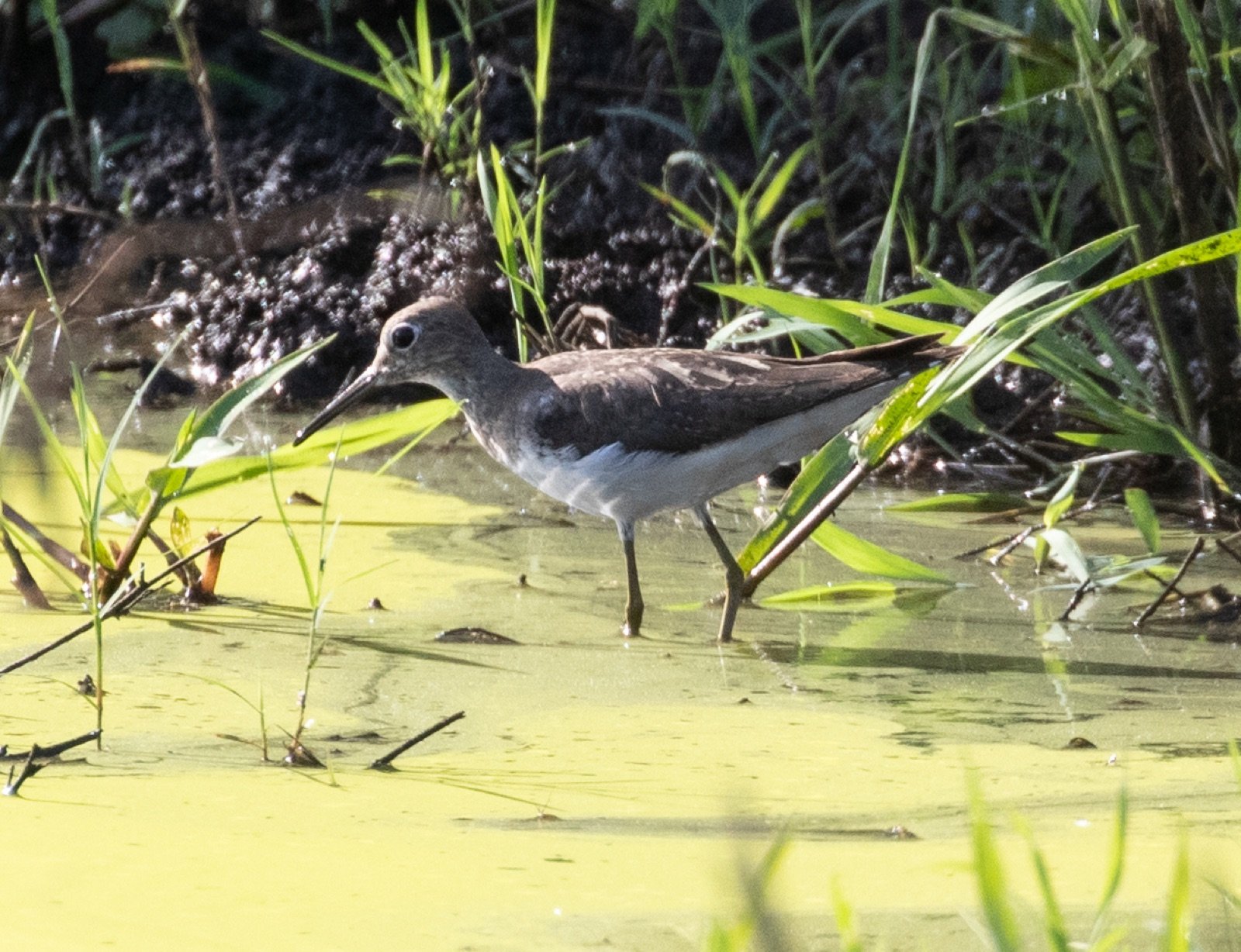
Family Scolopacidae
Solitary Sandpiper
Tringa solitaria
In Spanish: Andarríos Solitario (Tigüiza)
- Migrant
A lone, trembling sandpiper of shaded streams and ponds, here on migration.
The Solitary Sandpiper (Andarríos Solitario, known locally as Tigüiza) lives up to its name. It is usually alone or in small, scattered groups, never in big flocks, and it favours quiet water where vegetation reaches the edge.
In Costa Rica it is a migrant visitor. It breeds in the boreal forests of Alaska and Canada and winters in Central and South America and the Caribbean, so the birds you meet here have travelled a long way.
It suits a beginning birder because it turns up in ordinary places: a stream, a pond, a muddy corner. It is found regularly from the lowlands up to about 2000 m on both the Caribbean and Pacific slopes, so on a trip we build, a slow walk beside a bit of water is a fine place to start looking.
How to find it
Start with quiet fresh water where vegetation reaches the edge, rather than open mudbanks. Check ditches and small wet spots too, which are often too cramped for other waders. Birds move around with the season, following changes in the water level of their habitat, so check wetlands again as water rises or falls. In the highlands, walks around mountain ponds and streams are a good way to look, though it is uncommon there. Move slowly, watch for the trembling movement, and listen for the three-note whistle of a bird taking off.
How to recognise it
The adult is about 22 cm long and weighs about 45 g. It is slim, with dark wings and rump, a clear eye ring and a boldly barred tail.
In non-breeding plumage, the one you will most often meet here:
- the head, neck and chest are pale brownish
- the throat and belly are white
- the back is olive-brown with white spots
The bill is blackish with a grey-olive base, and the legs are dull greenish.
In breeding dress the head and neck are white with dark brown streaks, and the back is darker with more obvious white spots. Young birds look like winter adults, but the front of the neck and chest are tinged buff and flecked with brown.
What it sounds like
Behaviour and diet
The Solitary Sandpiper wades in shallow water, bobbing its head and turning its body. It pecks at aquatic insects, small mollusks and crustaceans, and it searches for food more purposefully than other Tringa species.
One observer in San José described a bird that looked nervous and seemed to tremble as if cold. That shaky habit is a useful clue when you scan a pond edge.
When it lands after a flight, it holds its wings straight up and then closes them slowly. It is usually alone or in small, scattered groups, never in big flocks.
Where it lives
This sandpiper lives along rivers and streams, ponds, marshes, flooded grassland, freshwater lagoons and muddy spots. It rarely uses salt pans. It avoids open mudbanks and prefers places where vegetation reaches the water's edge.
In Costa Rica it is found regularly from the lowlands up to about 2000 m, on both the Caribbean and Pacific slopes. During migration it sometimes climbs as high as 3000 m, so even mountain ponds can hold a passing bird.
When to see it
It is an uncommon migrant but widespread in fall (August to early October) and spring (mid-March to early May). A Costa Rican source also lists it as an uncommon winter resident, so some birds stay beyond the migration windows.
Similar birds
It resembles the Green Sandpiper of Europe and Asia, which is slightly larger and has a bright white rump. The Solitary has a dark rump and dark tail centre, and its tail edges are strongly barred. The rump and tail pattern in flight is the feature to check.
Names and lore in Costa Rica
Costa Ricans call it Tigüiza, alongside the AOCR name Andarríos Solitario. The same name is also used for the Spotted Sandpiper, so the two can be mixed up in everyday talk. Sandpipers in general are locally called correlimos, which suggests little runners.
Status and conservation
Listed as a migrant (M) on the AOCR list, and Least Concern globally on the IUCN list.
Photography tips
Check tiny sites, not just open shores: it is often found in ditches and small wet spots too cramped for other waders. Shaded water edges are worth a slow approach.
How we know this 14 sources, each read on the date shown
- Aves de Costa Rica read 2026-11-04
https://avesdecostarica.com/Tringa-solitaria.html - Flickr (Costa Rican natural history text) read 2026-11-04
https://www.flickr.com/photos/jobando/37676001411 - Animalia (Wikipedia-based text) read 2026-11-04
https://animalia.bio/solitary-sandpiper - Avespedia read 2026-11-04
https://avespedia.com/andarrios-solitario/ - NaturalistaUY (IUCN data) read 2026-11-04
https://www.naturalista.uy/taxa/3875-Tringa-solitaria - Hotel Rivel (Birds of Costa Rica blog) read 2026-11-04
https://hotelrivel.online/the-enigmatic-solitary-sandpiper-a-mountain-retreat-surprise/ - iNaturalist (Wikipedia text) read 2026-11-04
https://www.inaturalist.org/taxa/3875 - SEO/BirdLife read 2026-11-04
https://seo.org/ave/andarrios-solitario/ - Observadores de aves UNED read 2026-11-05
https://observadoresdeavesuned.wordpress.com/ - 10,000 Birds read 2026-11-05
https://www.10000birds.com/a-big-morning-in-costa-rica.htm - Aves Costa Rica (avesibericas.es) read 2026-11-05
https://www.avesibericas.es/costaricaaves2.htm - 10,000 Birds read 2026-11-05
https://www.10000birds.com/hoping-for-grasspipers-in-costa-rica.htm - Birds of the World (Cornell Lab) read 2026-11-05
https://birdsoftheworld.org/bow/species/solsan/cur/introduction - Ecosistemas de Costa Rica read 2026-11-05
https://ecosistemasdecostarica.blogspot.com/2012/08/aves.html