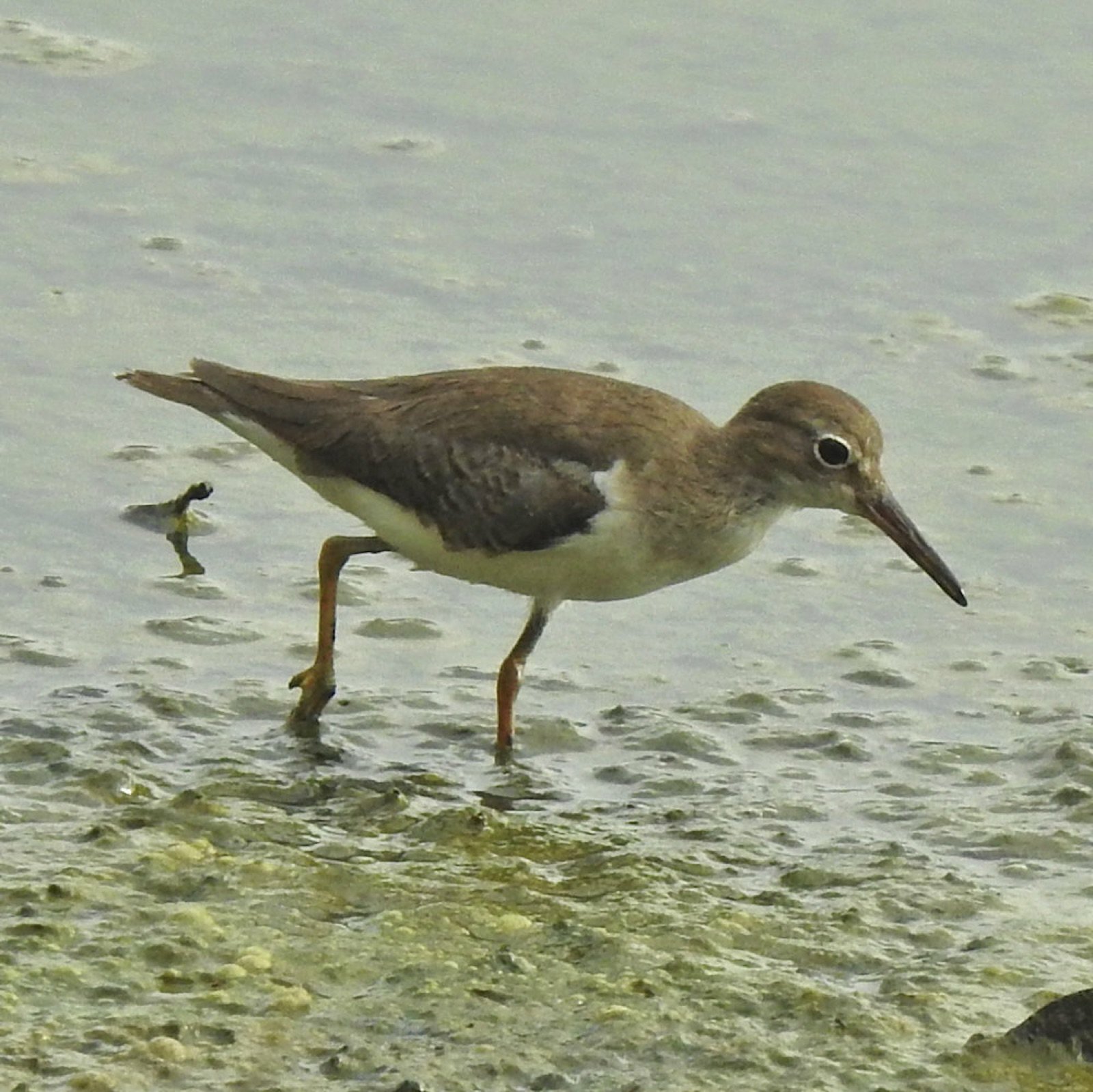
Family Scolopacidae
Spotted Sandpiper
Actitis macularius
In Spanish: Andarríos Maculado (Alzacolita, Piririza, Tigüiza)
- Migrant
A teetering shorebird of rivers and beaches, here as a migrant.
The Spotted Sandpiper (Andarríos Maculado) is a visitor to Costa Rica. It breeds near fresh water across most of Canada and the United States, then winters in the southern US, the Caribbean and South America.
In Costa Rica it lives in almost any watery habitat, from rain puddles, rivers and streams to the coast, and it is found from sea level up to about 1850 m. That makes it a bird to watch for on many kinds of outings.
Often the first clue is its back half, which bobs up and down in a teetering motion as it walks.
How to find it
Look along the edge of water, where the bird runs along the shore, stops and picks at small prey. Scan banks, rivers and rocky shores for single birds rather than flocks.
Each bird usually keeps to its own patch, so work along a shoreline a stretch at a time. Watch for the teetering back end, which often gives it away before anything else. Listen for the whistled notes when one takes off. A guided boat trip through a mangrove estuary has also turned one up.
How to recognise it
In winter plumage, which is what most visitors see, adults are dull brown above and white below. A brownish patch sits on each side of the upper breast.
The bill is brownish with a yellowish base, and the legs are dull yellow.
Young birds look like winter adults. They have pale fringes on the back feathers and stronger barring on the wing coverts.
In breeding plumage the bird has black bars on the upperparts and bold black spots on the underparts. Birds in Costa Rica may be seen in this plumage before they leave, so a spotted individual in spring is worth a second look.
What it sounds like
Recording: Whitney Brook Matson, CC BY 4.0, source, read 4 Nov 2026.
Behaviour and diet
It runs along the shore, stops, and picks off small insects, crustaceans and tiny fish. It can also catch flying insects that come within reach.
While feeding it crouches low, walks fast and darts at prey, all with a bobbing tail. It is not a flocking species. By day each bird keeps its own spaced-out patch of shore and defends it hard, though birds sleep in small groups.
When flushed it flies low over the water with stiff, shallow wingbeats. On the breeding grounds the sex roles are reversed: females defend territories and attract mates, while males incubate the eggs and care for the chicks.
Where it lives
It lives in almost any watery habitat, from rain puddles, rivers and streams to the coast. In Costa Rica it is found from sea level up to about 1850 m, and one tour site gives a range up to about 2,200 m.
It has been photographed on a Pacific beach, along the Tárcoles River, in a mangrove estuary, on the Caribbean slope and on inland rivers and streams, so it is not tied to the coast.
When to see it
It is a migrant that is common from early August to October and again from April to the end of May. A few non-breeding birds are rare summer residents, and one tour site says it can be found from July to May across the country.
Similar birds
Non-breeding birds lack the spots below and look much like Eurasia's Common Sandpiper. The Spotted Sandpiper has a more washed-out wing pattern in flight and usually pale yellow legs.
Names and lore in Costa Rica
Costa Rican sources give the common names Alzacolita, Piririza and Tigüiza alongside the official Andarríos Maculado. A Costa Rican naturalist site also lists the local name Pirrisa.
Status and conservation
The AOCR list marks it as a migrant (M), and the IUCN lists the species as Least Concern.
Photography tips
It is usually alone, so look for single birds along banks, rivers and rocky shores. A feeding bird crouches low, walks fast and darts at prey with a bobbing tail, so watch the shoreline for that movement.
How we know this 17 sources, each read on the date shown
- Ecos del Bosque (Cascadas del Toro) read 2026-11-04
https://ecosdelbosque.com/fauna/actitis-macularius - Travel To Eat read 2026-11-04
https://traveltoeat.com/spotted-sandpiper-actitis-macularius/ - Aves de Costa Rica read 2026-11-04
https://www.avesdecostarica.com/Actitis-macularius.html - Wikipedia read 2026-11-04
https://en.wikipedia.org/wiki/Spotted_sandpiper - Simple English Wikipedia read 2026-11-04
https://simple.wikipedia.org/wiki/Spotted_sandpiper - Animalia.bio read 2026-11-04
https://animalia.bio/spotted-sandpiper - Cornell Lab, All About Birds read 2026-11-04
https://www.allaboutbirds.org/guide/Spotted_Sandpiper/id - Wild Bird Journal read 2026-11-04
https://wildbirdjournal.blog/2026/09/29/spotted-sandpiper-identification-habitat-migration-diet-nesting-facts/ - Amy Birds read 2026-11-04
https://amybirds.com/tag/spotted-sandpiper/ - Essex Media & Explorations read 2026-11-04
https://www.xexplore.com/spotted-sandpiper/ - Naturalista Costa Rica read 2026-11-04
https://costarica.inaturalist.org/taxa/72458-Actitis-macularius - Diversidad y un poco de todo read 2026-11-04
https://www.diversidadyunpocodetodo.com/andarrios-maculado-actitis-macularius/ - BirdForum read 2026-11-04
http://www.birdforum.net/showthread.php?t=315132 - Indra Inn, Playa Grande read 2026-11-04
https://indrainn.com/explore/birdwatching/spotted-sandpiper/ - Cloudbridge Nature Reserve read 2026-11-04
https://www.cloudbridge.org/wp-content/uploads/2020/04/Bird-Species-List-Costa-Rica-13-April-2020.pdf - Flickr, Tárcoles natural history note read 2026-11-04
https://www.flickr.com/photos/jobando/31392604230 - Costa Rica Birding Trips read 2026-11-04
https://costaricabirdingtrips.com/scolopacidae/spotted-sandpiper-actitis-macularis