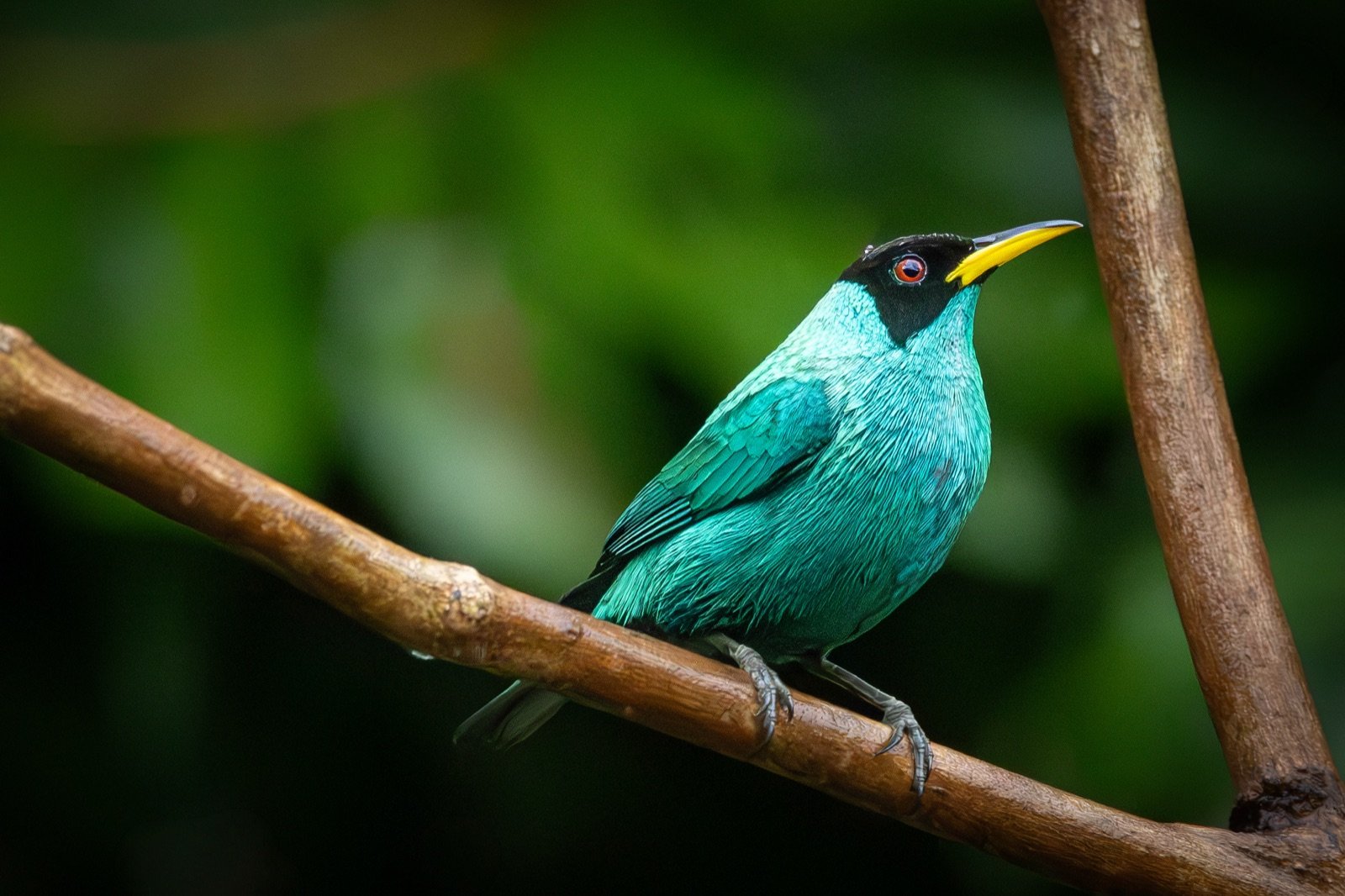
 Green Honeycreeper
Family Thraupidae
Green Honeycreeper
Chlorophanes spiza
In Spanish: Mielero Verde (Rey de Mar, Verde Mar, Rey de Trepadores)
- Resident
Blue-green male, yellow bill, red eye; at fruit feeders and flowers all year.
The Green Honeycreeper (Mielero Verde) is small, about 13 cm long and 19 g, yet the male is hard to overlook: bright blue-green with a black hood, a bright yellow bill and a red eye. It is described as fairly common in Costa Rica and is present all year.
The Caribbean slope is the most reliable region, from Tortuguero south to the forests around Puerto Viejo de Talamanca. It is a canopy bird by nature, but it comes lower to fruit feeders and fruiting bushes, which makes it a rewarding bird for a beginner.
On a trip we build, guests meet it at fruit feeders and in gardens beside rainforest, including around Sarapiquí.
How to find it
Look in fruiting trees and bushes, and watch for mixed flocks of tanagers, warblers and other small birds moving through the canopy. Pairs travel together, so when you see one, look for its mate.
Although it is a canopy bird by nature, it comes lower to visit feeders and fruiting bushes, and gardens near rainforest are good places to look. Blooming Heliconia or Costus ginger stands are also worth a patient watch, since the bird sips nectar there. Open Cecropia crowns give good views too.
How to recognise it
Male:
- bright blue-green plumage
- black hood
- bright yellow bill with a dark top ridge
- red eye
Females and young birds are plain green, paler and more yellowish below, with no dark hood. The adult female is larger, brighter and an even green, with a yellow lower bill and grayish legs.
It is a small bird, about 13 cm long and 19 g in weight, so once the light is good the male is easy to pick out, while the green female can vanish into foliage until she moves.
What it sounds like
Recording: Niels Krabbe, CC BY-SA 4.0, source, read 5 Nov 2026.
Behaviour and diet
It eats mostly fruit, with some nectar and insects, and it depends on nectar less than the Cyanerpes honeycreepers do. Birds travel through the canopy in pairs and often join mixed flocks of tanagers, warblers and other small birds.
At blooming flowers it sips nectar and may stay at one bloom for a few seconds.
Breeding in Costa Rica runs from April to July. The female builds the nest alone and incubates the eggs for about 13 days, and both parents feed the chicks.
Where it lives
In Costa Rica one source calls it common in the lowlands and foothills of both slopes, often up to about 1,200 m. Another places it on the Caribbean slope from sea level to about 1,000 m, and a third says it reaches about 1,500 m in northern Central America and Costa Rica, so the upper limit varies by source.
The Caribbean slope runs from Tortuguero south through Gandoca-Manzanillo Wildlife Refuge and the forests around Puerto Viejo de Talamanca. Photo records also come from Parque San Luis near San Ramón (957 m) and from Cinchona, both in Alajuela.
When to see it
It does not migrate within Costa Rica, so it is present all year. It moves only locally, following fruit and nectar supplies.
Similar birds
The Red-legged Honeycreeper, which is less common in Costa Rica, is the main look-alike, and the females resemble each other. The Green Honeycreeper female is larger, brighter and an even green, with a yellow lower bill and grayish legs. Plain green birds can also be mistaken for green warblers and vireos.
Names and lore in Costa Rica
Costa Rican names for this bird include Mielero Verde, Rey de Trepadores and Rey del Mar. The genus is called honeycreeper because these birds take flower nectar like bees and hummingbirds.
Status and conservation
It is a resident (R) on the AOCR list, rated Least Concern by the IUCN and described as fairly common in Costa Rica.
Photography tips
The green plumage can wash out in bright canopy light, so watch exposure closely. Fruit feeders and fruiting bushes bring the bird lower, and a male can come very close: one photographer got a nearly full-frame shot of a male in a bush just past a balcony rail in Sarapiquí.
How we know this 20 sources, each read on the date shown
- EcoRegistros read 2026-11-04
https://www.ecoregistros.org/ficha/Chlorophanes-spiza - Wikipedia (es) read 2026-11-04
https://es.wikipedia.org/wiki/Chlorophanes_spiza - Aves de Costa Rica read 2026-11-04
https://www.avesdecostarica.com/Chlorophanes-spiza.html - A.M. Costa Rica read 2026-11-04
https://amcostarica.com/Wild%20Costa%20Rica%20Mielero%20Verde%20072324.html - Wikipedia read 2026-11-04
https://en.wikipedia.org/wiki/Green_honeycreeper - Costa Rica Species read 2026-11-04
https://costaricaspecies.com/en/species/59d0f4ea-7c11-4b5a-bd20-40b5ded497fe/chlorophanes-spiza - Wild Photography read 2026-11-04
https://www.wildphotography.com/article/green-honeycreeper-costa-rica-photography-guide - EcoRegistros read 2026-11-04
https://www.ecoregistros.org/site/imagen.php?id=572927 - Birding Craft read 2026-11-04
https://birdingcraft.com/wordpress/2012/01/30/where-to-see-honeycreepers-and-dacnises-when-birding-costa-rica/ - Fotonat read 2026-11-04
https://fotonat.org/taxa/chlorophanes-spiza - Birds & Breakfast read 2026-11-04
https://birdsandbreakfast.com/en/green-honeycreeper/ - Photo blog (psnp.info) read 2026-11-04
https://psnp.info/p4td_/?p=20667 - 10,000 Bird Tours read 2026-11-04
https://10000birdtours.com/2026/07/26/green-honeycreeper-arenal-cr/ - Wild Photography read 2026-11-04
https://www.wildphotography.com/article/species-green-honeycreeper - Diversidad y un poco de todo read 2026-11-04
https://www.diversidadyunpocodetodo.com/mielerito-verde-chlorophanes-spiza-green-honeycreeper/ - EcuRed read 2026-11-04
https://www.ecured.cu/Mielero_verde - Travel To Eat read 2026-11-04
https://traveltoeat.com/feeding-patterns-of-bananaquits-and-honeycreepers/ - Retired in Costa Rica read 2026-11-04
https://www.charliedoggett.net/2016/12/30/honeycreepers-dacnis/ - Naturalist Journeys read 2026-11-04
https://www.naturalistjourneys.com/ibv/costa-rica/lodges - Trek Zone read 2026-11-04
https://trek.zone/en/costa-rica/animals/green-honeycreeper