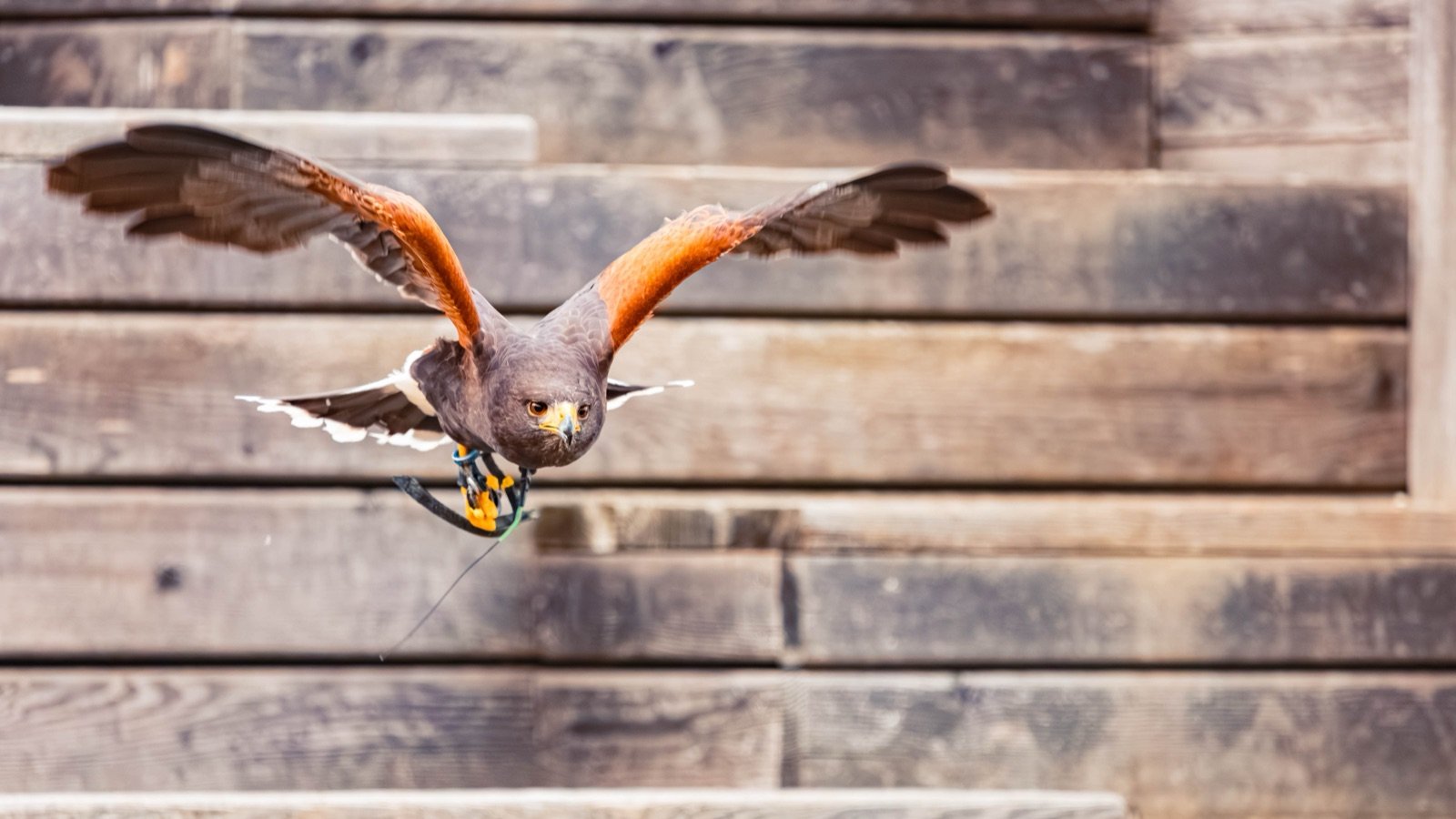
 Harris's Hawk
Family Accipitridae
Harris's Hawk
Parabuteo unicinctus
In Spanish: Gavilán Alicastaño
- Resident
Dark hawk with chestnut shoulders and a white-edged tail, hunting the open north
Harris's Hawk (Gavilán Alicastaño) is a dark raptor with chestnut shoulders and thighs, and in Costa Rica it is a bird of the north. It is a locally common resident in the Tempisque and Bebedero river basins of Guanacaste, and uncommon almost everywhere else.
Older English field guides called it the Bay-winged Hawk, a name that still fits: the chestnut wings are easy to see in flight. The white at the base and tip of the tail shows well too.
For a beginning birder it rewards a slow drive and a patient eye along roadside trees in the northern Pacific lowlands and the Caribbean north.
How to find it
Start in the northern Pacific lowlands, where the odds are best. Drive slowly and scan roadside trees, because perched birds are often found that way, as a tour group found on one northern road. Early and late in the day are the active hours, while midday birds sit high or soar. Open floodplain with long sight lines helps, as along an entrance road in the Carara area where it is an occasional bird. Be ready for a few visits if you want close views.
How to recognise it
Adults are mostly blackish brown or slate, with chestnut shoulders, thighs and wing linings.
The tail has white at the base and at the tip.
The cere, lores and legs are yellow, a bright touch on such a dark bird.
Length is about 53 cm.
In flight, the white rump and the white edge of the tail are very noticeable.
Immatures are browner than adults and streaked buff below. They keep the chestnut shoulders and thighs, which are the key mark.
What it sounds like
Recording: Antonio W. Salas, CC BY 4.0, source, read 4 Nov 2026.
Behaviour and diet
Harris's Hawk hunts actively, mostly early and late in the day. It flies fast along forest edges and open areas, then hovers over its prey. It eats mainly birds, with some mammals and lizards, and is seen alone or in pairs.
At midday it perches high in a tree or soars at considerable height, so the cooler hours are the better time to look.
Across its wider range it is unusual among raptors for hunting cooperatively in groups, usually two to seven birds, and groups also help with nesting.
Where it lives
It lives in scrub and marshy areas with scattered trees, forest patches, savannas, pastures and forest edges.
In Costa Rica it is locally common in the Tempisque and Bebedero river basins of Guanacaste. It is less common elsewhere in Guanacaste and in the Río Frío district. It is normally found only in the northern Pacific region, or on the Caribbean side in the north.
Reports from Limón and San José are probably wanderers.
When to see it
Breeding in Costa Rica runs from December to April. The nest is a stick platform high in a large savanna or forest-edge tree, with 2 eggs, rarely 3.
Similar birds
Immatures look a bit like young Buteogallus hawks, such as the Common Black Hawk, but they are slimmer. Chestnut shoulders and thighs are the sure sign. Adults are distinctive thanks to the white-marked tail and yellow facial skin and legs.
Names and lore in Costa Rica
Besides the official name Gavilán Alicastaño, Spanish names listed for this hawk in general sources include aguililla rojinegra, gavilán acanelado and gavilán rabiblanco. Older English field guides called it the Bay-winged Hawk, and local Turrialba birders still use that name for its chestnut wings.
Status and conservation
The AOCR list marks it R,M?, a resident with possible migrant status, and it is rated Least Concern globally.
Photography tips
Roadside trees are a good place to look for perched birds, and driving slowly while scanning them paid off for a tour group. At Angostura Dam, Turrialba, the hawk favoured the spot where the Río Reventazón enters the reservoir, and it took a few visits to get close views.
How we know this 13 sources, each read on the date shown
- Flickr (Costa Rican natural history account, photo at Ceiba, Orotina) read 2026-11-04
https://www.flickr.com/photos/jobando/36142164253 - Birds for Beer (Turrialba birding blog) read 2026-11-04
https://birdsforbeer.com/2019/12/24/harriss-hawk/ - Wikipedia read 2026-11-04
https://en.wikipedia.org/wiki/Harris's_hawk - Flora de la Mitad del Mundo read 2026-11-04
https://floradelamitaddelmundo.wordpress.com/2022/04/13/01920-aguililla-rojinegra-parabuteo-unicinctus/ - Birds for Beer read 2026-11-04
https://birdsforbeer.com/2019/03/31/first-good-photos-of-the-harriss-hawk-at-angostura-turrialba/ - NaturalistaUY (Wikipedia text) read 2026-11-04
https://www.naturalista.uy/taxa/5355-Parabuteo-unicinctus - Birding Craft read 2026-11-04
https://birdingcraft.com/wordpress/2010/09/07/where-are-the-raptors-when-birding-costa-rica/ - Field Guides trip list read 2026-11-04
https://fieldguides.com/triplists/cr220.html - Birding Craft read 2026-11-04
https://birdingcraft.com/wordpress/2014/02/12/a-couple-of-cool-hawks-and-other-raptors-during-recent-birding-in-costa-rica/ - Birding Craft read 2026-11-04
https://birdingcraft.com/wordpress/category/costa-rica-bird-finding-guide/ - Retired in Costa Rica read 2026-11-04
https://www.charliedoggett.net/2017/03/20/harriss-hawk/ - Wikipedia Español (es-academic) read 2026-11-04
https://es-academic.com/dic.nsf/eswiki/49188 - Biosonidos UNED read 2026-11-04
https://biosonidos.uned.ac.cr/node/190