Family Parulidae
Hooded Warbler
Setophaga citrina
In Spanish: Reinita Encapuchada
- Migrant
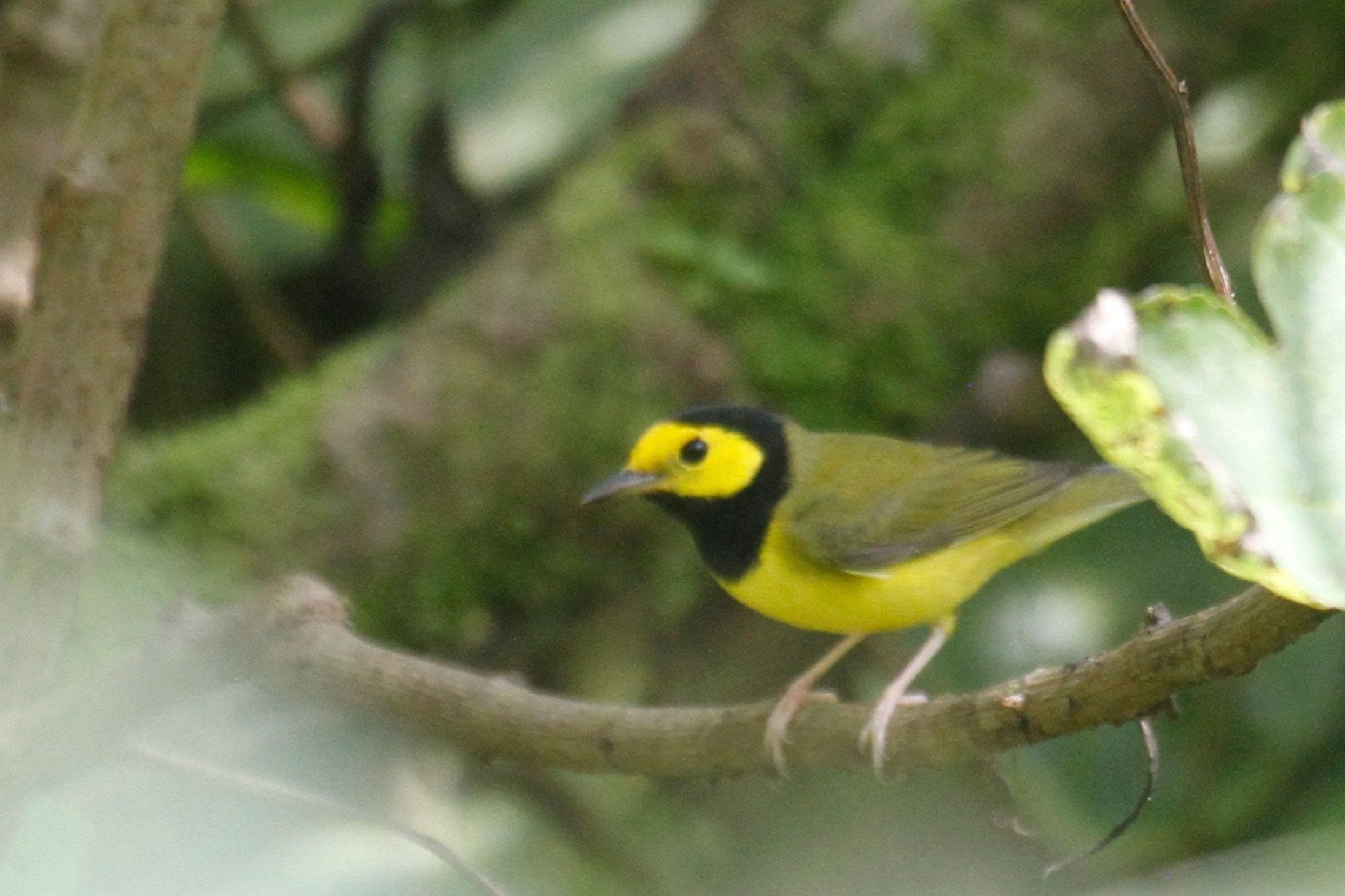
A yellow-faced warbler in a black hood, wintering low in damp scrub.
The Hooded Warbler is a small warbler, about 12 to 13 cm long, and the adult male is unmistakable: a bright yellow face framed by a black hood. It does not breed in Costa Rica. The official bird list classes it as a migrant (M), a bird that visits from elsewhere.
It breeds in eastern North America and winters from Mexico through Central America, including Costa Rica, where it is less common than in the Yucatan region. A Costa Rican natural history account rates it very uncommon to rare in several regions, so finding one is a small prize for a patient beginner.
Look low, in tangled growth and along edges, and watch for a flash of white in the tail.
How to find it
Search low, in damp scrub, forest edges, secondary forest and living fences rather than the canopy. It usually stays in the understory, so it is easier to see than canopy warblers. The constant tail flicks show white tail spots that help you spot it. For a female, check scrubby edges, since females use scrub and disturbed areas. Males favor mature forest, so look there for a black hood. When a mixed flock passes through, scan it carefully, because the bird often joins these flocks within its territory.
How to recognise it
The adult male is the easy one. Look for:
A bright yellow face framed by a black hood.
Black reaching the upper back, the sides of the neck and the chest.
An olive back and yellow underparts.
The female has a yellow forehead and face ringed by olive green, with little or no black. Her olive upperparts, yellow underparts and white tail flash are a combination no other warbler there shows. Young birds and females have a weak or missing black hood, an olive crown and a yellow throat.
The whole bird is small, about 12 to 13 cm long. It often flicks open its white outer tail feathers, and that flash is one of the quickest ways to pick it out of the foliage.
What it sounds like
Behaviour and diet
The Hooded Warbler stays low in the vegetation and flits upward to catch insects and spiders from the leaves. Its tail-flicking habit continues all year, and it flashes the white outer tail spots to startle flying insects into moving, which helps it catch them.
In winter each bird keeps its own territory, but it often joins mixed flocks that pass through that territory. The sexes also separate by habitat on the wintering grounds: males favor mature forest, while females use scrub, secondary forest and disturbed areas.
Where it lives
In Costa Rica it uses low, damp scrub, forest edges, secondary forest and living fences. A birding writer calls it regular, though not as common as some warblers, in wet tangled second growth in and near lowland rainforest.
It is recorded up to about 1200 m elevation. It is rated very uncommon to rare in the Caribbean lowlands, the Central Valley and the Rio General-Coto Brus region, plus a few other places.
When to see it
A Costa Rican natural history account says it is a winter resident from late September to late April or early May, and the first birds can return as early as mid-September. Northern migrant warblers are most varied in the dry season, December to April.
Similar birds
Young birds look almost the same as females. Males only get the full black hood at about 9 to 12 months old, so a hoodless bird can be a female or a young male. The yellow face, olive upperparts and white tail flash together separate it from other warblers there.
Names and lore in Costa Rica
Reinita Encapuchada is the name used in Costa Rica. Elsewhere the species is called Chipe Encapuchado in Mexico and Honduras, Monjita in Cuba and Reinita Viuda.
Status and conservation
The official Costa Rican list classes it as a migrant (M), and worldwide it is not considered globally threatened, with an estimated 5.2 million mature birds.
Photography tips
Because it usually stays in the understory, it is easier to see than canopy warblers. Watch for the white tail spots as it flicks its tail, and follow mixed flocks moving through low growth.
How we know this 12 sources, each read on the date shown
- Lista Oficial de las Aves de Costa Rica (AOCR) read 2026-11-04
https://listaoficialavesdecostarica.wordpress.com/lista-oficial/lista-oficial-online/ - Flickr, Historia Natural account (Sarapiqui photo page) read 2026-11-04
https://www.flickr.com/photos/jobando/33374809470 - Ecoregistros read 2026-11-04
https://www.ecoregistros.org/ficha/Setophaga-citrina - 10,000 Birds read 2026-11-04
https://www.10000birds.com/the-wintering-wood-warblers-of-costa-rica.htm - Chipes.org read 2026-11-04
https://chipes.org/portfolio/chipe-encapuchado/ - Wikipedia (Spanish) read 2026-11-04
https://es.wikipedia.org/wiki/Wilsonia_citrina - Wikipedia (es) read 2026-11-04
https://es.wikipedia.org/wiki/Setophaga_citrina - Birdingcraft read 2026-11-04
https://birdingcraft.com/wordpress/category/costa-rica-bird-finding-guide/ - iNaturalist (Wikipedia text) read 2026-11-04
https://www.inaturalist.org/taxa/145229-Setophaga-citrina - All About Birds (Cornell) read 2026-11-04
https://www.allaboutbirds.org/guide/Hooded_Warbler/overview - Birds of the World (Cornell) read 2026-11-04
https://birdsoftheworld.org/bow/species/hoowar/cur/introduction - Our Fine Feathered Friends read 2026-11-04
https://ourfinefeatheredfriends.com/2019/09/15/hooded-warbler-and-its-kin-bring-tropical-splash-to-area-woodlands/