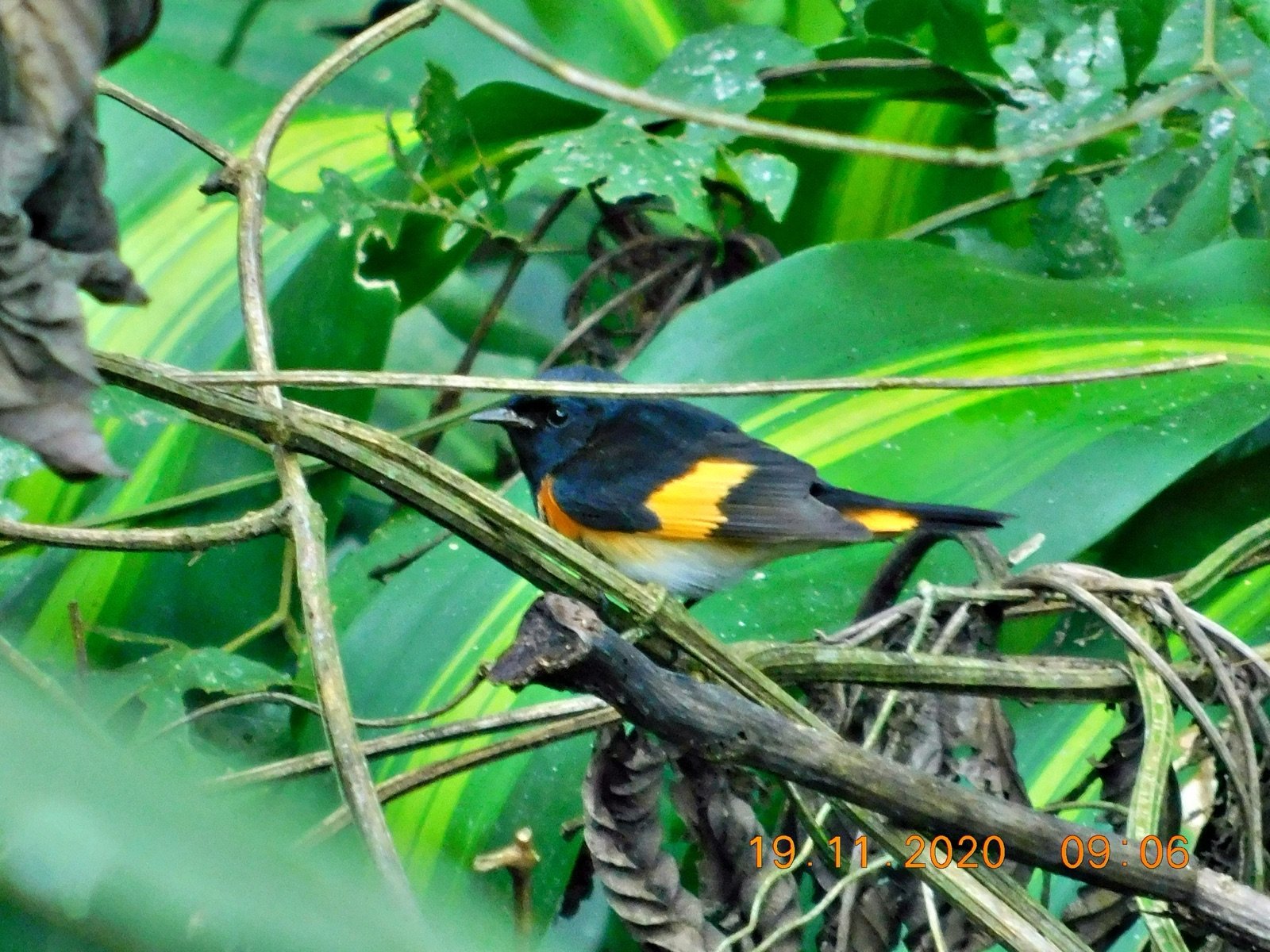
Family Parulidae
American Redstart
Setophaga ruticilla
In Spanish: Candelita Norteña (Raya Roja)
- Migrant
A restless black and orange warbler that spends the northern winter here.
The American Redstart (Candelita Norteña, Setophaga ruticilla) is a small migratory warbler. Costa Rica is one of the countries where it spends the non-breeding season, along with the rest of Central America and the Caribbean. It breeds in northern and eastern North America, so the birds you meet here have travelled a long way.
It makes a good first warbler for a beginner. A Costa Rica birding writer calls it one of the most common wintering warblers, especially where there is rainforest.
Adults average about 12 cm long, and bright patches flash in the wings and tail as the bird flits about and fans its tail open.
How to find it
Look in the middle and upper levels of forest, in open woodland and in partly cleared or tall secondary growth. It comes lower at gaps and edges, so those are good places to stand and scan. Going through a mixed flock at a forest edge is one of the best ways to find one. On migration it sometimes drops into low scrub, so do not ignore low vegetation. Watch for the constant flitting and the tail fanned open, which gives the bird away before you see the plumage.
How to recognise it
Adult males are mostly black with a white belly. Bright orange patches mark the sides of the chest, the wings and the tail.
Females have a grayish or olive-gray head and back with white underparts. Their side and tail patches are bright lemon yellow instead of orange.
Young males look like females but show orange tints on the sides, and they keep that look for their first year of life.
Adults are small, averaging about 12 cm long. Whatever the plumage, watch the behaviour too: a small warbler that lets its wings droop and fans its tail open to flash colour is very likely a redstart.
What it sounds like
Behaviour and diet
This is a very active bird that flits constantly and fans its tail open. It catches insects in flight and moves with great agility among branches, sometimes hovering or fluttering to take prey. It often lets its wings droop as it fans the tail, which flashes the bright patches.
It is usually alone and probably holds a territory in winter, but it may tag along with mixed flocks of birds.
Where it lives
On its wintering grounds in Central and South America it can use nearly any wooded habitat, including dry and wet forests, shade coffee and citrus plantations. It tends to avoid farmland without trees. During migration it uses tropical rainforest, deciduous secondary forest and fields with plenty of tall grass.
In Costa Rica it lives in the middle and upper levels of forest, in open woodland and in partly cleared or tall secondary growth. A Costa Rica warbler article puts it among the warblers that prefer the lower, warmer elevations.
When to see it
A Costa Rica birding blogger lists it among the few early migrant warblers already present in early September, before the main arrival wave. A second post from September 2026 also reports one in streamside vegetation.
Similar birds
Slate-throated Redstart and Collared Redstart have similar names but are resident birds of the highlands and middle elevations, not the migrant American Redstart. Slate-throated is common in middle-elevation forests on both slopes and flashes white-tipped tails. Collared Redstart replaces it higher up in cloud forest, is found only in Costa Rica and western Panama, and is locally called Amigo de Hombre, meaning friend of man.
Names and lore in Costa Rica
In Costa Rica the bird is called Candelita Norteña, and Raya Roja is given as another name. Other Spanish-speaking countries use different names, such as candelita americana in Ecuador, Peru and Chile, pavito americano in Honduras and pavito migratorio in Mexico.
Status and conservation
The AOCR list marks it as a migrant (M), and the IUCN rates the species Least Concern, with a world population estimated at about 42 million mature birds.
Photography tips
Mixed flocks at forest edges are the best place to start, since the bird often tags along with them. Gaps and edges bring it lower, which helps for photos. Its drooped wings and fanned tail flash the bright patches, so watch for that moment.
How we know this 13 sources, each read on the date shown
- Wikipedia (Spanish) read 2026-11-04
https://es.wikipedia.org/wiki/Setophaga_ruticilla - Wikipedia read 2026-11-04
https://en.wikipedia.org/wiki/American_redstart - Costa Rica Living and Birding (birdingcraft.com) read 2026-11-04
http://birdingcraft.com/wordpress/2025/09/01/reminders-of-bird-migration-in-costa-rica/ - Ecos del Bosque (citing Guía de Aves de Costa Rica) read 2026-11-04
https://ecosdelbosque.com/fauna/setophaga-ruticilla - Field Guides trip list 2018 read 2026-11-04
https://fieldguides.com/triplists/cos18.html - Field Guides trip list 2012 read 2026-11-04
http://fieldguides.com/triplists/cos12.html - 10,000 Birds read 2026-11-04
https://www.10000birds.com/the-wintering-wood-warblers-of-costa-rica.htm - Animalia.bio read 2026-11-04
https://animalia.bio/es/american-redstart - Smithsonian National Zoo read 2026-11-04
https://nationalzoo.si.edu/sites/default/files/documents/american_redstart.pdf - 10,000 Birds read 2026-11-04
https://www.10000birds.com/may-warblers-costa-rican-style.htm - Birds of the World read 2026-11-04
https://birdsoftheworld.org/bow/species/amered/cur/sounds - Field Guides Birding Tours trip list read 2026-11-05
https://fieldguides.com/triplists/crh19b.html - Field Guides Birding Tours trip list read 2026-11-05
https://fieldguides.com/triplists/cos19.html