Family Passeridae
House Sparrow
Passer domesticus
In Spanish: Gurrión Común (Electricista)
- Resident
An introduced town sparrow of markets, parks and café patios.
The House Sparrow is not a native Costa Rican bird. It reached the country from the north around 1974 and has spread steadily since then.
Today it is established in most cities and large towns, and it is still increasing. It is most common in the drier regions, and it is a bird of built-up places, so you meet it in town rather than in forest.
On a trip we build, it is the bird hopping about town centers, gardens and farms in Monteverde, and a handy reference point before you start on the native sparrows.
How to find it
Start in a town center, park or market, especially in the drier regions. In Monteverde, look around café patios and town markets, where House Sparrows gather and often hop about in groups. Listen for the chirping, which often gives them away before you see them. Check around restaurants, where they feed on grain, seeds and scraps. Early and late in the day, noisy flocks gather to roost or start the day.
How to recognise it
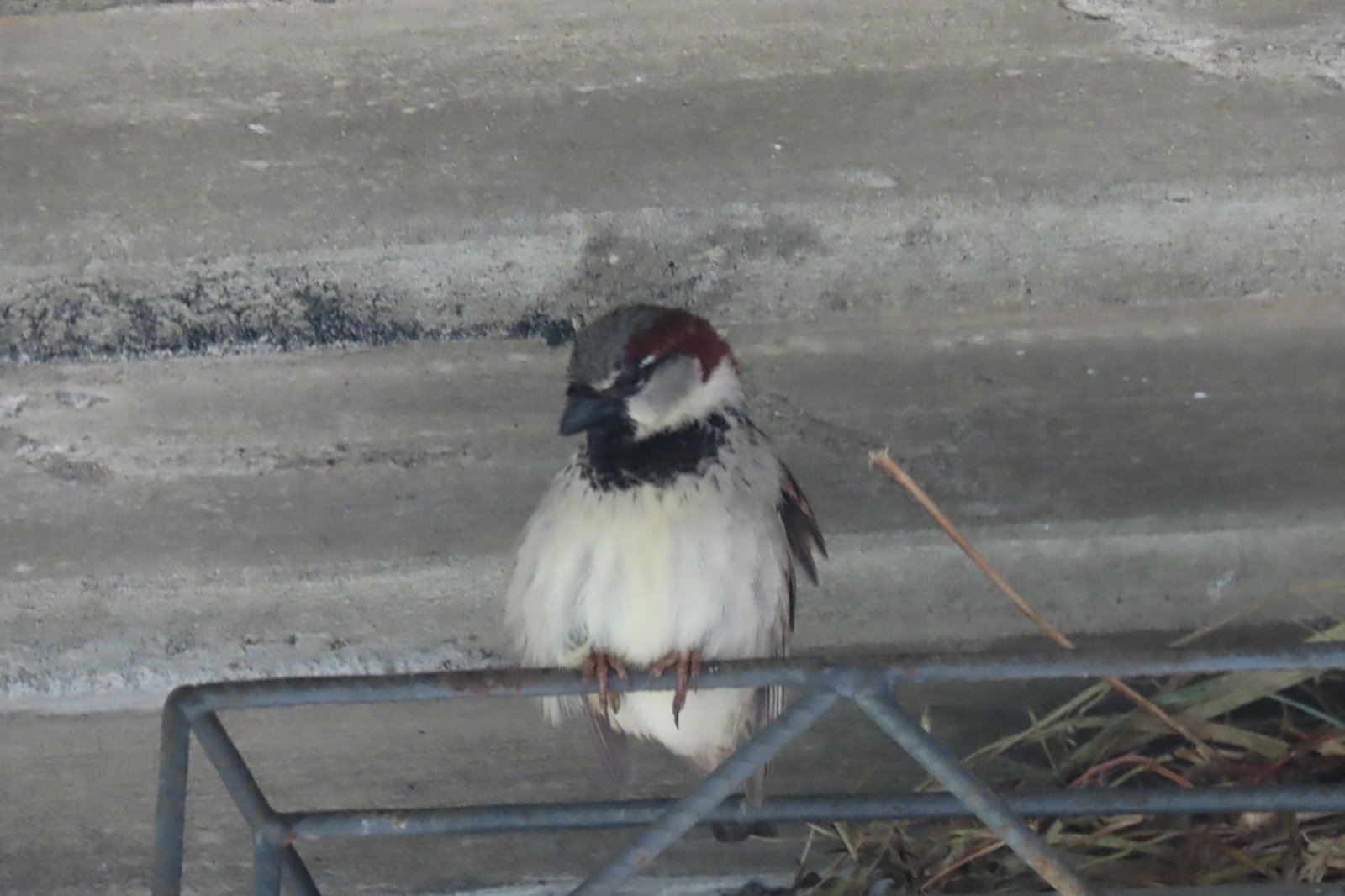
The House Sparrow is about 14 cm long and weighs about 26 g. The male is the easy one to learn.
Male field marks:
- dull grey crown
- chestnut behind the eye and on the nape
- black on the lores and below the eye
- black throat and chest
- white cheeks
- cinnamon-brown back streaked with black
- dull whitish belly
- black bill all year in Costa Rica, described by one guide as dark horn-colored
- pale brown legs
Young birds look like the adult female, with a darker crown and a faint grey bib. Juveniles are paler and buffier underneath.
What it sounds like
Recording: Eduardo A. Bolaños Vargas, CC BY 4.0, source, read 4 Nov 2026.
Behaviour and diet
It usually goes in pairs or small flocks of 5 to 15 birds, and it competes for food with the Rufous-collared Sparrow. A Costa Rican bird guide describes it as often invading new areas in flocks, then settling in tight colonies. As colonies grow, more birds nest as single pairs.
The nest is a messy ball of straw with a side entrance, often lined with string, plastic and paper. It is placed in a building crevice, in bromeliads or in dry palm leaves. Across its range it feeds on the ground, hopping quickly.
Where it lives
It lives in urban areas, mostly around parks, markets, grain silos and train stations. It is established in most cities and large towns and is most common in the drier regions.
In Monteverde it lives in the town area, where it is introduced and does not use cloud forest. Visitors meet it in town centers, gardens and farms there, and around restaurants and lodges.
When to see it
It breeds mainly from March to August in Costa Rica, though some nesting may happen all year. Nests with eggs or chicks may therefore be seen in any month.
Similar birds
The Rufous-collared Sparrow (comemaíz) is the bird most easily confused with it, and the two compete for food. The House Sparrow has a bigger bill, a flatter head and shorter legs. The male's black throat and chest and white cheeks help too.
Names and lore in Costa Rica
Costa Ricans call this bird Electricista, while the formal AOCR Spanish name is Gorrión Común. One Costa Rican bird guide also gives Setillero as a common name.
Status and conservation
Costa Rica's national checklist treats the House Sparrow as introduced, although the AOCR list gives it status R.
Photography tips
In big cities the House Sparrow is very trusting of people and lets them come close, while in smaller towns it is more wary. Café patios and markets, where groups hop about, are good places to try.
How we know this 9 sources, each read on the date shown
- Aves de Costa Rica read 2026-11-04
https://avesdecostarica.com/Passer-domesticus.html - Monteverde Travel read 2026-11-04
https://monteverdetravel.com/house-sparrow-gorrion-comun-in-monteverde-passer-domesticus-guide/ - Flickr (Costa Rica natural history text, Guápiles) read 2026-11-04
https://www.flickr.com/photos/jobando/28393719713 - ArgentiNat (Costa Rica Check List entry) read 2026-11-04
https://www.argentinat.org/taxa/13858-Passer-domesticus - Sierra de Baza (fichas de fauna) read 2026-11-04
https://sierradebaza.org/fichas-tecnicas/fichas-de-fauna/fichas-aves/aves-g-a-o/gorrion-comun-passer-domesticus - Guía de Aves de Costa Rica (via Flickr) read 2026-11-04
https://www.flickr.com/photos/jobando/28905843652/ - Cloudbridge Nature Reserve bird list read 2026-11-04
https://www.cloudbridge.org/wp-content/uploads/2020/04/Especies-de-Aves-Costa-Rica-13-April-2020.pdf - Revista de Biología Tropical read 2026-11-05
https://tropicalstudies.org/rbt/attachments/volumes/vol30-1/08-Reynolds-Gorrion.pdf - CONABIO (citing Stiles and Skutch) read 2026-11-05
http://www.conabio.gob.mx/conocimiento/exoticas/fichaexoticas/Passerdomesticusdomesticus00.pdf