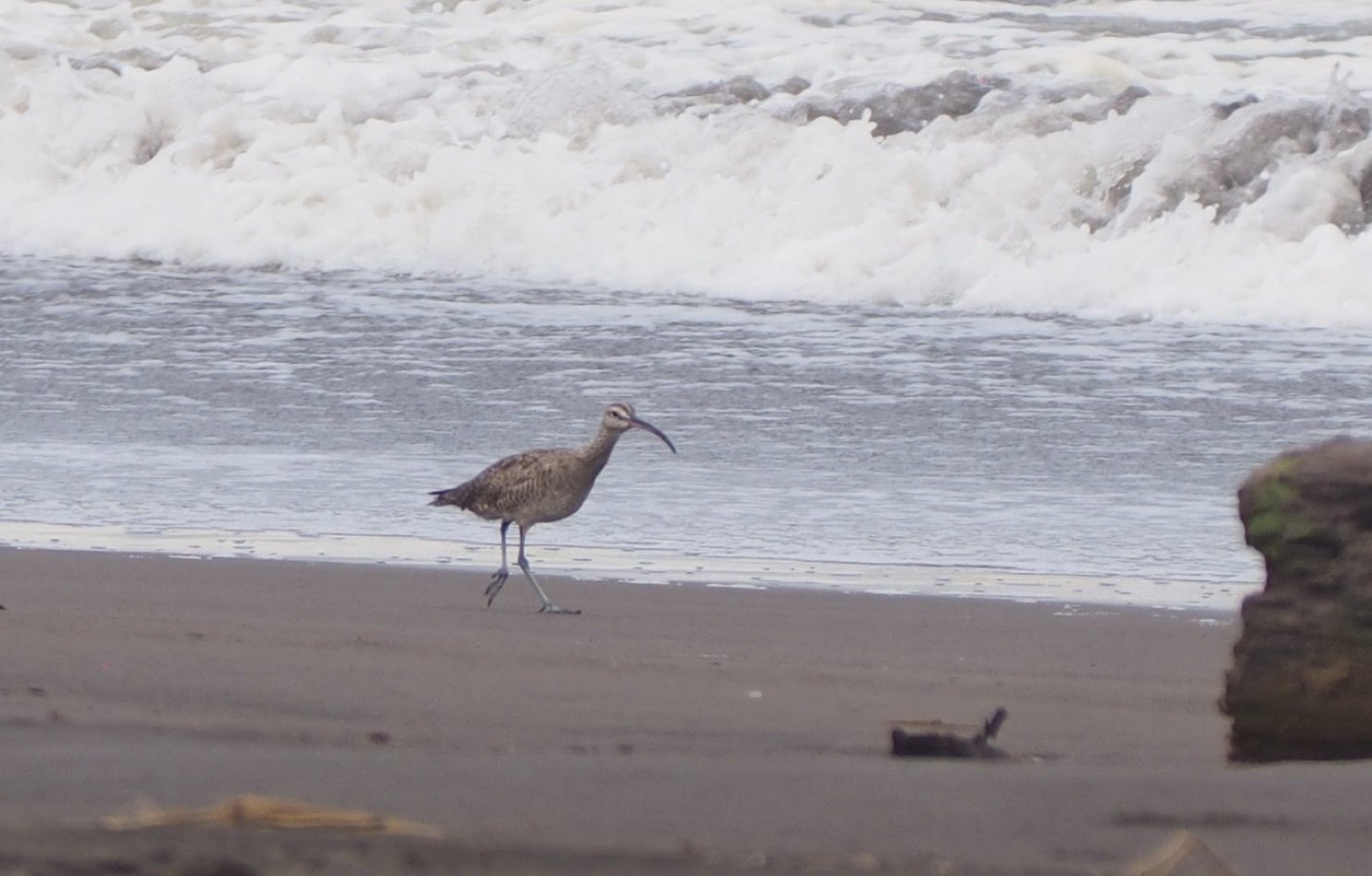
Family Scolopacidae
Hudsonian Whimbrel
Numenius hudsonicus
In Spanish: Zarapito Trinador (Cherelá, Zarceta)
- Migrant
A curve-billed migrant of Pacific mudflats and mangroves, here August to May.
The Hudsonian Whimbrel is a migrant from North America that can be found in Costa Rica from August to May. It is very common along the Pacific coast and uncommon on the Caribbean side, which tells you where to point your first walk along a shoreline.
Watch for a brown shorebird with a long, clearly downcurved bill, walking slowly through shallow water or over open mud. It is usually alone, though it sometimes stands among Willets.
Older trip reports list it as Whimbrel (Numenius phaeopus). The species has since been split in two, and the Hudsonian Whimbrel is the one found across the Americas, so you will meet both names in field guides and trip reports.
How to find it
Look in mangrove areas along the Pacific shore. The Sierpe River mangroves are a good place to watch it hunting, because the tide range there is large. Boat trips on the Tárcoles River near Carara have turned it up among many waterbirds. Walk slowly and scan shallow water, mudflats and wet sand for a bird probing with a long curved bill. Check any Willets you meet, since it sometimes joins them.
How to recognise it
Start with the bill: long and clearly downcurved.
The head is striped, with a striped crown.
The plumage is browner than a Willet's.
In flight the wings are brown throughout.
In flight there is no white rump: the rump, tail and back are all the same colour.
That last mark separates the Hudsonian form from the Old World Eurasian Whimbrel, whose rump is white. Photos taken on the beach at Tortuguero show the brown rump of the American form clearly.
What it sounds like
Recording: Richard Littauer, CC BY 4.0, source, read 4 Nov 2026.
Behaviour and diet
The Whimbrel walks slowly through very shallow water, probing mudflats or wet sand with its long bill. In Costa Rica it pokes the bill into small holes to find crabs, other crustaceans and insects. The curved bill fits the bend of a fiddler crab burrow, and it also eats other crabs, mollusks and small fish.
It forages over open flats, picking food from the surface or probing just below it, and it does not probe deeply despite the long bill. When it eats a crab, it may break off the legs first.
Where it lives
In Costa Rica it uses mudflats, creek edges, mangroves, beaches and rocky shores. It is very common along the Pacific coast and uncommon on the Caribbean side, where it has been recorded at Tortuguero and in Cahuita National Park. It is usually seen alone but sometimes with Willets.
When to see it
It can be found in Costa Rica from August to May. Southbound birds reach the Pacific coast in August and September, and a northbound influx along the Central American coast runs from mid-March to early May.
Similar birds
Long-billed Curlew, also a Costa Rican migrant, is larger with a longer bill and a plain crown, and shows rusty wing patches in flight. The Whimbrel has a striped crown and brown wings throughout. Willet has a straight, thick bill and a plain head, and flashes black and white wings in flight.
Names and lore in Costa Rica
The AOCR Spanish name is Zarapito Trinador. Other Spanish names listed for this species in Costa Rica are Cherelá and Zarceta.
Status and conservation
The AOCR list marks it as a migrant (M), and the IUCN lists the species as Least Concern.
Photography tips
Look for it on open flats, where it walks steadily and picks food from the surface. The Sierpe mangroves, with their large tide range, offer chances to watch it hunting. For identification shots, try to catch it in flight to show the uniform brown rump.
How we know this 21 sources, each read on the date shown
- Costa Rica Birding Trips read 2026-11-04
https://www.costaricabirdingtrips.com/scolopacidae/whimbrel-numenius-phaeopus - Birdtours.co.uk trip report read 2026-11-04
http://www.birdtours.co.uk/tripreports/costarica/costar10/list.htm - Birds of the World (Cornell) read 2026-11-04
https://birdsoftheworld.org/bow/species/whimbr3/cur/movement - Nicoya Peninsula Costa Rica read 2026-11-04
https://nicoyapeninsula.com/wildlife/waterbirds/ - Aves y Fotografía de Naturaleza (blog) read 2026-11-04
https://delfingofe.blogspot.com/2018/01/zarapito-trinador-americano-en-santona.html - All About Birds (Cornell Lab) read 2026-11-04
https://www.allaboutbirds.org/guide/Hudsonian_Whimbrel/overview - Aves de Chile read 2026-11-04
https://www.avesdechile.cl/052.htm - Wikipedia read 2026-11-04
https://en.wikipedia.org/wiki/Hudsonian_whimbrel - All About Birds (Cornell Lab) read 2026-11-04
https://www.allaboutbirds.org/guide/Whimbrel/id - All About Birds (Cornell Lab) read 2026-11-04
https://www.allaboutbirds.org/guide/Whimbrel/species-compare/ - All About Birds (Cornell Lab) read 2026-11-04
https://www.allaboutbirds.org/guide/Willet/species-compare/ - Gallery of Birds read 2026-11-04
http://www.galleryofbirds.com/costarica/whimbrel.htm - BirdForum read 2026-11-04
https://www.birdforum.net/threads/whimbrel-costa-rica.315139/ - BirdForum read 2026-11-04
https://www.birdforum.net/threads/whimbrel-costa-rica-2014.306116/ - Birdfinders trip report read 2026-11-04
https://www.birdfinders.co.uk/news/costa-rica-2005.html - Exotic Birding (Palo Verde checklist) read 2026-11-04
https://www.exoticbirding.com/costarica/paloverde/checklist.html - Exotic Birding (Osa checklist) read 2026-11-04
http://www.exoticbirding.com/costarica/osa-peninsula/checklist.html - AvesTikas read 2026-11-04
https://avestikas.com/2023/06/01/numenius-phaeopus/ - Audubon Field Guide read 2026-11-04
https://www.audubon.org/field-guide/bird/hudsonian-whimbrel - Asturnatura read 2026-11-04
https://www.asturnatura.com/especie/numenius-phaeopus - Tus Buenas Noticias read 2026-11-04
https://www.tusbuenasnoticias.com/noticias/historias/2026/10/13/65632-zarapito-trinador-y-su-migracion-a-san-quintin