Family Scolopacidae
Upland Sandpiper
Bartramia longicauda
In Spanish: Pradero (Gansa)
- Migrant
A grassland sandpiper that mostly flies over; try open fields in fall.
The Upland Sandpiper is a sandpiper that avoids the shore. It is a grassland bird, and in Costa Rica it is a migrant, marked M on the official list of the country's birds. Costa Ricans call it Pradero, and the list adds Gansa as a second name.
This is a bird to read about with realistic hopes. It breeds in North America and winters in South America, flying more than 5,000 km on each migration, so Costa Rica is only a stopover. A Costa Rica birding blog says it passes through every fall but is hardly ever seen.
That is part of its appeal: if you do find one in a short-grass field, you have found something most visitors never notice.
How to find it
Most visitors will meet it, if at all, in open fields: Guanacaste cattle pastures, rice fields and the grassy areas near the Central Valley airport. Local birders often check the open meadows around that airport in fall, because a few Upland Sandpipers pause in open habitats there. In Guanacaste there is so much pasture that finding one is described as a needle in a haystack, so patience matters. This prairie bird blends in so well that one seen near the airport was almost impossible to spot without binoculars. Scan every bird in a short-grass field, and listen at night in fall, especially before dawn.
How to recognise it
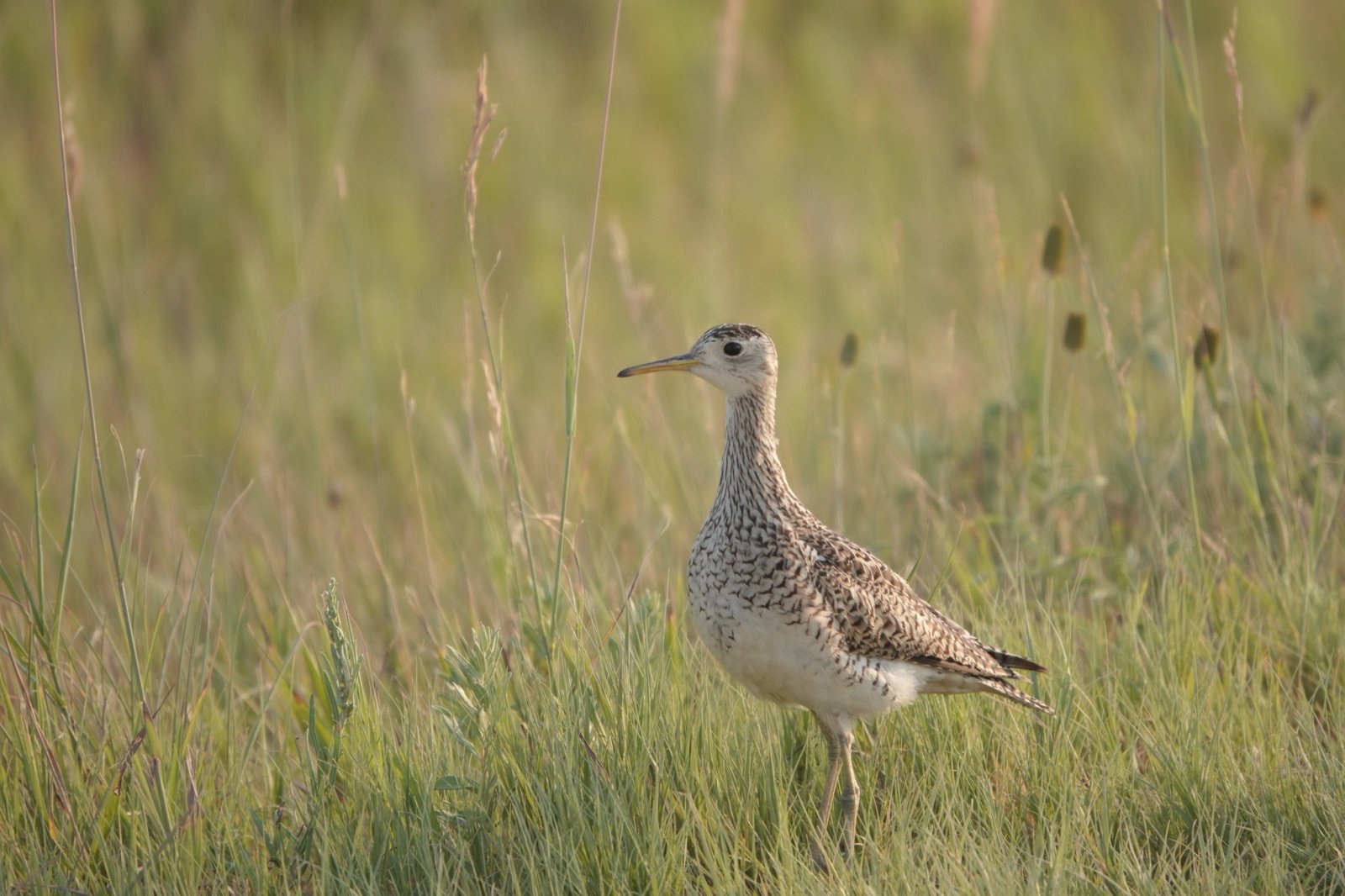
The Upland Sandpiper is a large, long-necked sandpiper of 28 to 32 cm. Across its range, these are the marks to check on any bird standing in a short-grass field:
A small head with large eyes.
A short yellow bill with a dark tip.
Long yellow legs.
A speckled brown back.
A white belly with brown marks.
The small head on a long neck is a useful first impression, because it sets the bird apart from the shorebirds you may know from a beach or a muddy edge.
What it sounds like
Recording: Eduardo Luis Beltrocco, CC BY 4.0, source, read 4 Nov 2026.
Behaviour and diet
It eats mostly insects, such as grasshoppers. On migration it may travel alone, in pairs or in groups, and it often flies at night, stopping in open fields. That habit helps explain why so few are seen, and many birds likely fly on without stopping at all.
A survey of Cocos Island reported one flushed from grass at the forest edge on a trail above Chatham, and it was seen repeatedly. That shows the species can turn up on offshore islands.
Where it lives
Across its range this is a grassland bird. It uses short, grassy fields for feeding and avoids the shoreline habitats typical of other sandpipers.
In Costa Rica it is listed as a migratory species in the bird catalogue for the Greater Metropolitan Area, the Central Valley. Most birds probably land in the open cattle fields of Guanacaste, and Cocos Island has produced a record too.
When to see it
Local birders watch for it in fall. Old records quoted from Bent's life history list a Costa Rica fall arrival on September 5, and a later date from San José was November 15.
Similar birds
Birders searching for Upland Sandpiper in Costa Rica usually look for it among the other grasspipers: American Golden-Plover, Buff-breasted Sandpiper and Baird's Sandpiper. All four use open short-grass fields, so check every bird in such a field.
Names and lore in Costa Rica
Costa Rican sources call it Pradero, and the official list adds Gansa as a second name. Elsewhere in Latin America it is also known as Batitú and Correlimos Sabanero.
Status and conservation
The official list of Costa Rican birds marks the Upland Sandpiper (Pradero, also called Gansa) as migratory (M).
How we know this 13 sources, each read on the date shown
- Lista Oficial de las Aves de Costa Rica (AOCR) read 2026-11-04
https://listaoficialavesdecostarica.wordpress.com/lista-oficial/lista-oficial-online/ - Cocos Island bird survey (via ResearchGate) read 2026-11-04
https://www.researchgate.net/publication/215447724_La_fragmentacion_del_habitat_impactos_sobre_la_dinamica_huesped-parasito_de_la_avifauna_en_paisajes_agropecuarios_de_Esparza_Costa_Rica - Museo Nacional de Costa Rica, Catálogo de Aves de la GAM read 2026-11-04
https://www.museocostarica.go.cr/wp-content/uploads/Investigaciones/historia-natural/gam/datos-biodiversidad/aves/catalogo/catalogo_aves_gam_2.pdf - NH PBS Nature Works read 2026-11-04
https://nhpbs.org/natureworks/uplandsandpiper.htm - A-Z Animals read 2026-11-04
https://a-z-animals.com/animals/upland-sandpiper/ - Cornell Birds of the World read 2026-11-04
https://birdsoftheworld.org/bow/species/uplsan/cur/movement - Birding Craft read 2026-11-04
https://birdingcraft.com/wordpress/2014/09/ - Birding Craft read 2026-11-04
https://birdingcraft.com/wordpress/2021/09/ - 10,000 Birds read 2026-11-04
https://www.10000birds.com/hoping-for-grasspipers-in-costa-rica.htm - Avibase read 2026-11-04
https://avibase.bsc-eoc.org/species.jsp?avibaseid=BF1DA86E0714FD01 - Vermont Center for Ecostudies read 2026-11-04
https://vtecostudies.org/blog/live-updates-tracking-upland-sandpiper-trans-hemispheric-migration - Visit Costa Rica read 2026-11-04
https://www.visitcostarica.com/things-to-do/greatest-wildlife-spectacles/on-the-wing - Birdzilla read 2026-11-04
https://www.birdzilla.com/birds/upland-sandpiper/