Family Jacanidae
Wattled Jacana
Jacana jacana
In Spanish: Jacana Sureña
- A
All-black jacana with red wattles, sporadic in southern Costa Rica
The Wattled Jacana is a South American marsh bird, and Costa Rica is the northern edge of its range. Here it turns up only now and then, in the south, within the Amistad Pacifico and Osa conservation areas.
A birder who found one in the Coto 47 marshes, in the south Pacific, had seen it in Costa Rica only once before, at the same site. That tells you what kind of target this is: patient, uncertain and rewarding.
For a beginning birder, the key is knowing the common lookalike, the Northern Jacana, and reading every jacana in the southern wetlands with care.
How to find it
Head for the south Pacific wetlands and scan the swampy edges and the water plants. Coto 47 lies south of Villa Neily, its marshes are large, and a bird was found a short way from the road near the Colorado River.
Local knowledge counts. A birder who lives at Coto 47 knew where the jacana was, and the guide says he would have missed it without that help. Another trip there had failed to find it at least five times.
At the Las Pangas sector there are hundreds of Northern Jacanas in flooded conditions, so check each one, because the rare Wattled can be mixed in. Look closely at any odd jacana, since one near the road looked like a Northern x Wattled hybrid.
How to recognise it
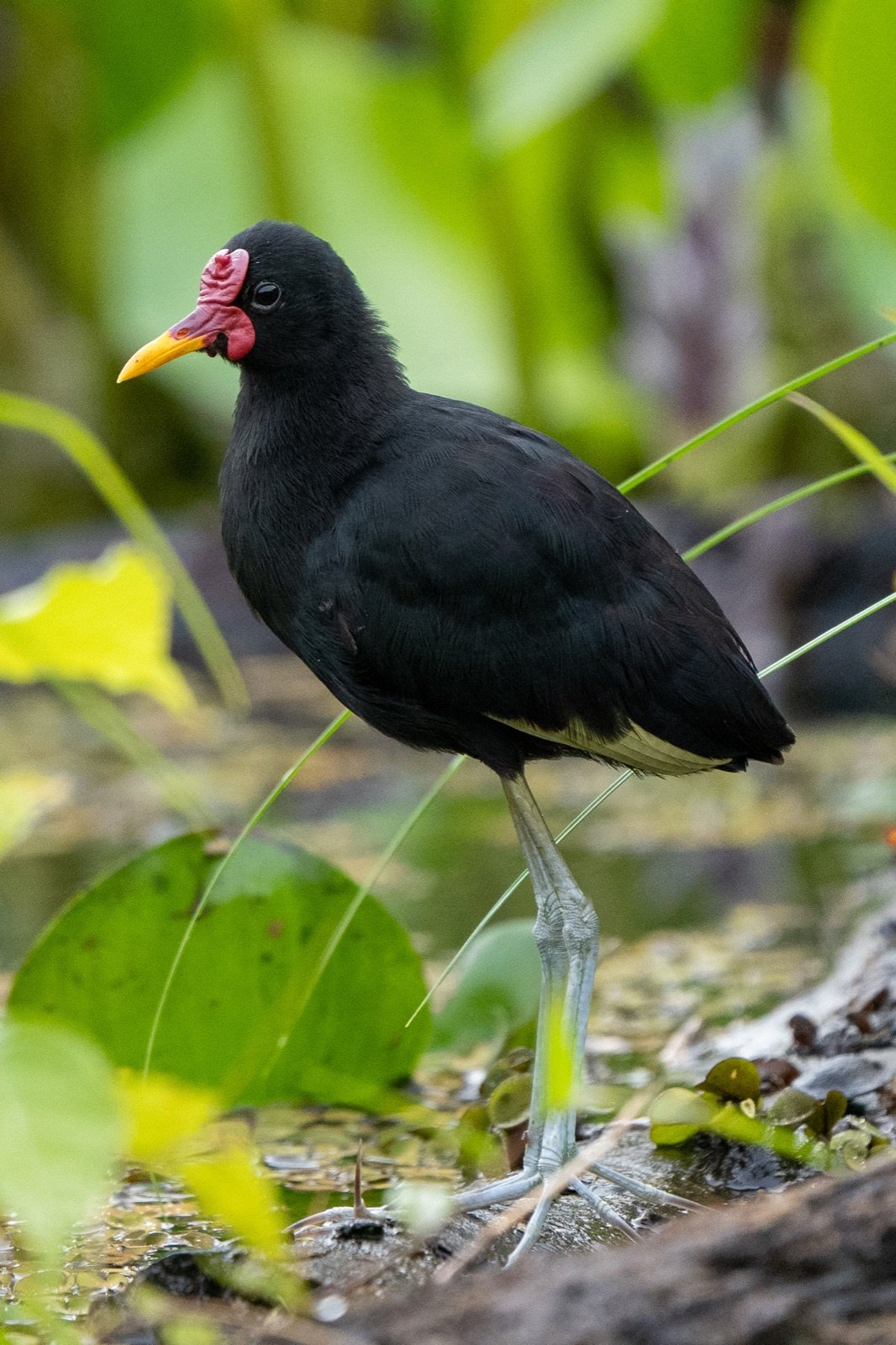
Adults are all black with a purple gloss. The wattles and the base of the bill are crimson to magenta, and the rest of the bill is orange-yellow. The legs are grayish.
Look at the face first. The Wattled has a large forked wattle on the forehead and a small wattle on each side of the bill, not a stiff shield. The bird seen at Coto 47 showed black plumage, a yellow bill and a red shield on the forehead, which is the look to watch for.
Males are about 23 cm long and 95 g. Females are a little larger, about 25.5 cm and 130 g.
Immature birds look like Northern Jacanas, but they show at least traces of the wattles.
What it sounds like
Recording: Eduardo Luis Beltrocco, CC BY 4.0, source, read 4 Nov 2026.
Behaviour and diet
The Wattled Jacana is social, and it stands upright while feeding to watch for danger.
At Coto 47 one bird was seen alone in swampy ground near a warehouse at a Y junction. It moved between the swamp behind the warehouse and the one beside or in front of it.
A dated record shows how brief a sighting can be: a single bird was seen and photographed on the morning of 9 October 2016 in the Coto 47 marshes, near the road to La Campiña, Puntarenas.
Where it lives
It lives in ponds, marshes and lagoons, especially where flowering water plants grow. It also uses sheltered riverbanks where lotus, water hyacinth or grasses spread over calm or slow-moving water.
In Costa Rica it belongs to the southern part of the country, within the Amistad Pacifico and Osa conservation areas. Across its wider range it runs from Costa Rica and western Panama to eastern Peru and northern Argentina.
When to see it
A single bird was photographed in the morning of 9 October 2016 at Coto 47.
Similar birds
The Northern Jacana is the common lookalike. It has a chestnut back and wings and a yellow forehead shield, while the Wattled is all black with red wattles. The two match in size, shape and yellow flight feathers, so colour and facial skin do the separating. Immature Wattled birds can look like Northern Jacanas, so look for traces of wattles.
Names and lore in Costa Rica
Costa Rica's official Spanish name is Jacana Sureña, and the older name Jacana Carunculada also appears in Spanish lists. The Northern Jacana is called cirujano, mulita or gallito de agua, and the same names may be heard for jacanas generally.
Status and conservation
Listed as A on the AOCR list, it appears only sporadically in Costa Rica, at the northern edge of its range.
Photography tips
Scan each jacana in a flooded marsh and look for black plumage with red wattles. Check the swamps beside roads and buildings at Coto 47, where one bird moved between neighbouring swamps near a warehouse.
How we know this 16 sources, each read on the date shown
- Manuel Antonio Birding blog read 2026-11-04
https://manuelantoniobirding.wordpress.com/tag/wattled-jacana-costa-rica/ - Flickr natural history entry (Spanish), Ciudad Neily photo read 2026-11-04
https://www.flickr.com/photos/jobando/30325216766 - Manuel Antonio Birding blog read 2026-11-04
https://manuelantoniobirding.wordpress.com/tag/wattled-jacana/ - Bird Watching Costa Rica read 2026-11-04
https://www.birdwatchingcostarica.com/ave/wattled-jacana/ - Wikipedia read 2026-11-04
https://en.wikipedia.org/wiki/Wattled_jacana - Birding Manuel Antonio (Johan Chaves) read 2026-11-04
https://manuelantoniobirding.wordpress.com/tag/coto-47/ - Avibase read 2026-11-04
https://avibase.bsc-eoc.org/species.jsp?avibaseid=DA09D0CE - ResearchGate (vocalization study abstract) read 2026-11-04
https://www.researchgate.net/figure/J-spinosa-Northern-Jacana-left-hybrid-spinosa-X-jacana-center-and-J-jacana_fig1_268281306 - Panama Birds & Wildlife Photos blog read 2026-11-04
http://panama-wildlife.blogspot.com/2014/12/featured-family-jacanas-of-panama.html - Audubon Field Guide read 2026-11-04
https://www.audubon.org/field-guide/bird/northern-jacana - bioRxiv vocalization study read 2026-11-04
https://www.biorxiv.org/content/10.1101/757336.full.pdf - Costa Rica Living and Birding read 2026-11-05
https://birdingcraft.com/wordpress/page/8/ - Osa Green Travel read 2026-11-05
https://osagreentravel.com/other-tours/ - Birding Manuel Antonio (blog) read 2026-11-05
https://manuelantoniobirding.wordpress.com/tag/esquinas-lodge/ - Birding Manuel Antonio (blog) read 2026-11-05
https://manuelantoniobirding.wordpress.com/tag/birding-costa-rica/ - Costa Rican natural history entry (via Flickr) read 2026-11-05
https://www.flickr.com/photos/jobando/30416818408