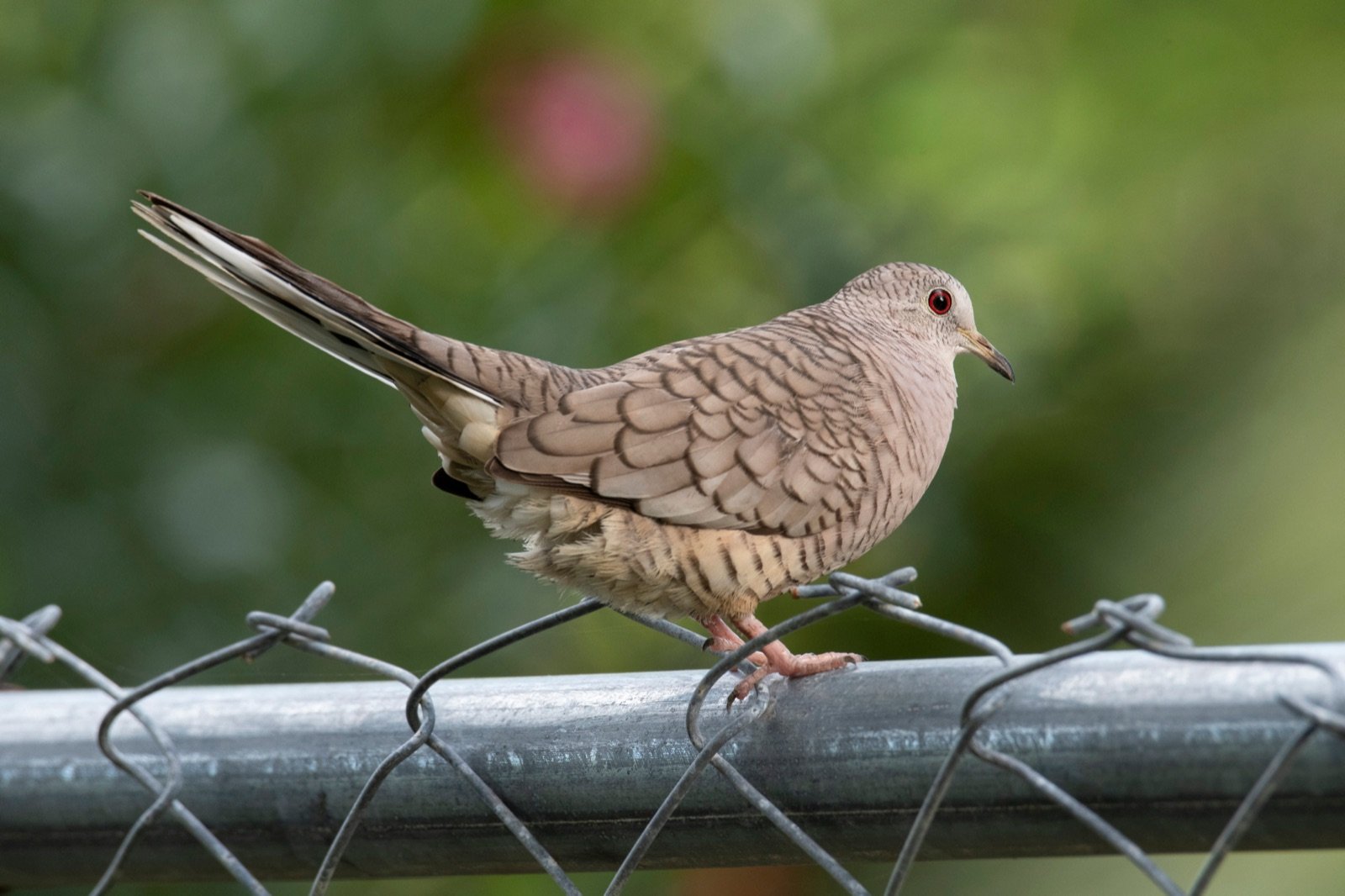
 Inca Dove
Family Columbidae
Inca Dove
Columbina inca
In Spanish: Tortolita Colilarga (San Juan, Tórtola)
- Resident
A small scaly dove with a long tail, easy around towns and farms
The Inca Dove (Tortolita Colilarga) is a small, slim dove that looks scaly all over. In Costa Rica it is an abundant resident across the northwest lowlands, and it is common in the Central Valley too.
It is a gentle first dove for a beginner, because it often stays close to buildings, gardens and farms. On a trip we build through Guanacaste, the dry forest of Palo Verde National Park is a likely place to meet it, and it also turns up around buildings and fields near Playa Hermosa.
Its story here is a short one. It was first reported in Costa Rica in 1928 and has been spreading south ever since.
How to find it
Look for it on the ground in towns, gardens, farms and open scrub, where it is often tame and stays close to buildings. Scan bare ground for a small scaly dove nodding its head with each step. Listen for the repeated cooing from power lines and antennas, and for the dry wing rattle when it takes off. Pairs have been found on a fence in front of a scrubby yard by the road in Guanacaste, and in a courtyard and nearby fields around Playa Hermosa. A short flush usually lands it on a nearby shrub or tree, so you can often watch it again.
How to recognise it
Look for a small, slim dove with a long, square-tipped tail edged in white. The pale sandy brown feathers have dark edges, so the bird looks scaly all over. The eye is red.
In flight it shows bright chestnut underwings and white outer tail feathers, and the reddish wing patches flash as it goes. The wings also make a dry rattle on take-off, which helps you notice it. That rattle is quiet but distinctive, a dry shuffle a bit like running a finger quickly over a fanned deck of cards.
When it walks, it nods its head forward and back with each step, a useful clue when you scan bare ground.
What it sounds like
Behaviour and diet
The Inca Dove walks on the ground picking up seeds and grit from open or sparsely vegetated ground. It lives in pairs or small flocks and roosts in trees.
It is often tame and stays close to buildings. When flushed, it usually makes a short, quick flight to a nearby shrub or tree.
It mainly eats seeds and grain from the ground, and it often swallows small grit to help grind hard seeds.
Where it lives
In Costa Rica this dove lives in open areas with little forest: savannas, second growth, forest edges, pastures, and urban and semi-urban areas.
It is abundant across the northwest lowlands and becomes gradually less common southward along the Pacific coastal strip, reaching at least Quepos. It is common in the Central Valley, reaching Ochomogo in the east, and uncommon or rare at least as far as Paraíso.
In dry forest it shares habitat with the Banded-backed Wren.
When to see it
It breeds from April to August, possibly into October. The nest is a flimsy platform of straw and twigs placed 1 to 8 m up in a tree, often a thorny one, and the clutch is 2 white eggs.
Similar birds
Other ground doves are the usual lookalikes. Common Ground Dove is stockier with a short tail, its scaling is only on the neck and chest, and it has large dark wing spots. Inca Dove has a long tail and is scaly everywhere. Near the Tempisque River it turned up in open country with Common Ground-Doves and Ruddy Ground-Doves.
Names and lore in Costa Rica
Costa Ricans know it as Tortolita Colilarga, the official AOCR name, and use the local names San Juan and Tórtola. A Spanish-language species list gives plain Tortolita. Elsewhere in Latin America it is also called tortolita mexicana, tórtola cola larga, conguita and coquita.
Status and conservation
The AOCR list marks it as a resident (R), and the IUCN rates it Least Concern, with a very large range.
Photography tips
One Costa Rica photo caption says it is quite common in savanna but not always easy to get, and another saw it only very briefly near Quepos. Your best chance is a tame bird around buildings, fences and courtyards in Guanacaste. Watch for the head nod on bare ground, and be ready for the short flush to a nearby shrub.
How we know this 17 sources, each read on the date shown
- Flickr (Costa Rica natural history caption, Chomes, Puntarenas) read 2026-11-04
https://www.flickr.com/photos/jobando/29940956344 - JungleDragon (Wikipedia-based) read 2026-11-04
https://www.jungledragon.com/specie/7718/inca_dove.html - Pigeonpedia read 2026-11-04
https://pigeonpedia.com/inca-dove/ - Simply Birding read 2026-11-04
https://www.simplybirding.com/birds/inca-dove-columbina-inca/ - Flickr (AOCR natural history caption, Palo Verde) read 2026-11-04
https://www.flickr.com/photos/jobando/29940923634 - Meadowhawk blog read 2026-11-04
https://meadowhawk.wordpress.com/2023/04/26/costa-rica-a-birding-day-on-the-resort/ - Birding Craft read 2026-11-04
https://birdingcraft.com/wordpress/2011/09/12/birding-near-playa-hermosa-guanacaste-costa-rica/ - Birding Craft read 2026-11-04
https://birdingcraft.com/wordpress/2021/11/24/which-bird-vocalizations-to-study-for-birding-in-costa-rica/ - All About Birds (Cornell Lab) read 2026-11-04
https://www.allaboutbirds.org/guide/Inca_Dove/sounds - Flickr (Luis Vargas, Coronado, San José) read 2026-11-04
https://www.flickr.com/photos/36288885@N02/49116596573 - NaturalistaUY read 2026-11-04
https://www.naturalista.uy/taxa/3544 - Wikipedia (Spanish) read 2026-11-04
https://es.wikipedia.org/wiki/Columbina_inca - ResearchGate (range expansion study) read 2026-11-04
https://www.researchgate.net/figure/Global-Inca-Dove-range-progression-through-the-past-6-decades-Images-generated-using_fig2_355723554 - The Firefly Forest read 2026-11-04
https://fireflyforest.net/firefly/2007/08/23/inca-dove-in-costa-rica/ - Birda read 2026-11-04
https://app.birda.org/species-guide/4839/Inca_Dove - Geoportal FIPRODEFO (Mexico) read 2026-11-04
https://geoportal.fiprodefo.gob.mx/pofmet/gpfu/enfermedades/columbina-inca/ - UNED Biosonidos read 2026-11-04
https://biosonidos.uned.ac.cr/node/3832