Family Laridae
Kelp Gull
Larus dominicanus
In Spanish: Gaviota Cocinera
- A
An accidental gull far from home, with only a few Costa Rican records.
Kelp Gull (Gaviota Cocinera) is a very rare visitor to Costa Rica. The official list marks it with status A, meaning accidental, so this is a bird to hope for rather than plan a trip around.
The species is common in southern South America and ranges north along the coasts to Ecuador in the west. Costa Rican birds are therefore far north of the normal range, which fits that accidental status.
The first official Costa Rican record was on Isla del Coco on 16 December 2013. On a coastal trip we build, an estuary mouth is the kind of place where a stray gull could turn up, and knowing its marks helps you read it correctly.
How to find it
Check river mouths and estuaries on a coastal day, since the mainland bird was at a river mouth near Quepos. Scan flocks of smaller gulls for a larger bird standing out among them. Look at the legs first: yellowish green points to Kelp Gull. Then check that the back is deep black rather than slate. Harbours are also worth a look, as the species gathers there elsewhere in its range. Listen for the harsh two-part call.
How to recognise it
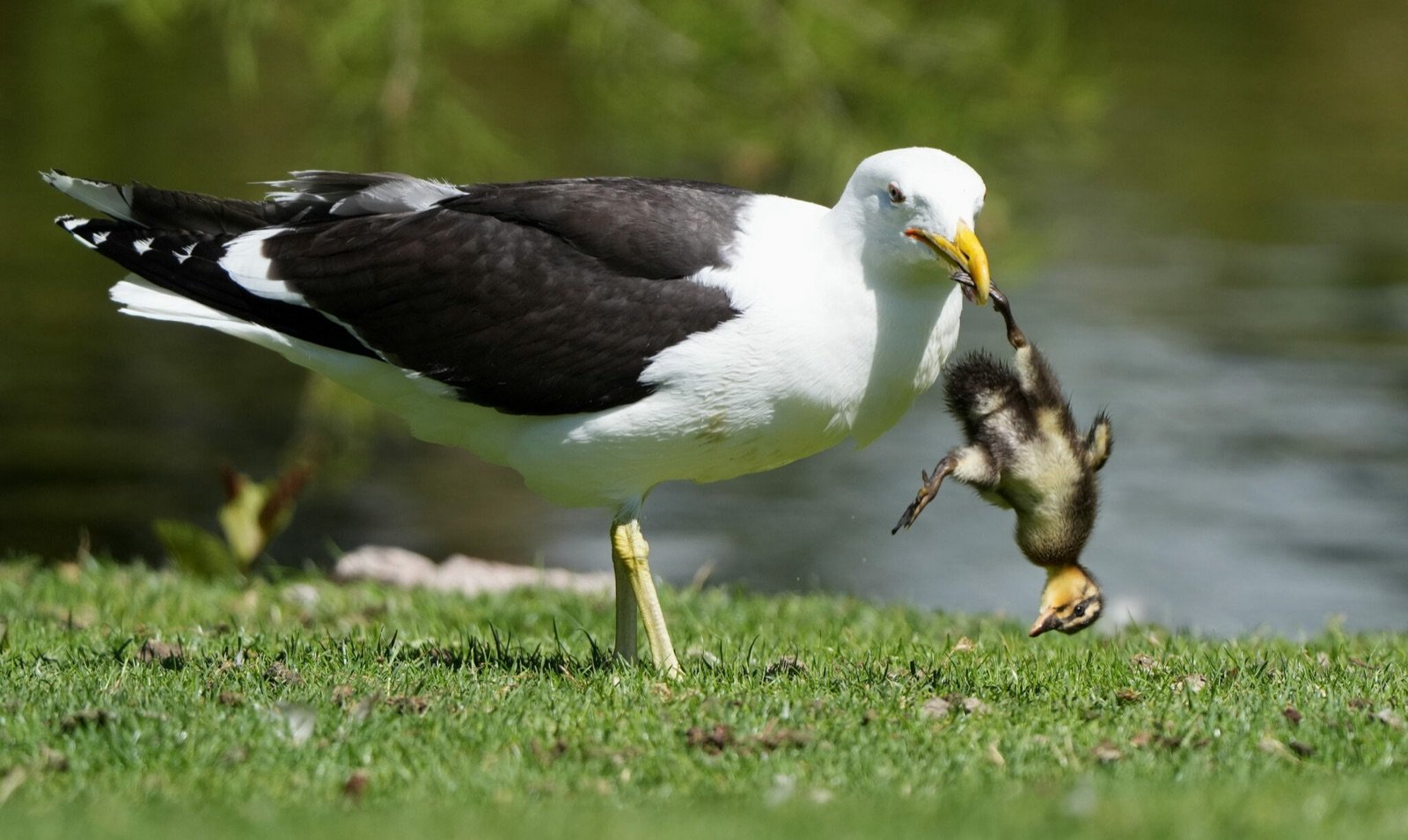
Adults are bold black-backed gulls. Look for these marks:
A strong yellow bill with a clear red spot on the lower mandible.
A deep black back and wings against a white head, neck and underparts.
A head that stays fully white all year.
Yellowish green legs, also described as greenish or grey.
Only a small white wing-tip window.
In size it sits between Lesser Black-backed and Great Black-backed Gulls, which it resembles. Young birds are grey-brown with pale edging, dull legs and a black bill. They quickly gain a pale bill base and a mostly white head and underparts, and take about three or four years to become adult. Beside smaller local gulls its bulk stands out: at Barra del Colorado, one was the largest gull in a group of four Laughing Gulls.
What it sounds like
Recording: Richard Littauer, CC BY 4.0, source, read 4 Nov 2026.
Behaviour and diet
Kelp Gull is an opportunist that eats almost anything, and it often gathers at harbours and rubbish dumps. It uses both marine and land food sources.
It is bold and dominant, especially where gulls feed and rest, and it can act aggressively toward other birds. It may be alone, in pairs or in flocks.
Where it lives
Across its range it is mainly a coastal gull, found on beaches, rocky shores and islands. It also uses estuaries and harbours.
In Costa Rica the records come from Isla del Coco in the Pacific, from a river mouth on the Pacific coast near Quepos, and from the Colorado River mouth at Barra del Colorado on the Caribbean side. Ten gull species have been recorded in the country, most of them sporadic vagrants along the coast, and Kelp Gull is one of these strays with no known resident population.
When to see it
The dated Costa Rican sightings are 8 January 2013, 16 December 2013 and 26 January 2014. All fall in December and January, but no season is established for the species.
Similar birds
Great Black-backed Gull has pink legs, while Kelp Gull has yellow-green legs. Lesser Black-backed Gull is smaller and slimmer, with a paler slate-grey back. Both are also accidental in Costa Rica, so check legs and back colour. In the Costa Rican paper, Lesser Black-backed was ruled out for one bird because it has pinkish to yellowish legs at that age.
Names and lore in Costa Rica
The official Costa Rican Spanish name is Gaviota Cocinera. The first record notice also lists Gaviota Dominicana, a name that refers to the Dominican Order of friars, whose habits were black and white like the adult gull.
Status and conservation
The official list of the birds of Costa Rica marks Kelp Gull as status A, accidental, a very rare visitor.
How we know this 15 sources, each read on the date shown
- Lista Oficial de las Aves de Costa Rica (AOCR) read 2026-11-04
https://listaoficialavesdecostarica.wordpress.com/lista-oficial/lista-oficial-online/ - Lista Oficial de las Aves de Costa Rica (AOCR blog) read 2026-11-04
https://listaoficialavesdecostarica.wordpress.com/2014/02/19/larus-dominicanus-confirmada-para-costa-rica-continental/ - SEO/BirdLife read 2026-11-04
https://seo.org/ave/gaviota-cocinera/ - Ecoregistros read 2026-11-04
https://www.ecoregistros.org/sheet/Larus-dominicanus&idusuario=2757&idlugar=365&idpais=2&idprovincia=1458 - Lista Oficial de las Aves de Costa Rica (AOCR) news read 2026-11-04
https://listaoficialavesdecostarica.wordpress.com/category/noticias/page/2/ - EcoRegistros read 2026-11-04
https://www.ecoregistros.org/ficha/Larus-dominicanus - Marine Ornithology (Bonilla et al. 2014) read 2026-11-04
https://www.marineornithology.org/PDF/42_1/42_1_3-4.pdf - Lista Oficial Aves de Costa Rica (AOCR) read 2026-11-04
https://listaoficialavesdecostarica.wordpress.com/nuevos-registros/ - Cornell Birds of the World read 2026-11-04
https://birdsoftheworld.org/bow/species/kelgul/cur/introduction - Bird Identifier read 2026-11-04
https://birdidentifier.com/encyclopedia/kelp-gull - iNaturalist (Wikipedia text) read 2026-11-04
https://www.inaturalist.org/taxa/4388-Larus-dominicanus - Asturnatura read 2026-11-04
https://www.asturnatura.com/especie/larus-dominicanus - Bonilla et al. 2014 (Marine Ornithology), via ResearchGate read 2026-11-05
https://www.researchgate.net/publication/259892878_Caribbean_records_of_Long-tailed_Jaeger_Stercorarius_longicaudus_from_Costa_Rica - Watching Birds Costa Rica read 2026-11-05
https://watchingbirdscostarica.com/blog/tortuguero-gull-south-america-picks-list-903/ - Wikipedia read 2026-11-05
https://en.wikipedia.org/wiki/Kelp_gull