Family Laridae
Western Gull
Larus occidentalis
In Spanish: Gaviota Occidental
- A
A dark-backed Pacific gull, accidental here, seen around the Puntarenas ferry.
The Western Gull (Gaviota Occidental) is not a bird anyone plans a trip around, and that is part of its charm. It normally lives along the Pacific coast of North America, breeding from Washington State south to central Baja California, so Costa Rica lies far south of its range.
The official Costa Rican list gives it status A, the accidental category for rare vagrants. The records committee announced it as a new species for the country in a post dated May 2014, after a single bird at Caldera, Puntarenas, on 20 January 2014.
For a beginning birder it is a lovely lesson in looking at the gulls everyone else ignores. On a trip we build along the central Pacific coast, a large, dark-backed gull among the Laughing Gulls at Puntarenas is worth a second look.
How to find it
Check the gulls at Puntarenas port and on the ferry to the Nicoya Peninsula. One Western Gull lingered there for a whole season, apparently drawn by the food and warmth, so this is the place to start. Scan the flock and look for a dark-backed gull among the Laughing Gulls. Laughing Gull and Franklin's Gull are both common on the same ferry route, so a large, bulky, dark-backed bird should stand out. Check the bill: yellow with a red spot, and heavy.
How to recognise it
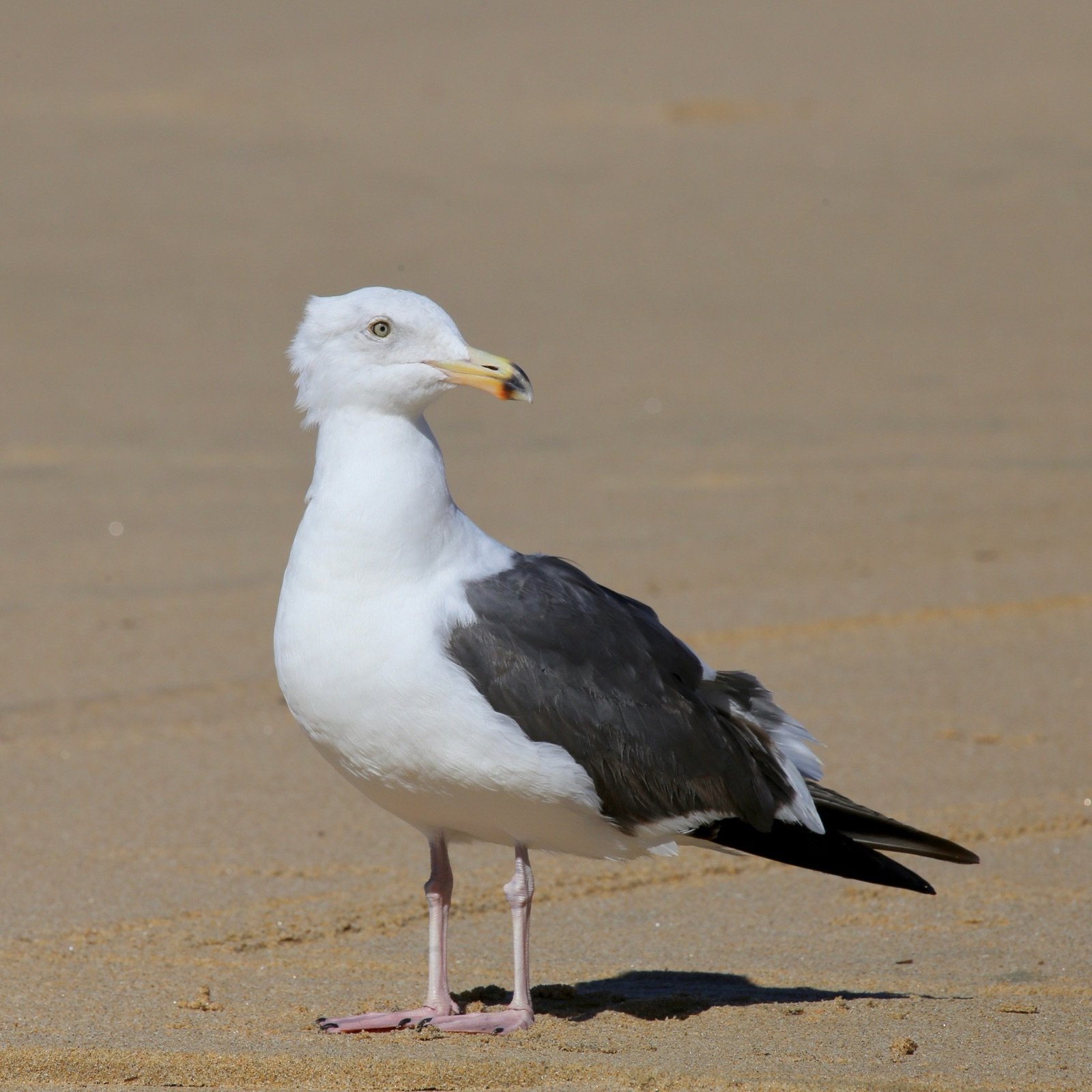
Adults are large gulls with a white head and body and a dark slate-grey back. The bill is yellow with a red spot near the tip, and the legs are pink.
The Western Gull is about the size of an American Herring Gull but looks bulkier. Its bill often looks swollen and droops toward the tip.
Juveniles are mottled greyish brown with a black bill. They take about four years to reach full adult plumage, so a brown, heavy-billed gull may be a young bird still working toward the adult look.
Two subspecies exist. The northern one, L. o. occidentalis, has a paler back, though still clearly darker than a California Gull. The southern one, L. o. wymani, has a darker back and paler eyes.
What it sounds like
Behaviour and diet
Across its range it eats fish, marine invertebrates and carrion, and it scavenges at garbage dumps. It often follows fishing boats and drops hard-shelled prey onto rocks to break them open.
It also harasses cormorants and pelicans until they cough up their catch, then eats it.
That taste for boats and scraps fits the Costa Rican bird that stayed around the Puntarenas ferry and its surroundings for more than one full season, apparently attracted by the food and warmth.
Where it lives
Across its range it lives mostly right on the coast, in estuaries, on beaches and around city waterfronts. It often ranges well out to sea and is almost never found far inland.
It winters from Vancouver Island to the tip of Baja.
In Costa Rica it has no resident population. The records come from the central Pacific coast of Puntarenas: the first bird at Caldera, and a later bird around the Puntarenas ferry and port.
When to see it
The first accepted Costa Rican record was on 20 January 2014, which fits a winter vagrant, though only that one date is given. A later bird was still present around the Puntarenas ferry in December 2021, after staying more than one full season.
Similar birds
The Asian Slaty-backed Gull looks similar, with paler eyes, a straighter bill, deeper pink legs and a row of white spots on the inner primaries in flight, which the Western Gull lacks. Other large gulls to rule out are California Gull, Glaucous-winged Gull, Yellow-footed Gull and Thayer's Gull. California Gull is also accidental in Costa Rica. Western Gulls often hybridise with Glaucous-winged Gulls, which makes identification harder.
Names and lore in Costa Rica
The official Costa Rican name is Gaviota Occidental, used in the national list and in field reports by Costa Rican birders.
Status and conservation
The official Costa Rican list gives the Western Gull status A, accidental, so it is a rare vagrant and not a resident or regional endemic.
Photography tips
The ferry crossing and the port at Puntarenas are the places where a bird lingered, so start there. A dark slate-grey back against the white and paler gulls around it makes the bird easy to pick out in the frame. Aim for the yellow bill with its red spot and the pink legs.
How we know this 17 sources, each read on the date shown
- Lista Oficial de las Aves de Costa Rica (AOCR) read 2026-11-04
https://listaoficialavesdecostarica.wordpress.com/lista-oficial/lista-oficial-online/ - Lista Oficial de las Aves de Costa Rica (AOCR) read 2026-11-04
https://listaoficialavesdecostarica.wordpress.com/ - Wikipedia read 2026-11-04
https://en.wikipedia.org/wiki/List_of_birds_of_Costa_Rica - Cornell Birds of the World read 2026-11-04
https://birdsoftheworld.org/bow/species/wesgul/cur/introduction - Coastal Interpretive Center read 2026-11-04
https://www.interpretivecenter.org/news/western-gull - Audubon Field Guide read 2026-11-04
https://www.audubon.org/field-guide/bird/western-gull - iNaturalist (Wikipedia text) read 2026-11-04
https://www.inaturalist.org/taxa/4345-Larus-occidentalis - Planet of Birds read 2026-11-04
https://planetofbirds.com/charadriiformes-laridae-western-gull-larus-occidentalis/ - Wildlife Vagabond read 2026-11-04
https://wildlifevagabond.com/wildlife/birds/gulls-auks-and-allies/gulls/western-gull/ - Monterey Bay Aquarium read 2026-11-04
https://www.montereybayaquarium.org/animals-the-ocean/animals-a-to-z/western-gull - Lista Oficial de las Aves de Costa Rica (AOCR) read 2026-11-04
https://listaoficialavesdecostarica.wordpress.com/nuevos-registros/ - La Nación read 2026-11-04
https://www.nacion.com/ciencia/medio-ambiente/gaviota-y-bolsero-se-dejan-ver-por-primera-vez-en-el-pais/CTD55AGWDVCFHDIJV6U6OFTSF4/story/ - Roberto Vargas Masís blog read 2026-11-04
https://robertovargasmasis.wordpress.com/2021/12/14/cabuya-mi-lugar-favorito/ - All About Birds (Cornell Lab) read 2026-11-04
https://www.allaboutbirds.org/guide/Western_Gull/sounds - Larkwire read 2026-11-04
https://www.larkwire.com/library/bird-sounds/491/Western-Gull-songs-and-calls - NatureMapping Foundation read 2026-11-04
https://naturemappingfoundation.org/natmap/facts/espanol/western_gull_es.html - Birds of the World read 2026-11-04
https://birdsoftheworld.org/bow/species/wesgul/cur/introduction?lang=es