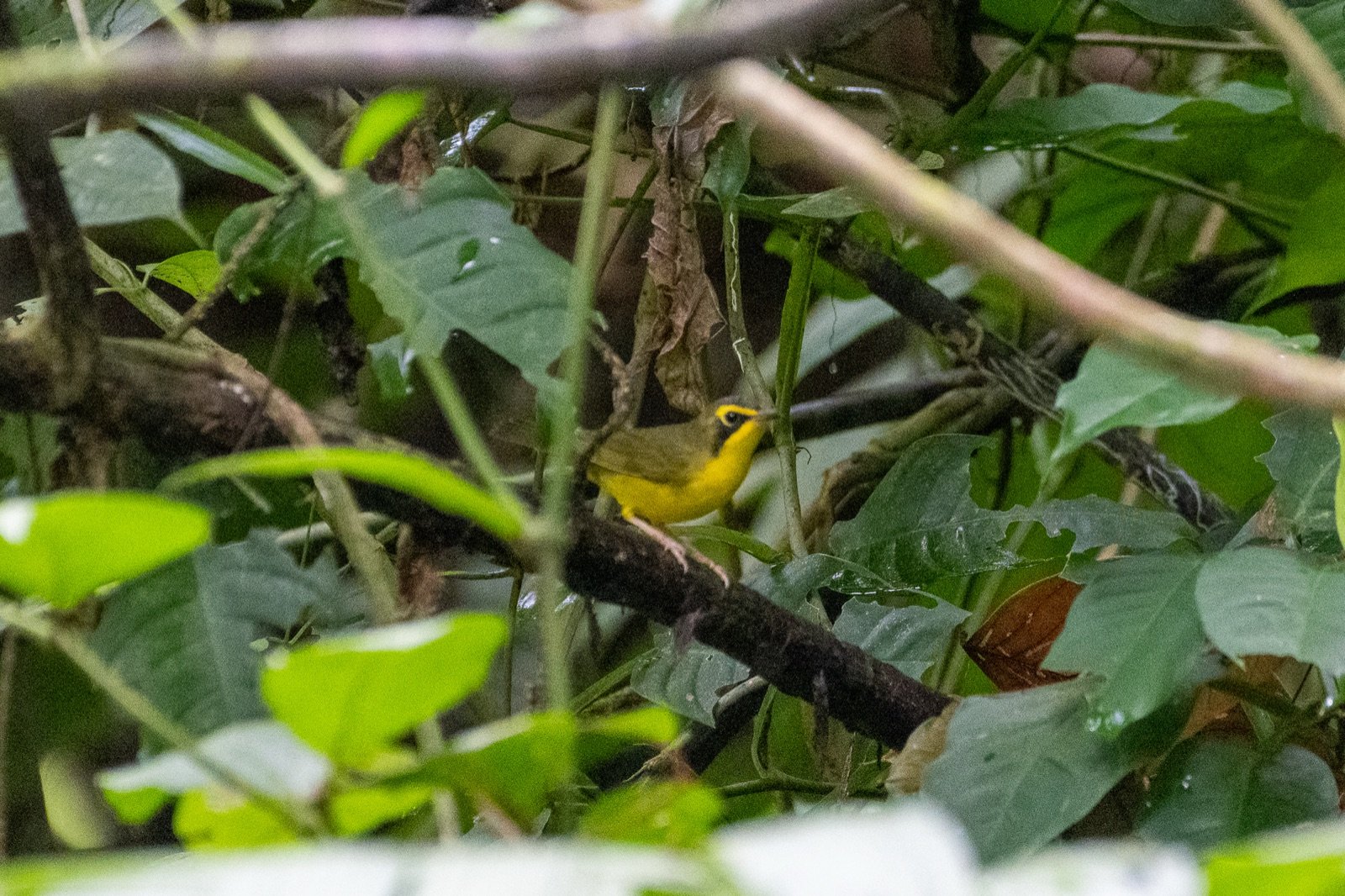
Family Parulidae
Kentucky Warbler
Geothlypis formosa
In Spanish: Reinita Cachetinegra
- Migrant
A yellow-spectacled warbler that walks the forest floor all winter.
The Kentucky Warbler is a winter visitor to Costa Rica. Birds arrive from early to mid September and stay until late April, and they do not breed here. A Costa Rican account calls it a widespread winter resident, uncommon to common.
It keeps to the forest understory and is usually heard well before it is seen. Winter birding here brings a good selection of wintering warblers, and this one is called a star wintering bird that uses second growth and forest.
On a trip we build, a short walk along a forest trail in the lowlands is the way to look for it, listening for a loud chip note and scanning the leaf litter.
How to find it
Walk a short trail into the forest rather than staying on roadsides and edges, since this is an understory bird. Listen for the loud chip note, because it is hard to see. Look around army ant swarms, where wintering birds watch from a perch and wait for an insect to be flushed. Shade-coffee and cacao plantations are also worth checking. On arrival and departure, check thickets and low brush, not only the forest interior. Expect to find one bird alone on the forest floor.
How to recognise it
Look for a bird that is bright yellow below and olive above. These are the marks to check:
A black cap and a black cheek, which read as sideburns.
Bold yellow marks like spectacles that do not fully circle the eye.
Unstreaked yellow underparts.
A short tail.
Pink or flesh coloured legs.
The female has less black on the face, which looks more olive grey. Because it stays low in the understory, the first thing you notice may be a small yellow shape walking over the leaf litter.
What it sounds like
Behaviour and diet
It forages mostly by walking on the ground, picking insects from leaf litter and flipping dead leaves. It walks rather than hops, and it bobs its tail. In Costa Rica it also hops on logs and flits along twigs in low thickets.
Each bird defends a small feeding territory through the winter, so expect to find one alone, not in a flock. It often follows army ant swarms, watching from a perch until the ants flush an insect, then grabbing it. Birds ruffle their crown feathers when agitated.
Where it lives
In winter in the tropics it needs dense forest and second growth. In Costa Rica it winters in the lowlands of both the Caribbean and Pacific slopes. It regularly reaches 1,200 m and locally 1,850 m.
It is most numerous on the southern Pacific slope and scarcest on the northern Pacific slope. A Costa Rican account says it is scarcer in the Guanacaste lowlands, where it uses the wetter gallery forests. It also winters in shade-coffee and cacao plantations.
When to see it
In Costa Rica it is a winter resident. Birds arrive from early to mid September and stay until late April.
Similar birds
The Common Yellowthroat male has a solid black mask and no yellow spectacles, while the Kentucky Warbler has black sideburns and yellow spectacles. Canada Warbler is grey above and has a necklace of black streaks across the yellow breast.
Names and lore in Costa Rica
Reinita Cachetinegra is the name used in Costa Rica, Nicaragua and Panama. Mexico calls the bird chipe cachetinegro, Puerto Rico uses reinita de Kentucky, and Colombia uses reinita de anteojos, which means spectacled warbler.
Status and conservation
The official Costa Rican bird list classes the Kentucky Warbler as M, a migrant: a winter visitor that does not breed in the country.
Photography tips
Wait quietly beside a short forest trail and watch the leaf litter, since it walks on the ground and bobs its tail. A perch near an army ant swarm is a good place to watch, because birds wait there for the ants to flush an insect.
How we know this 15 sources, each read on the date shown
- Lista Oficial de las Aves de Costa Rica (AOCR) read 2026-11-04
https://listaoficialavesdecostarica.wordpress.com/lista-oficial/lista-oficial-online/ - Rancho Mastatal species list (Tico Tweeter) read 2026-11-04
https://ranchomastatal.com/species-list - Cloudbridge Nature Reserve bird list read 2026-11-04
https://www.cloudbridge.org/wp-content/uploads/2020/04/Bird-Species-List-Costa-Rica-13-April-2020.pdf - Aves y Ventanas Costa Rica read 2026-11-04
https://avesyventanascostarica.wordpress.com/2020/10/09/aves/ - All About Birds (Cornell Lab) read 2026-11-04
https://www.allaboutbirds.org/guide/Kentucky_Warbler/overview - Vorstman's Guide to the Birds of North America read 2026-11-04
https://www.vorstman.com/vogelgids-nam/en/species/kentucky-warbler.html - Audubon Field Guide read 2026-11-04
https://www.audubon.org/field-guide/bird/kentucky-warbler - Kern Audubon Society read 2026-11-04
https://www.kernaudubonsociety.org/bird-of-the-week-kentucky-warbler-2/ - Flickr post quoting a Costa Rican natural history account read 2026-11-04
https://www.flickr.com/photos/jobando/40905454062 - Birds of the World (Cornell) read 2026-11-04
https://birdsoftheworld.org/bow/species/kenwar/cur/distribution - 10,000 Birds read 2026-11-04
https://www.10000birds.com/the-wintering-wood-warblers-of-costa-rica.htm - All About Birds (Cornell Lab) read 2026-11-04
https://www.allaboutbirds.org/guide/Kentucky_Warbler/id - Missouri Department of Conservation read 2026-11-04
https://mdc.mo.gov/discover-nature/field-guide/kentucky-warbler - Bird Identifier read 2026-11-04
https://birdidentifier.com/encyclopedia/kentucky-warbler/kentucky-warbler-identification-guide - Wikipedia (Spanish) read 2026-11-04
https://es.wikipedia.org/wiki/Geothlypis_formosa