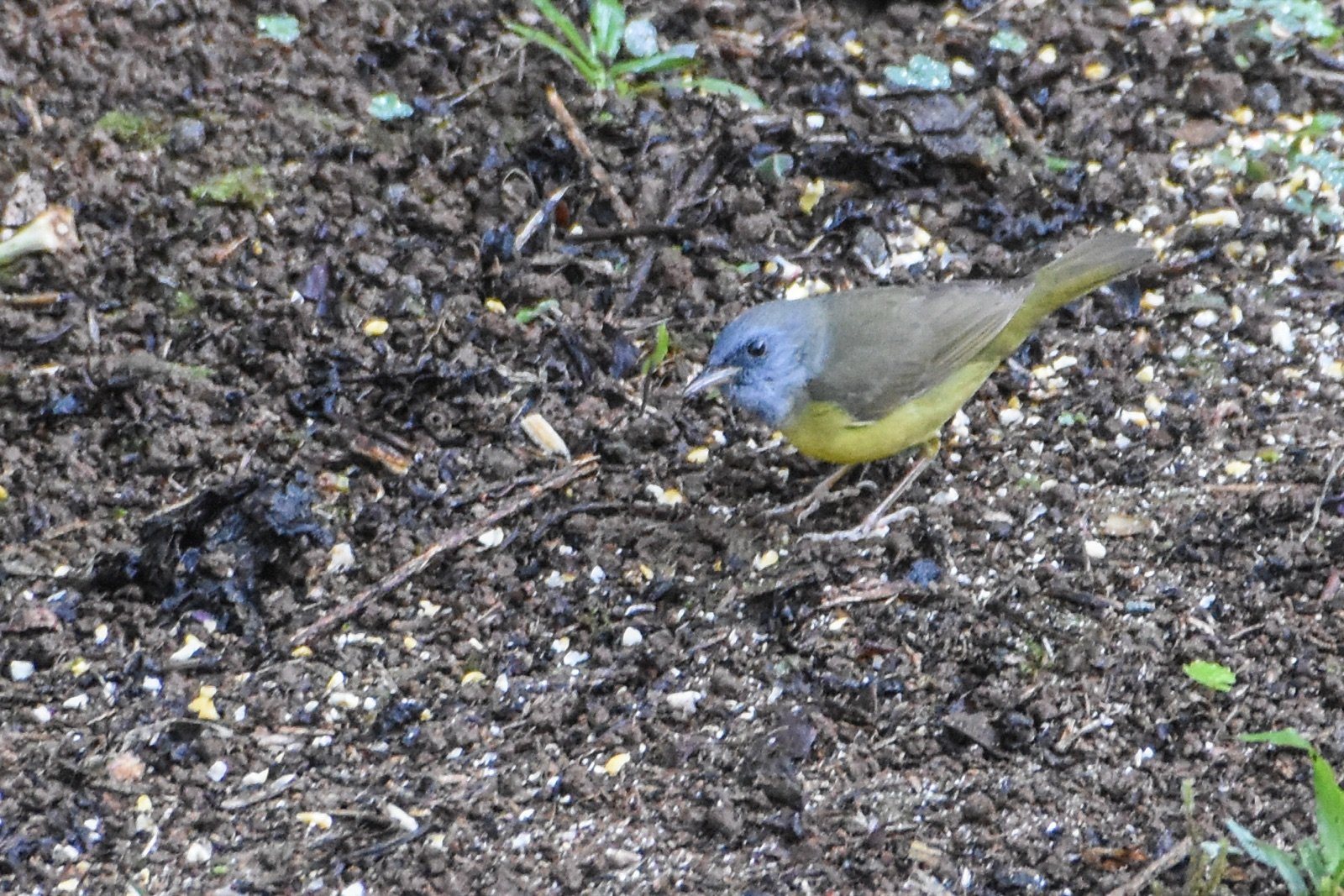
Family Parulidae
Mourning Warbler
Geothlypis philadelphia
In Spanish: Reinita Enlutada
- Migrant
A gray-hooded skulker of low, tangled scrub, here from autumn to spring
The Mourning Warbler (Reinita Enlutada) is a common winter resident in the lowlands of both the Caribbean and Pacific slopes of Costa Rica. It arrives in autumn and stays until spring.
It is also one of the most famous skulkers of the warbler family: common but seldom seen. Wintering birds usually stay hidden in dense foliage, so the trick is to look low and be patient.
On a trip we build, guests can meet it in lowland second growth and in gardens with brushy undergrowth on both slopes, and along rainforest edges.
How to find it
Look in dense understory, second growth and rainforest edges, and watch low tangles in brushy gardens. A warbler moving through low undergrowth in a garden near Turrialba is most often this species, and a birder there reports it visiting every year. Birds are quiet in winter, so listen for the sharp chip. Fruit feeders and bathing pools in the Caribbean foothills have drawn it into view. If you pass an army ant swarm, check its edges for birds following it.
How to recognise it
Adult males are the easiest to name. They have a gray hood, black lores and a black patch on the throat and breast, like a dark bib. The body is olive above and yellow below, with pink legs and a thin pointed bill.
Females and immatures are plainer. They have a gray-brown head with an incomplete eye-ring, and they lack the male's black bib. That broken eye-ring is a useful mark on young birds, because it helps separate them from similar warblers.
What it sounds like
Behaviour and diet
In tropical lowlands in winter this warbler may forage very low. It moves through dense understory and keeps out of sight. It sometimes joins groups of birds that follow army ant swarms and takes insects the ants flush out.
A tour guide notes that Mourning Warblers can be wonderfully confiding on their winter grounds, even though they are often elusive on the breeding grounds. A tour report also describes a singing male found in a pasture.
Where it lives
In Costa Rica it frequents low, young second-growth scrub and overgrown regrowth patches. It is a common winter resident in the lowlands of both the Caribbean and Pacific slopes, and it reaches up to about 1400 m in the Central Valley. One natural history account lists many conservation areas, including Tortuguero, Osa, Guanacaste and Arenal.
It is also found in dense understory and at rainforest edges. A tour report says it is typically found in open areas, especially low, wet vegetation.
When to see it
It arrives in autumn, from mid-September to early November, and a few birds turn up in late August in some years. October is a peak month for fall migration, and tours have recorded it in late December and January before it leaves between late April and mid-May.
Similar birds
MacGillivray's Warbler looks very similar, but it is extremely rare in Costa Rica, so a gray-hooded warbler there is almost certainly a Mourning Warbler. Connecticut Warbler has a complete eye-ring and a larger bill, while immature Mourning Warblers show only a broken eye-ring.
Names and lore in Costa Rica
Costa Rica's local Spanish name is Reinita Enlutada, and the Costa Rican entry also lists a variant, Reinita Enlutada Llorón. Elsewhere it is called reinita plañidera in Ecuador, chipe llorón in Mexico and cigüita triste in the Dominican Republic.
Status and conservation
The AOCR list marks it as a migrant (M), and it is listed as Least Concern among the roughly 222 migrant species that stop over or winter in Costa Rica.
Photography tips
Birders in the Caribbean foothills found it easier to see at the fruit feeders below the balcony and at the bathing pools. One bird was also seen bouncing across the lawn at breakfast.
How we know this 19 sources, each read on the date shown
- Flickr post of Costa Rican natural history account (Reinita Enlutada) read 2026-11-04
https://www.flickr.com/photos/jobando/30070026350 - Bird-window collisions in Costa Rica (ResearchGate) read 2026-11-04
https://www.researchgate.net/publication/399052521_Bird-window_collisions_in_Costa_Rica_taxonomic_characterization_migratory_status_geographic_distribution_and_conservation - Audubon Field Guide read 2026-11-04
https://www.audubon.org/field-guide/bird/mourning-warbler - Birds for Beer read 2026-11-04
https://birdsforbeer.com/2018/05/26/from-costa-rica-to-minnesota-12-migrant-warblers/ - 10,000 Birds read 2026-11-04
https://www.10000birds.com/the-wintering-wood-warblers-of-costa-rica.htm - Cornell Lab, All About Birds read 2026-11-04
https://www.allaboutbirds.org/guide/Mourning_Warbler/lifehistory - Wikipedia read 2026-11-04
https://en.wikipedia.org/wiki/Mourning_warbler - Mass.gov read 2026-11-04
https://www.mass.gov/info-details/mourning-warbler - Cornell Lab, All About Birds read 2026-11-04
https://www.allaboutbirds.org/guide/Mourning_Warbler/id - Avibase read 2026-11-04
https://avibase.bsc-eoc.org/species.jsp?lang=EN&avibaseid=1A0096F2F929CEA2 - Reserva Biológica Los Carpinteros read 2026-11-04
https://reservacarpinteros.org/aves/geothlypis-philadelphia - Field Guides tour report read 2026-11-04
https://fieldguides.com/triplists/crh19p.html - Field Guides tour report read 2026-11-04
https://fieldguides.com/triplists/crh21b.html - Birdquest tour report read 2026-11-04
https://www.birdquest-tours.com/wp-content/uploads/2025/07/costa-rica-classic-2025-text.pdf?v=1766840199 - Birding Craft read 2026-11-04
https://birdingcraft.com/wordpress/2023/10/03/october-the-most-exciting-month-for-birding-in-costa-rica/ - Cloudbridge Nature Reserve read 2026-11-04
https://www.cloudbridge.org/wp-content/uploads/2020/04/Bird-Species-List-Costa-Rica-13-April-2020.pdf - Aves y Ventanas Costa Rica read 2026-11-04
https://avesyventanascostarica.wordpress.com/2020/10/09/aves/ - Universidad de Costa Rica (Kérwá) read 2026-11-04
https://www.kerwa.ucr.ac.cr/items/fa1013d0-ebc8-4403-8e30-7c7028fea4ee - Field Guides tour report read 2026-11-04
https://fieldguides.com/triplists/crh19a.html