Family Tyrannidae
Least Flycatcher
Empidonax minimus
In Spanish: Mosquerito Chebec
- Migrant
The smallest, greyest migrant Empidonax, a rare winter visitor.
The Least Flycatcher (Mosquerito Chebec) is a migrant and winter resident in Costa Rica, and a very rare one in the lowlands of both slopes. It arrives from early October and stays until at least late April.
Costa Rica sits at the southern edge of its normal winter range, which is why a find here feels like a small prize.
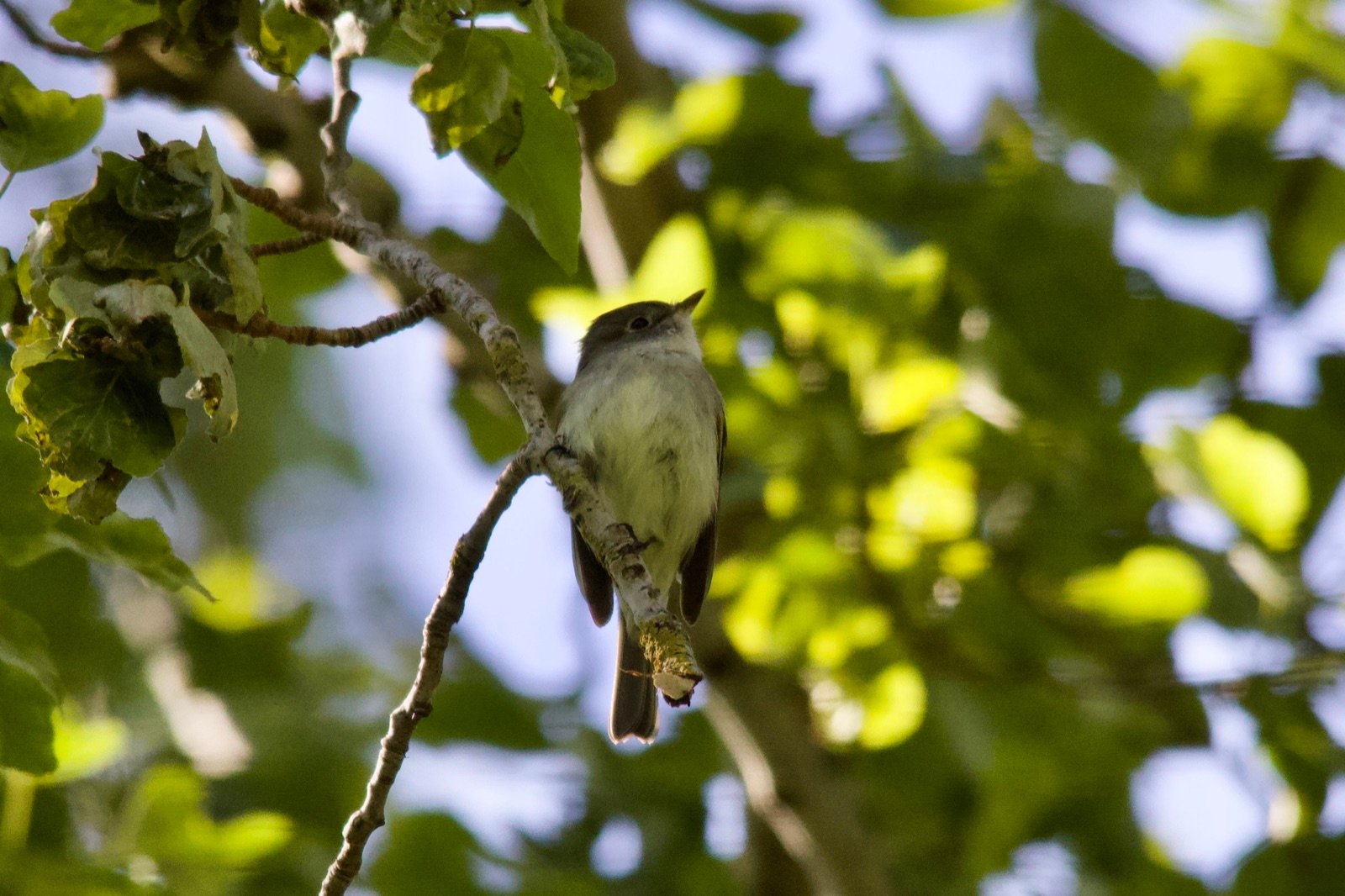
It belongs to the Empidonax group, the olive flycatchers that often confuse beginners. This one is among the easier ones, because it is the smallest and greyest of the migrant Empidonax in Costa Rica, with a bright white eye ring and wing bars.
How to find it
Work forest edges, old second growth and scrubby regrowth rather than deep forest. Cacao and other tree plantations are worth a slow walk too. Scan at shrub height and in the upper understory, and look up for quick movements and frequent changes of perch. Because winter birds are solitary and stay in one spot, a place where you find one may be worth rechecking. Confirm the small size and the bold white eye ring, since on migration it may be silent and hard to tell apart.
How to recognise it
Start with size: about 11.5 cm long, the smallest and greyest of the migrant Empidonax in Costa Rica.
Look for these marks:
A small bill, short and broad, with a pale lower half.
A notched tail.
A notably bright white eye ring and wing bars.
Grey olive upperparts, with a grey crown and nape that show little or no green tint.
A white throat and a dull olive wash on the breast.
A yellow tint on the belly and flanks.
Its short wing tips let it pump its tail upward without flicking its wings.
What it sounds like
Recording: Sean Vanderluit, CC BY 4.0, source, read 4 Nov 2026.
Behaviour and diet
In winter in Costa Rica the Least Flycatcher is solitary and stays in one spot, and it may defend a territory. It hunts by short sallies and hovering flights within the vegetation, like other migrant Empidonax. It catches insects from branches in the middle to upper levels and changes perches often, so quick movements are the clue to look for. Empidonax flycatchers in general often flick their wings and tails quickly.
Where it lives
In Costa Rica it lives at forest edges, old second growth, scrubby regrowth and tree plantations such as cacao. It usually stays low, at shrub height and in the upper understory.
It is mostly a lowland bird on both the Caribbean and Pacific slopes. On migration it climbs to at least 1200 m in the central highlands.
When to see it
It arrives from early October and stays until at least late April.
Similar birds
Costa Rica's other Empidonax species include Alder, Willow, White-throated, Yellowish and Black-capped flycatchers. The group is often confusing, but the Least is one of the easier ones to identify. Small size, a grey crown and nape and a bold eye ring help set it apart.
Names and lore in Costa Rica
In Costa Rica the bird is called mosquerito chebec. Other Spanish speaking countries use different names, such as mosquerito menor in Honduras and mosquerito mínimo in Mexico. The English name 'chebec' is an old nickname that imitates the sound of its song.
Status and conservation
On the AOCR list it is a migrant (M), a winter resident that is very rare in the lowlands of both slopes, and its population trend is listed as decreasing.
Photography tips
Look up for quick movements and frequent changes of perch, at shrub height and in the upper understory. A bird that holds one spot in winter can be returned to for a better look.
How we know this 12 sources, each read on the date shown
- Aves de Costa Rica read 2026-11-04
https://avesdecostarica.com/Empidonax-minimus.html - Flickr (Costa Rican bird account) read 2026-11-04
https://www.flickr.com/photos/jobando/33552960492 - Cloudbridge Nature Reserve read 2026-11-04
https://www.cloudbridge.org/wp-content/uploads/2020/04/Bird-Species-List-Costa-Rica-13-April-2020.pdf - All About Birds, Cornell Lab read 2026-11-04
https://www.allaboutbirds.org/guide/Least_Flycatcher/overview - Wikipedia read 2026-11-04
https://en.wikipedia.org/wiki/Empidonax - Wikipedia read 2026-11-04
https://en.wikipedia.org/wiki/List_of_birds_of_Costa_Rica - American Bird Conservancy read 2026-11-04
https://abcbirds.org/birds/least-flycatcher/ - Birds Colombia (La Voz de las Aves) read 2026-11-04
https://birdscolombia.com/2021/02/01/atrapamoscas-minimo-least-flycatcher-empidonax-minimus/ - Wikipedia (es) read 2026-11-04
https://es.wikipedia.org/wiki/Empidonax_minimus - Wikipedia read 2026-11-04
https://en.wikipedia.org/wiki/Least_flycatcher - Cornell Birds of the World read 2026-11-04
https://birdsoftheworld.org/bow/species/leafly/cur/sounds - City College of San Francisco bird page read 2026-11-04
https://fog.ccsf.edu/~jmorlan/LeastFlycatcherIMG_1928.htm