Family Tyrannidae
Yellowish Flycatcher
Empidonax flavescens
In Spanish: Mosquerito Amarillento
- Resident
A small yellow highland flycatcher with a bold eye ring, found all year.
The Yellowish Flycatcher (Mosquerito Amarillento) is a small bird of Costa Rica's mountains, and a good one for learning the tricky Empidonax group, because its eye ring gives you something clear to look for. It is a common resident here and is not migratory, so it can be looked for all year.
It lives in cool highland forest between about 800 and 2,500 m. On a trip we build around the highlands, guests can meet it in cloud forest areas such as Monteverde and San Gerardo de Dota, and records also come from Montserrat de Coronado.
The species was first described from a specimen collected at Barranca, Costa Rica, so this is a bird with deep local roots.
How to find it
Look at forest edges, small patches of second growth, plantations and gardens, and keep your eyes low. Scan low vegetation for a small yellow bird making quick sallies. Check the eye ring first: pale yellow and thick behind the eye. Learn the thin dawn song too, since voice separates it readily from similar birds. Check creek banks and streamside trees as well.
How to recognise it
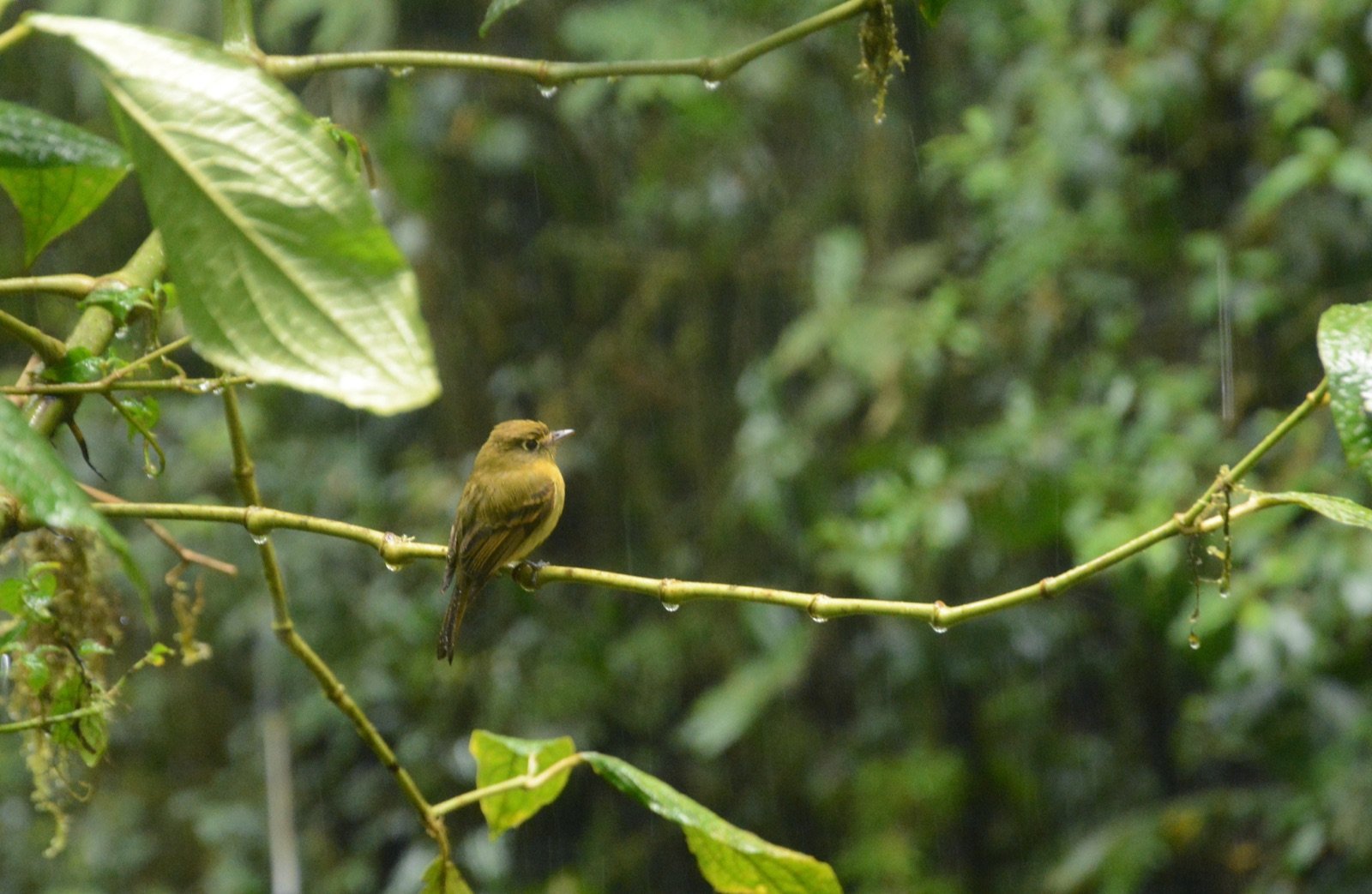
This is a small bird, 12.5 to 14 cm long. Adults show a pale yellow, almond-shaped eye-ring on a yellowish green face, and a dusky tail with yellowish green edges.
The eye ring is the best field clue in Costa Rica. It is thicker behind the eye and more prominent than in any migrant Empidonax, and a bander noted that it visibly extends behind the eye. The bird often seems to have a slight crest.
The underparts are yellow, with wing bars darker than those of the Yellow-bellied Flycatcher. They are also yellower than that migrant's, despite its name.
What it sounds like
Recording: rawcomposition, CC0 1.0, source, read 4 Nov 2026.
Behaviour and diet
These are active birds, usually seen alone outside the breeding season. Like other Empidonax flycatchers, they often flick their wings and tails quickly.
The bird usually stays low, in shorter trees and shrubs, and it sometimes joins mixed-species flocks. It takes prey by picking it from foliage, by short sallies in flight, or sometimes from the ground.
Where it lives
In Costa Rica this flycatcher lives between about 800 and 2,500 m elevation. It favors cool mountain forest, especially edges and clearings, and also second growth and bushy pastures. It lives in the understory of humid montane cloud forest and is also seen in gardens and coffee plantations.
The Costa Rican form occurs from central Costa Rica into western Panama, as far as Veraguas Province.
When to see it
It is a common resident of Costa Rican mountains and is not migratory, so it can be looked for all year. The migrant Empidonax species that resemble it are the ones that come and go.
Similar birds
Migrant Empidonax such as Willow, Alder and Acadian Flycatchers pass through in autumn, but the Yellowish has a more prominent eye ring than any of them. Among migrants only the Yellow-bellied Flycatcher is a common winter resident in Costa Rica. Costa Rica has three native Empidonax: this one, the White-throated and the Black-capped Flycatcher. The Pine Flycatcher is most alike but duller and less green, and voice separates the two.
Names and lore in Costa Rica
In Costa Rica and Panama the usual Spanish name is Mosquerito Amarillento. Other Spanish names include Mosquero Amarillento, Mosquitero Amarillento in Nicaragua, and Papamoscas Amarillo Sureño in Mexico.
Status and conservation
The AOCR list marks it as a resident (R), the IUCN rates it Least Concern, and it is described as common in Costa Rica.
Photography tips
Nests are often placed 2 to 4.5 m up in a crevice in a tree trunk or earth bank. Nests near small streams have been recorded, so creek banks and streamside trees are worth checking. A bird perched on a low branch is a typical pose, so work the low vegetation at forest edges.
How we know this 15 sources, each read on the date shown
- Wikipedia read 2026-11-04
https://en.wikipedia.org/wiki/Yellowish_flycatcher - Bird Watching Costa Rica read 2026-11-04
https://www.birdwatchingcostarica.com/ave/yellowish-flycatcher/ - Wikipedia read 2026-11-04
https://en.wikipedia.org/wiki/Empidonax - EcoRegistros read 2026-11-04
https://www.ecoregistros.org/ficha/Empidonax-flavescens - Birda read 2026-11-04
https://app.birda.org/species-guide/17518/Yellowish_Flycatcher - Wikipedia (Spanish, via Wikiwand) read 2026-11-04
https://www.wikiwand.com/es/articles/Empidonax_flavescens - Wikipedia (Spanish) read 2026-11-04
https://es.wikipedia.org/wiki/Empidonax_flavescens - Cornell Birds of the World read 2026-11-04
https://birdsoftheworld.org/bow/species/yelfly1/cur/introduction - Aves de Costa Rica read 2026-11-04
https://www.avesdecostarica.com/Empidonax-flavescens.html - BirdForum Opus read 2026-11-04
https://www.birdforum.net/opus/Yellowish_Flycatcher - Macaulay Library read 2026-11-04
https://macaulaylibrary.org/asset/201004221 - Birding Craft read 2026-11-04
https://birdingcraft.com/wordpress/tag/yellowish-flycatcher/ - Oiseaux.net read 2026-11-04
https://www.oiseaux.net/en/photos/stanislas.gallen/yellowish.flycatcher.1.html - Birds for Beer read 2026-11-04
https://birdsforbeer.com/2010/02/02/yellow-bellied-flycatcher-in-the-hand/ - 10,000 Birds read 2026-11-04
https://www.10000birds.com/no-need-to-fear-the-flycatcher-in-costa-rica.htm