Family Podicipedidae
Least Grebe
Tachybaptus dominicus
In Spanish: Zambullidor Enano
- Resident
Tiny, dark, yellow-eyed diver of ponds across Costa Rica.
The Least Grebe, Zambullidor Enano in Spanish, is the smallest swimming bird in Costa Rica. It looks all dark, with striking yellow eyes, a black pointed bill and a black crown, and it dives when frightened.
It is a resident on both the Caribbean and Pacific slopes, from the lowlands to about 1,525 m, and it is most numerous in the Central Valley, Guanacaste and the San Vito region. Costa Ricans call it Piche, a name that comes from its call.
Birders have found it in roadside ponds on the way to Villa Lapas and on the Pacific coast, so on a trip we build, a pond with floating plants is always worth a slow scan.
How to find it
Scan ponds and lagoon edges that have plenty of floating or edge vegetation. Because it often sinks low when alarmed, look carefully for a small head and neck. Listen too: its metallic trills, often a pair's duet, can reveal it before you see it. A local golf course guide says the ponds by holes 10 and 15 are the best places there, though it may use other permanent water, and it is typically seen in large groups. Roadside ponds can also hold a couple, so keep an eye on small water as you travel.
How to recognise it
Start with size. This is the smallest grebe in the New World, only about 21 to 27 cm long, and the smallest swimming bird in Costa Rica.
In Costa Rica look for:
- an all dark look
- striking yellow eyes
- a black crown
- a black pointed bill, short and rounded
- white inner flight feathers, which show in flight
Breeding adults are brownish grey above with a darker crown and throat. Non-breeding birds are paler with a whitish throat. Immatures are paler and greyer than adults.
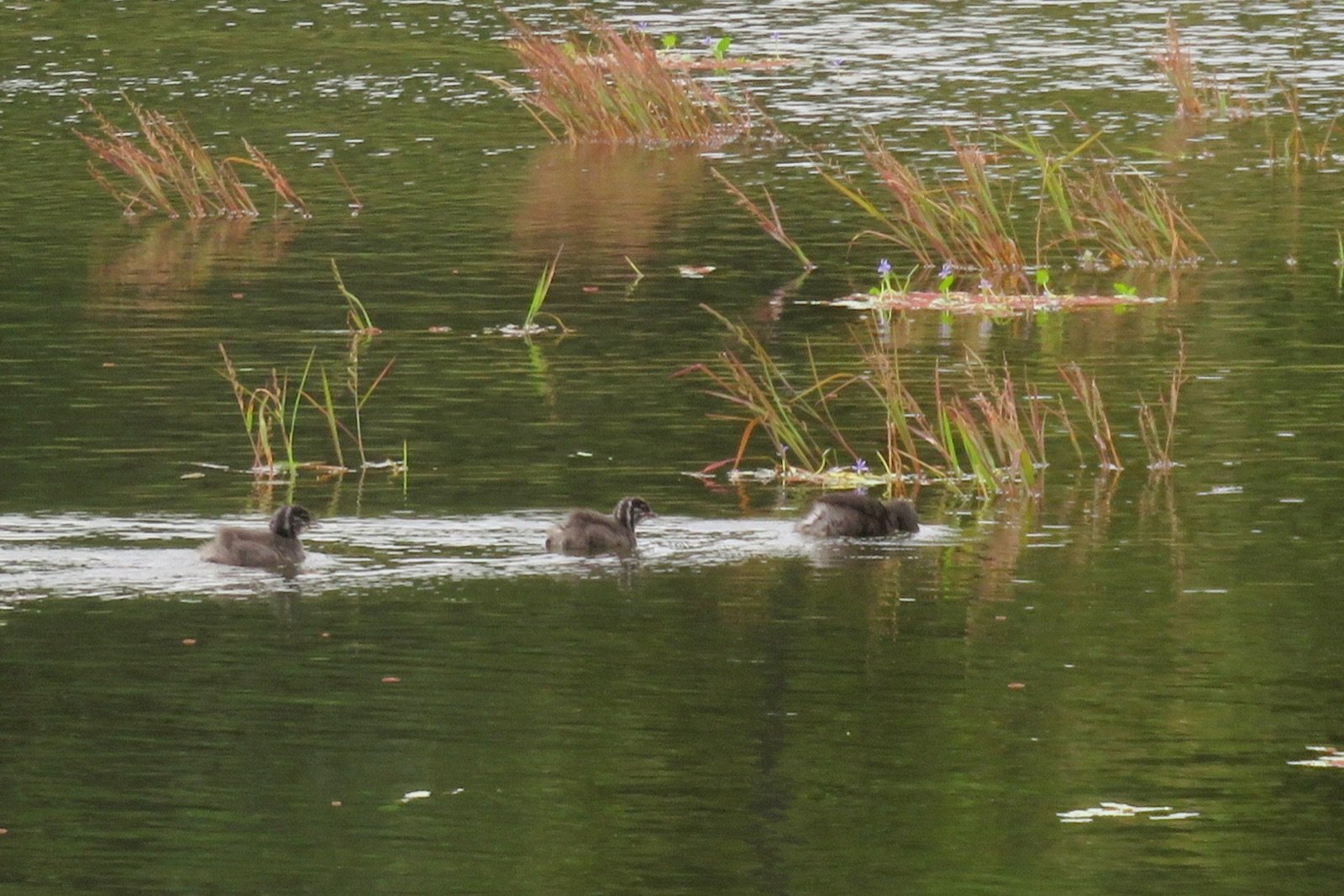
Juveniles look different again: blackish above, with bold white stripes on the head and neck and a whitish underside. Their eye looks dark at first glance.
What it sounds like
Recording: Richard Littauer, CC BY 4.0, source, read 4 Nov 2026.
Behaviour and diet
The Least Grebe dives when frightened. It is usually alone or in pairs, though adults are sometimes seen with three or four well-grown young, and breeding happens almost all year. It nests on a floating mat of water plants.
When alarmed it often sinks low, leaving only the head and neck showing. It eats small fish, crustaceans, frogs and aquatic insects.
In one Costa Rican park pond, adults and chicks swam together and hunted in the open, so families can be easy to watch.
Where it lives
In Costa Rica it lives on slow rivers, on ponds covered with vegetation, and along the edges of larger bodies of water. It is present and fairly common on lakes and small ponds across the country, up to roughly 1500 m above sea level, and a Costa Rican source gives about 1,525 m as its upper range.
It is a resident on both the Caribbean and Pacific slopes, from the lowlands upward. It is most numerous in the Central Valley, Guanacaste and the San Vito region, and the National Museum lists it among the birds of the Greater Metropolitan Area.
Similar birds
Pied-billed Grebe is the other regular grebe in Costa Rica. The Least Grebe is much smaller and darker, with yellow eyes and a pointed black bill. It is dark and gray-faced, with a small thin bill. Some winter Eared Grebes are quite dark and may also have yellow eyes.
Names and lore in Costa Rica
Costa Rican sources list several common names: patillo, pato de agua and zambullidor enano. One Spanish-name list gives Zambullidor Menor for Costa Rica, while the AOCR list uses Zambullidor Enano. Many people know it as Piche, after its call.
Status and conservation
The AOCR list marks it as a resident (R), and the IUCN rates the Least Grebe as Least Concern.
Photography tips
A scope helps: on one tour a Least Grebe was hard to see without one. Another tour heard a bird long before reaching it and found it on an exposed perch. That bird came back, but to a different perch, so patience pays.
How we know this 17 sources, each read on the date shown
- Aves de Costa Rica read 2026-11-04
https://avesdecostarica.com/Tachybaptus-dominicus.html - Animalia.bio (from Wikipedia) read 2026-11-04
https://animalia.bio/least-grebe?environment=142 - Wikipedia (Spanish) read 2026-11-04
https://es.wikipedia.org/wiki/Tachybaptus_dominicus - Wikipedia read 2026-11-04
https://en.wikipedia.org/wiki/Least_grebe - Aves de Costa Rica (Podicipedidae) read 2026-11-04
https://www.avesdecostarica.org/podicipedidae.html - Flickr (Lassetjus photo) read 2026-11-04
https://www.flickr.com/photos/lassetjus/34871220885 - Museo Nacional de Costa Rica read 2026-11-04
https://www.museocostarica.go.cr/nuestro-trabajo/investigaciones/historia-natural/gam/aves/ - Featherscan read 2026-11-04
https://www.featherscan.com/birds/least-grebe - Wikipedia (List of birds of Costa Rica) read 2026-11-04
https://en.wikipedia.org/wiki/List_of_birds_of_Costa_Rica - La Iguana Golf Course local bird guide read 2026-11-04
https://www.golflaiguana.com/wp-content/uploads/sites/9272/2023/10/Wildlife_page.pdf - Cornell Lab All About Birds read 2026-11-04
https://www.allaboutbirds.org/guide/Least_Grebe/sounds - Audubon Field Guide read 2026-11-04
https://www.audubon.org/field-guide/bird/least-grebe - Field Guides Birding Tours, Costa Rica 2018 trip list read 2026-11-04
https://fieldguides.com/triplists/cos18.html - Naturalist Journeys Costa Rica species list read 2026-11-04
https://www.naturalistjourneys.com/pdf/trip-reports/299-201801-central_america-costa_rica-species_list.pdf - Damisela read 2026-11-04
https://www.damisela.com/zoo/ave/otros/podiciped/dominicus/index.htm - ResearchGate (Least Grebe feeding on ranids in Costa Rica) read 2026-11-04
https://www.researchgate.net/publication/305471295_FEEDING_BEHAVIOR_OF_THE_LEAST_GREBE_Tachybaptus_dominicus_UPON_NEOTROPICAL_RANIDS_IN_COSTA_RICA - Field Guides trip report 2024 read 2026-11-04
https://fieldguides.com/triplists/cr124PRINT.html