Family Passerellidae
Lincoln's Sparrow
Melospiza lincolnii
In Spanish: Sabanero de Lincoln
- Migrant
A secretive, streaky winter sparrow of Costa Rica's scrubby highlands, rare here.
Lincoln's Sparrow (Sabanero de Lincoln) reaches Costa Rica as a rare to casual fall migrant and winter visitor, with a stay given as mid-November to late February.
It breeds from Alaska and northern Canada south into the western and northeastern U.S. and winters regularly south to Honduras, only casually to Panama. Costa Rica sits at the far edge of that winter range, so a sighting here makes birding news.
For a beginning birder it is a lesson in patience. It is very secretive and often goes unseen or unheard even where it is common, and it is easy to take for a Rufous-collared Sparrow. A careful look shows it is clearly different.
How to find it
Start in scrubby, grassy edges, dry or swampy, and watch the ground under bushes and grass. A Costa Rican naturalist says it is often missed because it gets mistaken for a Rufous-collared Sparrow, so look carefully at every sparrow. Listen for the buzzy zeee or zeet, which can reveal a hidden bird. At Monteverde, spishing brought the first observer's bird out of dense tall grass on a hillside, and it came into clear view several times. Gentle pishing in shrubby fields can also coax one to peek out, but you get only a short time to raise your binoculars.
How to recognise it
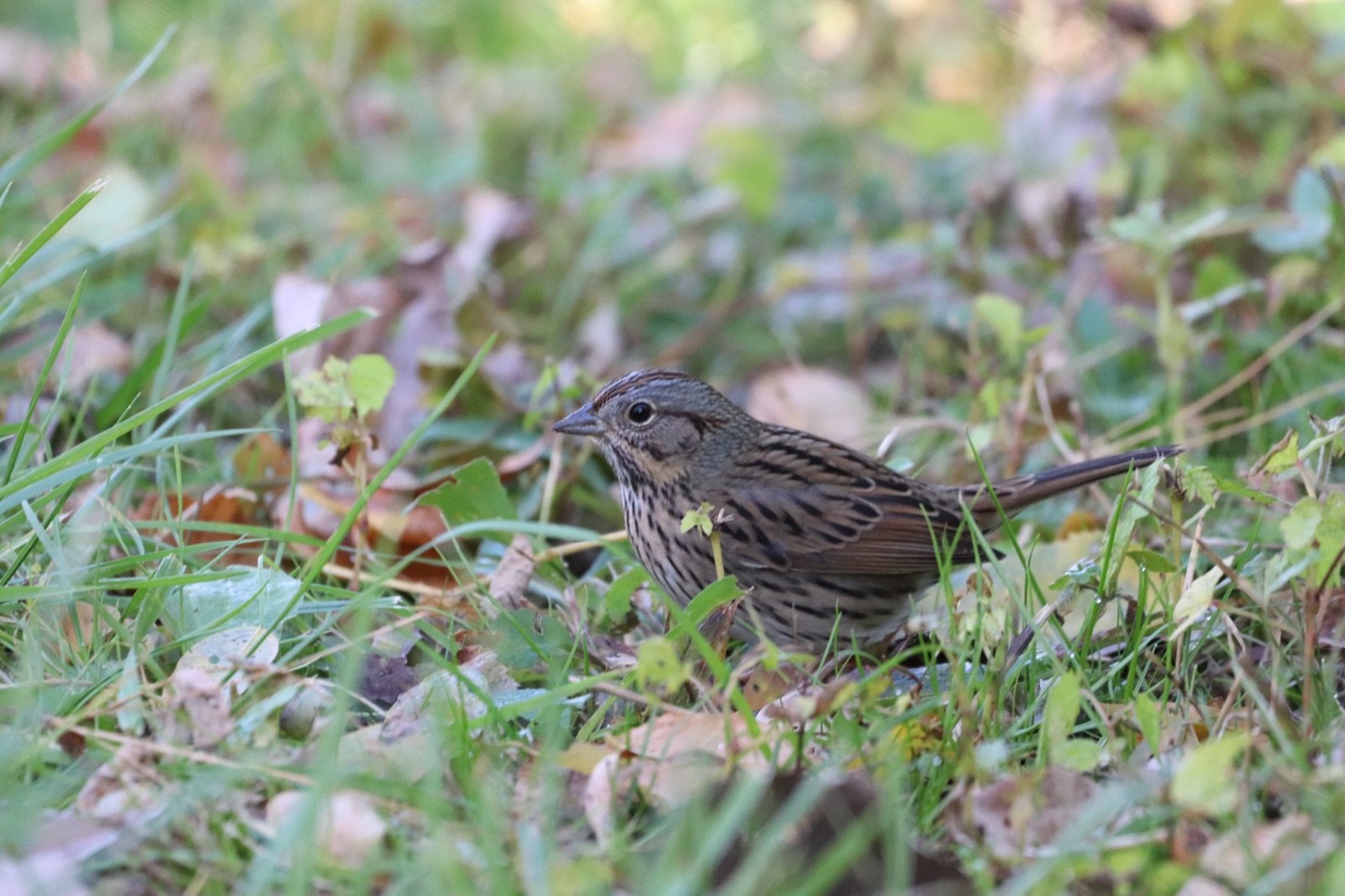
This is a small sparrow, about 13.5 cm long. Look for these marks:
Grayish brown upperparts with black streaks.
Bright brown stripes on the crown and wings.
A narrow whitish eye ring.
Gray sides to the head and neck.
A buffy stripe along the cheek.
Fine streaks on a buffy chest and sides.
Compared with a Rufous-collared Sparrow it is slimmer and has no crest. Costa Rican birders debating photos also point to its fine bill and different color pattern when separating it from a young Rufous-collared.
What it sounds like
Recording: Matt Wallace, CC BY 4.0, source, read 4 Nov 2026.
Behaviour and diet
Lincoln's Sparrow feeds on the ground beneath grass or bushes, looking for seeds and small insects. It is usually alone, but sometimes wanders with Rufous-collared Sparrows, which is one reason to check every flock closely.
Across its range it usually stays low under thick cover, which explains why it so often slips past unnoticed.
Where it lives
In Costa Rica it prefers scrubby areas, either dry or swampy. Reported sites are in the highlands: Monteverde in the Cordillera de Tilarán, and near Cartago and San Pedro de Montes de Oca in the upper Central Valley.
The first Costa Rican records came from the Monteverde area, between about 1390 and 1440 m elevation, in the middle of the Monteverde community. The conservation areas listed for it are Arenal, Cordillera Volcánica Central and Tortuguero.
When to see it
The national bird list gives its stay as mid-November to late February. A Costa Rican guide says November and December seem to be the best months for lost or rare birds, including vagrant sparrows like this one.
Similar birds
The Rufous-collared Sparrow (Zonotrichia capensis) is the usual confusion here, but Lincoln's is slimmer and has no crest. Away from Costa Rica, a Song Sparrow is bulkier and often has a dark central breast spot, while Lincoln's has finer chest streaks and a buffy chest band. Juveniles look much like young Swamp Sparrows, but a Lincoln's rarely has an evenly colored crown.
Names and lore in Costa Rica
The official Costa Rican Spanish name is Sabanero de Lincoln. Elsewhere in Spanish-speaking countries it is called Gorrión de Lincoln, Chingolo de Lincoln or Pinzón de Lincoln.
Status and conservation
The AOCR list marks it as a migrant (M), a rare to casual fall migrant and winter visitor, and its global conservation status is Least Concern.
Photography tips
Patience matters more than gear. Watch low, weedy edges and be ready with binoculars or camera, since spishing or gentle pishing may bring the bird into view only for a short time. The Monteverde bird came out of dense tall grass and showed clearly several times.
How we know this 14 sources, each read on the date shown
- Flickr post quoting a Costa Rican natural history account (not on the allowed source list, please verify) read 2026-11-04
https://www.flickr.com/photos/jobando/39062092794 - Flickr post quoting a Costa Rican natural history account (not on the allowed source list, please verify) read 2026-11-04
https://www.flickr.com/photos/jobando/39771972531 - Cornell Lab, All About Birds read 2026-11-04
https://www.allaboutbirds.org/guide/Lincolns_Sparrow/overview - Sacramento Audubon Society read 2026-11-04
https://www.sacramentoaudubon.org/kids-corner/meet-the-lincoln-sparrow - Wikipedia read 2026-11-04
https://en.wikipedia.org/wiki/Lincoln's_sparrow - Cornell Birds of the World read 2026-11-04
https://birdsoftheworld.org/bow/species/linspa/cur/introduction - FotoNaturaleza forum read 2026-11-04
https://fotonaturaleza.net/foro/?m=t&tid=10748 - Avibase read 2026-11-04
https://avibase.bsc-eoc.org/species.jsp?avibaseid=AF49F8903B6DC7A5 - Wilson Bulletin 1979 read 2026-11-04
https://digitalcommons.usf.edu/cgi/viewcontent.cgi?article=8354&context=wilson_bulletin - Birding Craft read 2026-11-04
http://birdingcraft.com/wordpress/2024/11/27/its-rare-bird-time-in-costa-rica/ - Birding Craft read 2026-11-04
https://birdingcraft.com/wordpress/tag/sunbittern/ - Animalia read 2026-11-04
https://animalia.bio/lincolns-sparrow - Audubon Field Guide read 2026-11-04
https://www.audubon.org/field-guide/bird/lincolns-sparrow - SparrowBirds read 2026-11-04
https://sparrowbirds.com/lincolns-sparrow/