Family Passerellidae
Savannah Sparrow
Passerculus sandwichensis
In Spanish: Sabanero Zanjero
- A
A small streaked sparrow of open ground, and a rare stray here.
The Savannah Sparrow, Sabanero Zanjero in Costa Rican Spanish, is not a bird to plan a day around. The official Costa Rican bird list gives it the status A, accidental, which makes it a rare vagrant rather than a resident or a regional endemic.
Across North America it is a widespread and abundant sparrow of open grassland. Northern breeders winter from the southern United States across Central America and the Caribbean to northern South America, which explains how a stray can end up here.
For a beginning birder it is a useful bird to know: a small, streaked sparrow of fields and pastures, easy to overlook, and a reminder of how many open places nobody has birded closely.
How to find it
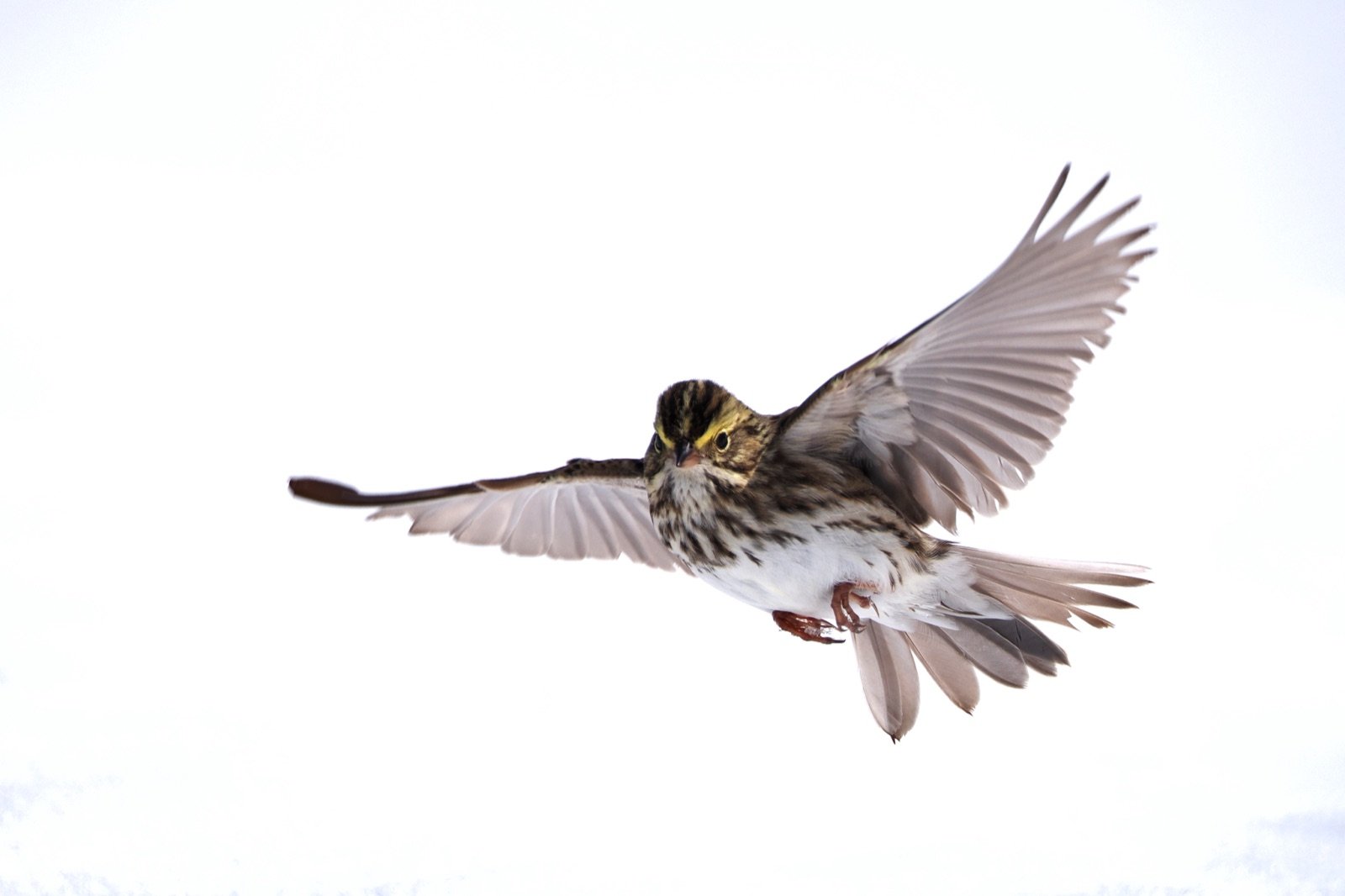
Head for open areas, so think fields and pastures rather than forest. Strays are scattered across thousands of unbirded fields, which is exactly why they are hard to find. Scan fence lines and low perches, where males like to sit. Listen for the thin, high tseep and the buzzy trill. If a streaked sparrow flushes, watch the short tail flare as it circles down. Check the eyebrow, tail shape and breast spot before deciding what you have.
How to recognise it
This is a small sparrow, about 13 cm long, a size given for the species across its range.
Look for these marks together:
Streaked brown back.
White belly with brown streaks on the breast and flanks.
A pale line over the eye, sometimes yellowish near the bill.
A short, notched tail.
Because the yellow tint can be faint, judge the whole pattern rather than one mark. Streaks below, a pale eyebrow and that short tail together point to Savannah rather than to other streaked sparrows.
What it sounds like
Behaviour and diet
Range-wide, this sparrow forages on the ground or in low bushes. It eats mainly seeds, and also insects in the breeding season. Males sing in spring and summer from exposed low perches such as fenceposts. When flushed, the bird flies up, flares its short tail and circles to land some yards away. These habits describe the species in general, not Costa Rican birds, but they are a good guide to what to watch for in an open field.
Where it lives
Across its range it favours open ground such as prairies, pastures and some farm fields, rather than the brushy edges that Song Sparrow prefers. Grassland is its typical habitat. In Costa Rica it has no resident population, so any bird would be a stray in open fields and pastures. A lodge blog says a few birds reach the highlands from the north, but that claim is general and sits oddly with the accidental official status.
When to see it
A Costa Rican birding blog says rare and vagrant birds can turn up in any month, and that November and December seem best for lost birds, including strays among the sparrows. That advice is general, not specific to this species.
Similar birds
Song Sparrow also has a central breast spot, but it lacks the yellow eyebrow, has a longer tail, and is generally darker with coarser flank streaking. Vesper Sparrow shows a white eyering and no pale eyebrow, and has white outer tail feathers in flight, which the Savannah lacks. In Costa Rica it could also be mistaken for other streaked sparrows that stray south, including Lincoln's Sparrow, which has a different status on the Costa Rican list.
Names and lore in Costa Rica
The Costa Rican Spanish name is Sabanero Zanjero. Other Spanish names listed for the species include Gorrión Sabanero and Gorrión de Sabana, and the latter form is used in countries such as Mexico and Colombia.
Status and conservation
The official Costa Rican list (AOCR) gives it the status A, accidental, and an older version of the list did the same.
Photography tips
Stray sparrows are hard to find because they are scattered across thousands of unbirded fields and pastures, so checking open fields and pastures is the way to look. Exposed low perches such as fenceposts are where males sing, which may offer a clear view.
How we know this 14 sources, each read on the date shown
- Lista Oficial de las Aves de Costa Rica (AOCR) read 2026-11-04
https://listaoficialavesdecostarica.wordpress.com/lista-oficial/lista-oficial-online/ - Museo Nacional de Costa Rica read 2026-11-04
https://www.museocostarica.go.cr/nuestro-trabajo/investigaciones/historia-natural/gam/aves/ - Birdwatching in Costa Rica read 2026-11-04
https://birdwatchingincostarica.com/bird-lists/ - Hotel Rivel blog read 2026-11-04
https://hotelrivel.online/un-pedacito-de-norteamerica-en-las-montanas-de-costa-rica-el-gorrion-sabanero-2/ - Wikipedia read 2026-11-04
https://en.wikipedia.org/wiki/Savannah_sparrow - All About Birds, Cornell Lab read 2026-11-04
https://www.allaboutbirds.org/guide/Savannah_Sparrow/overview - Missouri Department of Conservation read 2026-11-04
https://mdc.mo.gov/discover-nature/field-guide/savannah-sparrow - Birds of the World (Cornell) read 2026-11-04
https://birdsoftheworld.org/bow/species/savspa/cur/sounds - All About Birds (Cornell Lab) read 2026-11-04
https://www.allaboutbirds.org/guide/Savannah_Sparrow/id - Naturalista Costa Rica read 2026-11-04
https://costarica.inaturalist.org/taxa/9981-Passerculus-sandwichensis - Avibase read 2026-11-04
https://avibase.bsc-eoc.org/species.jsp?avibaseid=26EB95E7 - Birding Craft (Costa Rica rare birds) read 2026-11-04
http://birdingcraft.com/wordpress/tag/costa-rica-rare-birds/ - Wikipedia read 2026-11-04
https://en.wikipedia.org/wiki/List_of_birds_of_Costa_Rica - Birda read 2026-11-04
https://app.birda.org/species-guide/34846/Savannah_Sparrow