Family Parulidae
MacGillivray's Warbler
Geothlypis tolmiei
In Spanish: Reinita de Tupidero
- Migrant
A skulking gray-hooded winter visitor, easily mixed up with Mourning Warbler.
MacGillivray's Warbler, known here as Reinita de Tupidero, is a migrant that visits Costa Rica from the north and does not breed in the country. Visitors are most likely to meet it in brushy highland habitats, not in lowland forest.
It is fairly uncommon and greatly outnumbered by the very similar Mourning Warbler, so the real challenge is the identification. On a trip we build, a bird like this is a bonus to check carefully, not a target to count on.
How to find it
Look in brushy highland habitats rather than lowland forest. Open forest is a poor place to look, because the bird forages inside dense vegetation and on the ground. Try thickets, shrubbery and tangles along wooded streams. Listen for the hard tik or tsik, since this is usually how the bird is found. Then check every Mourning Warbler carefully for the white eye arcs.
How to recognise it
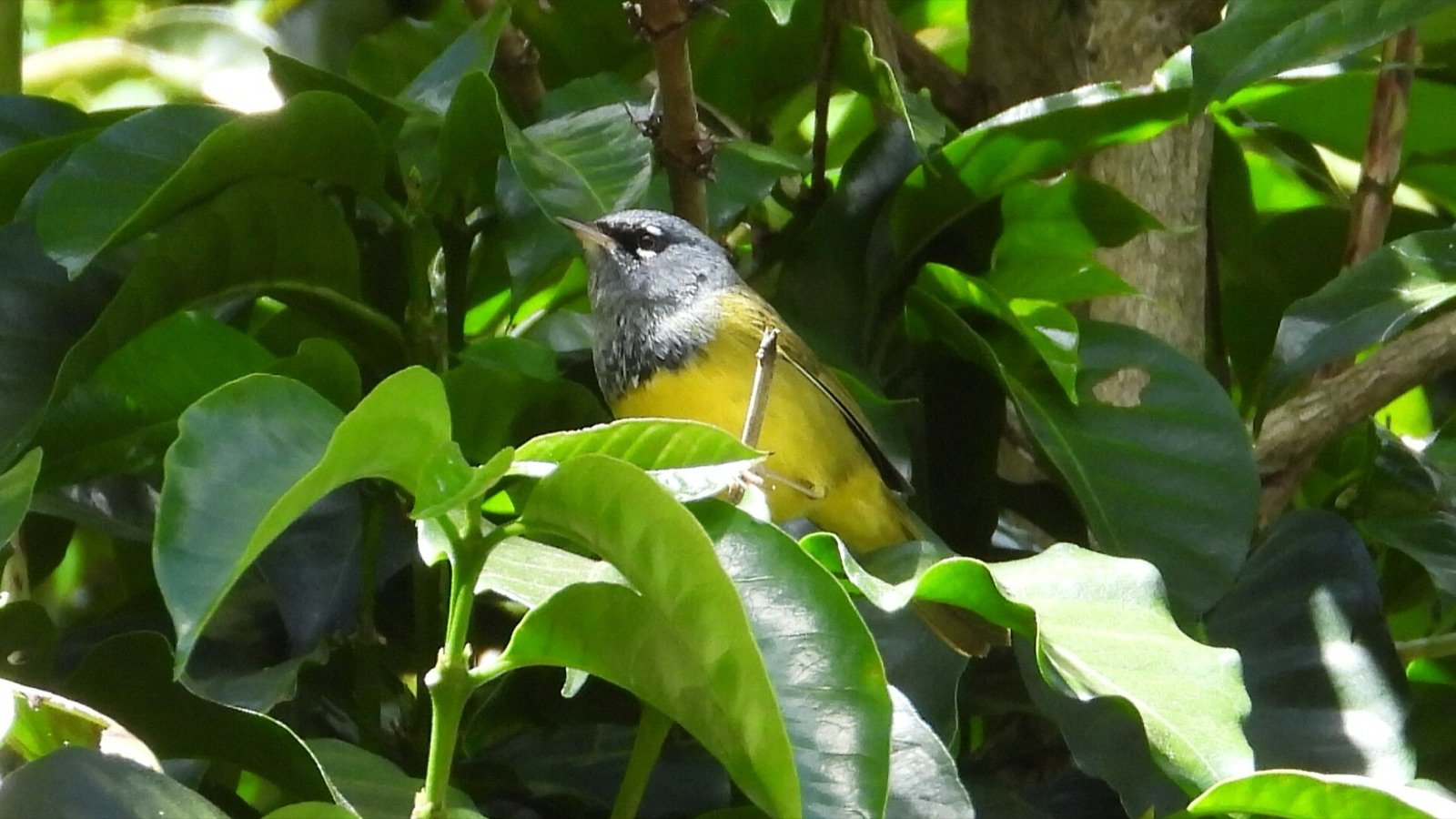
Adults are olive above and yellow below, with a full gray hood. The best mark is the pair of sharp white crescents above and below the eye, and it is the feature that separates this bird from Mourning Warbler.
The female is a paler version of the male. Her upperparts are greyer green and her white eye arcs are fainter.
The male Mourning Warbler's gray hood looks very similar, and Mourning is far more frequent in Costa Rica. Do not assume every gray-hooded warbler is MacGillivray's. Look for the eye arcs every time.
What it sounds like
Behaviour and diet
This is a shy skulker of dense brush and it is hard to see. It stays on or near the ground in dense cover and feeds mainly on insects, gleaning them from foliage and low vegetation. It hops on the ground when hunting and flicks its tail from side to side as it forages.
On the wintering grounds each bird defends a feeding territory and usually forages alone. Birders usually locate it by its call or song, and males sing from open or hidden perches in the understory.
Where it lives
In Costa Rica and the rest of Central America, this warbler winters mainly on the Pacific slope and in the highlands, ranging south to Panama. On its wintering grounds it uses early-growth habitat such as dense brush, scrub, field edges and streamside strips. In the tropics it is also found in forest undergrowth in foothills and mountains. In Costa Rica, visitors are most likely to meet it in brushy highland habitats.
When to see it
Birds arrive on the wintering grounds from late August or early September.
Similar birds
Mourning Warbler is nearly identical but lacks the clear white arcs around the eye. Both species are migrants in Costa Rica, and Mourning is the far more frequent of the two. The song of MacGillivray's is longer and more complex, with more syllables.
Names and lore in Costa Rica
Costa Ricans call it Reinita de Tupidero. In other countries it has other Spanish names, such as chipe de MacGillivray in Honduras, reinita orejuda in Nicaragua and chipe lores negros in Mexico.
Status and conservation
The AOCR list marks it as a migrant (M), meaning it visits from the north and does not breed in Costa Rica.
Photography tips
Because it forages inside dense vegetation and on the ground, patience at the edge of a thicket works better than walking open forest. Try tangles along wooded streams and listen for a singing male in the understory.
How we know this 16 sources, each read on the date shown
- Birdwatching in Costa Rica (official list) read 2026-11-04
https://birdwatchingincostarica.com/bird-lists/ - Municipalidad de Turrialba, bird guide read 2026-11-04
https://www.muniturrialba.go.cr/docs/turismo/Guia%20de%20Aves%20de%20Turrialba%202020.pdf - Cloudbridge Nature Reserve read 2026-11-04
https://www.cloudbridge.org/wp-content/uploads/2020/04/Bird-Species-List-Costa-Rica-13-April-2020.pdf - Wikipedia (Spanish) read 2026-11-04
https://es.wikipedia.org/wiki/Oporornis_tolmiei - Cornell Birds of the World read 2026-11-04
https://birdsoftheworld.org/bow/species/macwar/cur/introduction - Audubon Field Guide read 2026-11-04
https://www.audubon.org/field-guide/bird/macgillivrays-warbler - BWD Magazine read 2026-11-04
https://bwdmagazine.com/species/macgillivrays-warbler/ - Bird Watching Academy read 2026-11-04
https://www.birdwatchingacademy.com/blogs/blog/macgillivrays-warbler - Animal Diversity Web read 2026-11-04
https://animaldiversity.org/accounts/Oporornis_tolmiei/ - Oiseaux-Birds read 2026-11-04
https://www.oiseaux-birds.com/card-macgillivray-s-warbler.html - Aves y Ventanas Costa Rica read 2026-11-04
https://avesyventanascostarica.wordpress.com/2020/10/09/aves/ - Birdquest Ultimate Costa Rica Tour Report 2024 read 2026-11-04
https://www.birdquest-tours.com/birding-tour-reports/costa-rica-classic-2024/ - 10,000 Birds read 2026-11-04
https://www.10000birds.com/the-wintering-wood-warblers-of-costa-rica.htm - Birds for Beer read 2026-11-04
https://birdsforbeer.com/2018/05/26/from-costa-rica-to-minnesota-12-migrant-warblers/ - Cornell All About Birds read 2026-11-04
https://www.allaboutbirds.org/guide/MacGillivrays_Warbler/id - BirdWeb read 2026-11-04
https://birdweb.org/birdweb/bird/macgillivrays_warbler