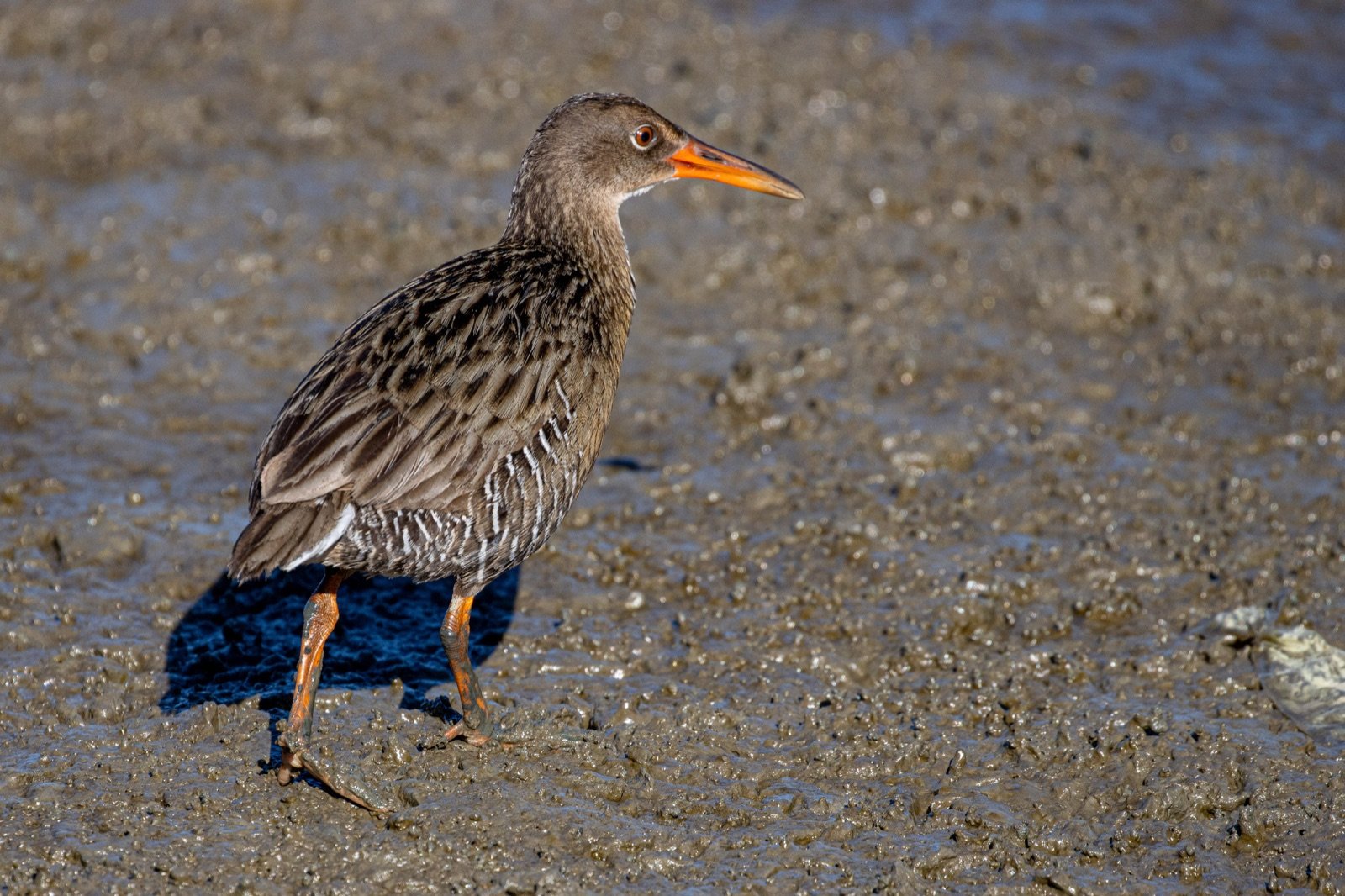
Family Rallidae
Mangrove Rail
Rallus longirostris
In Spanish: Rascón Picudo
- Resident
A shy rail of the northwest Pacific mangroves, nesting at Chomes.
The Mangrove Rail, or Rascón Picudo, is a medium-large rail of Costa Rica's northwest Pacific coast. The official Costa Rican bird list gives it as a resident species, yet before 2015 it was listed as a migrant with no specimens or photos.
That changed in June 2015, when the first proven nest in the country was found in the mangroves of Chomes, Puntarenas, on the Gulf of Nicoya. The Official List committee published photos of it.
On a trip we build around the Gulf of Nicoya coast, Chomes and Puerto Morales are the stops where a beginner can try for it, scanning the short black mangroves early in the day.
How to find it
At Chomes and Puerto Morales, check the short, scrubby black mangroves, where the rail lurks in the thick growth. Go early and scan the edges of that habitat. Listening to the Costa Rican recordings beforehand will help you pick out its calls. Keep the bill shape and the barred flanks in mind so that even a brief view counts.
How to recognise it
Mangrove Rail is a medium-large rail, about 36 to 41 cm long across its range. Another reference gives about 33 cm and a weight of 260 to 310 g, so treat size as approximate.
Look for these marks:
- grayish brown upperparts overall
- a reddish chest
- a whitish belly
- black and white bars on the flanks
- a long bill that curves slightly down, dark above and orange to reddish below
- light orange-red legs
The bill gives the Spanish name Rascón Picudo. If you only get a short view, try to catch the bill shape and the reddish chest together.
The Honduran subspecies is the only Mangrove Rail with a dusky breast band. Costa Rican birds are presumed to be the same subspecies, though specimens are needed to confirm it.
What it sounds like
Recording: Jennifer Rycenga, CC BY 4.0, source, read 4 Nov 2026.
Behaviour and diet
The natural history of Mangrove Rail is presumably much like that of Clapper Rail, but it has been studied far less, so much of what is known is borrowed from its relative.
Rails in general are shy and secretive, and this one lurks in dense mangrove growth. It forages on foot, sometimes probing shallow brackish water or mud with its long bill. The nest is made of small sticks among mangrove roots, very close to the water, and a clutch is 3 to 7 purple eggs with ochre spots.
Where it lives
As the name suggests, this rail lives mainly in mangroves, and it also uses coastal saline lagoons. That describes the species in general.
The Pacific coast population runs from El Salvador to northwestern Costa Rica, and Birds of the World describes it as only recently discovered. In Costa Rica it is a northwest Pacific bird, and the documented birds are in the mangroves of Puntarenas on the Gulf of Nicoya coast.
Similar birds
Mangrove Rail was once treated as a subspecies of Clapper Rail, but a genetic study showed they are separate species. Clapper Rail is only a rare or accidental visitor in Costa Rica. A Costa Rica field guide shows Mangrove Rail next to Russet-naped, Gray-cowled and Rufous-necked Wood Rails. The wood rails are larger, and Rufous-necked Wood Rail is also a mangrove bird, so check size and bill carefully.
Names and lore in Costa Rica
The official Costa Rican Spanish name is Rascón Picudo. Other Spanish names used elsewhere in Latin America include Rascón de Manglar, Rascón Manglero, Pollo de Manglar and Polla de Mangle.
Status and conservation
The official Costa Rican bird list (AOCR) gives Mangrove Rail (Rascón Picudo) as a resident species.
Photography tips
Go early and work the edges of the short, scrubby black mangroves, where the rail lurks in thick growth. Patience at the edge of cover suits a shy bird, and knowing the calls beforehand helps you locate it.
How we know this 16 sources, each read on the date shown
- Cornell Birds of the World read 2026-11-04
https://birdsoftheworld.org/bow/species/manrai1/cur/introduction - Birds Colombia (citing Wikipedia) read 2026-11-04
https://birdscolombia.com/2022/06/27/rascon-manglero-mangrove-rail-rallus-longirostris/ - dibird.com read 2026-11-04
https://dibird.com/species/mangrove-rail/ - Cornell Birds of the World (Spanish) read 2026-11-04
https://birdsoftheworld.org/bow/species/manrai1/cur/introduction?lang=es - Lista Oficial de las Aves de Costa Rica (AOCR) read 2026-11-04
https://listaoficialavesdecostarica.wordpress.com/lista-oficial/lista-oficial-online/ - Birding Craft read 2026-11-04
https://birdingcraft.com/wordpress/category/mangroves/ - Birds of Costa Rica (Howell et al.), excerpt read 2026-11-04
https://dokumen.pub/birds-of-costa-rica-9780691243351.html - Avibase read 2026-11-04
https://avibase.bsc-eoc.org/species.jsp?avibaseid=89DB7F74E2C61252&avibaseid=89DB7F74E2C61252 - Western Field Ornithologists (Fonseca Mangrove Rail paper) read 2026-11-04
https://archive.westernfieldornithologists.org/archive/V47/47(4)-p262-p273.pdf - Lista Oficial de las Aves de Costa Rica read 2026-11-04
https://listaoficialavesdecostarica.wordpress.com/nuevos-registros/ - Revista Minerva, Universidad de El Salvador read 2026-11-04
https://revistas.ues.edu.sv/index.php/minerva/article/download/2443/2423/6038 - Maley et al. 2016, Fonseca Mangrove Rail read 2026-11-05
https://web.corral.tacc.utexas.edu/arctos-s3/ewommack/2019-11-27/Maleyetal2016.pdf - ArgentiNat (Spanish summary) read 2026-11-05
https://www.argentinat.org/taxa/367714-Rallus-longirostris - Wikipedia read 2026-11-05
https://en.wikipedia.org/wiki/Mangrove_rail - Avibase Costa Rica checklist read 2026-11-05
https://avibase.bsc-eoc.org/checklist.jsp?region=CR - Wikipedia, List of birds of Costa Rica read 2026-11-05
https://en.wikipedia.org/wiki/List_of_birds_of_Costa_Rica