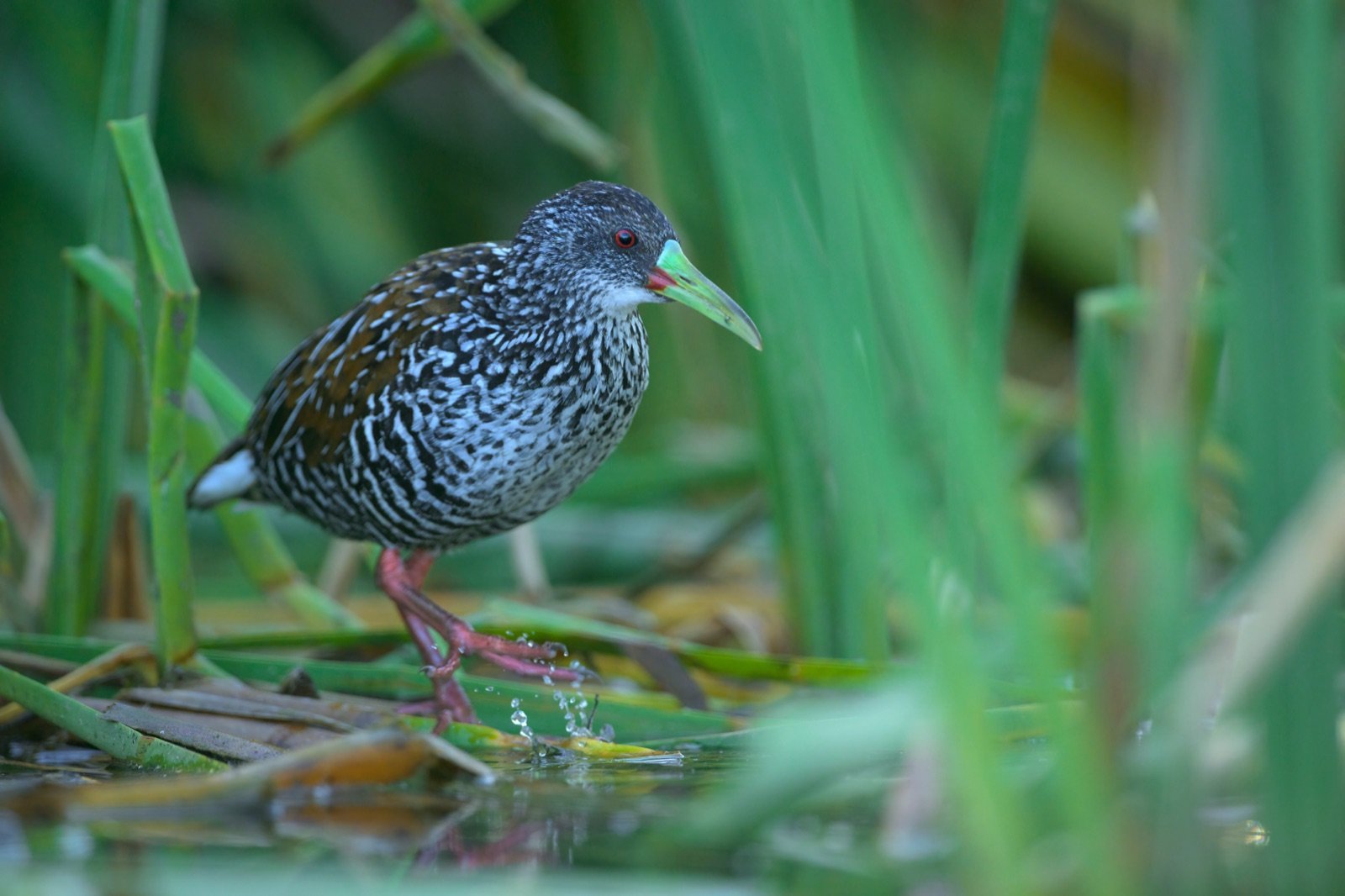
 Spotted Rail
Family Rallidae
Spotted Rail
Pardirallus maculatus
In Spanish: Rascón Moteado
- Resident
A black and white marsh rail that steps out of the reeds when the water drops.
The Spotted Rail (Rascón Moteado) is a resident of Costa Rica's freshwater marshes, and a shy one. It hides among reeds, grasses and smartweed, and it mostly walks and runs rather than flying, so it is hard to see.
Medio Queso wetland, near Los Chiles in the Huetar Norte region, is named as the best place in the country to look for it. On a trip we build around the north, a boat ride with a local boatman who knows the marsh is how guests get their chance.
When water levels fall, the rail leaves cover and feeds at the canal edge, and a bird that is normally almost impossible to spot becomes a real possibility.
How to find it
Look at dawn, at dusk, or on dark rainy days along the edges of dense vegetation. At Medio Queso, near Los Chiles, birders see Spotted Rail on a boat trip with a local boatman. Visitors in the low-water months got close views without using playback. Without the boat, birding is limited to the dike. To reach the wetland, take the gravel road east from the Los Chiles airport; it ends at the Medio Queso river, which has no bridge, so do not drive into it. The dirt roads around the area are also worth exploring.
How to recognise it
Adults are 25 to 28 cm long. Look for these marks:
Head and neck: black with white spots.
Back: brown and black with long white streaks.
Wings: dark brown feathers.
Underparts: barred black and white.
Legs: red.
Bill: long, slightly downcurved and yellowish, with red at the base of the lower bill.
The plumage is considered unmistakable, so the challenge is getting a look through the vegetation, not telling it from other birds.
What it sounds like
Recording: Niels Krabbe, CC BY-SA 4.0, source, read 5 Nov 2026.
Behaviour and diet
The Spotted Rail is shy but not especially timid. It may come close to an observer inside dense vegetation, yet it rarely goes into open spots. It mostly walks on the ground and runs fast, which is why it is so hard to see.
It forages in shallow water or along the water's edge. In the morning it may feed in the open on mud or in water near cover. It moves locally in response to changing water levels.
Where it lives
In Costa Rica it lives in freshwater marshes, hiding among reeds, grasses or patches of smartweed (Polygonum). Across its wider range it also uses swamps, rice fields, grassy ditches and wet grasslands. One Costa Rican site had grass roughly 45 cm to 1 m tall.
Costa Rican natural history notes describe a likely wide but patchy range on both slopes. Confirmed records come from the Tempisque river basin, near Cartago and Turrialba, and the Río Frío area. The Huetar Norte, Tempisque, Arenal and Cordillera Volcánica Central conservation areas are listed as part of its distribution.
When to see it
A Costa Rican bird was recorded in breeding condition in July. At Medio Queso, birders got close views in late March and April, when water levels were low, and March to early May is described as best there. High water later made a visit too late for the rails.
Similar birds
Among its relatives, the Spotted Rail is the one that is blackish-brown with white markings. The Blackish and Plumbeous Rails are brown above and dark grey below.
Names and lore in Costa Rica
Costa Rican lists use Rascón Moteado. Locals call the Medio Queso wetland El Roble and go there to fish on weekends, while local ornithologists use the name Humedal Medio Queso, which is also where Spotted Rail is looked for.
Status and conservation
The official Costa Rican bird list gives it resident status, and it is described as locally common here and rated Least Concern globally.
Photography tips
At Medio Queso in March, as water drops, hidden birds like Spotted Rail leave cover and feed at the canal edge. Late March and April are best, and a boat is the way to get close. Birders have had close, sharp-focus views from the boat when water was low.
How we know this 18 sources, each read on the date shown
- Flickr (Historia Natural text, Finca Las Trancas, Liberia) read 2026-11-04
https://www.flickr.com/photos/jobando/35885306255 - Medio Queso wetland article (acopaf.site) read 2026-11-04
https://acopaf.site/ojs3/index.php/cyp/article/download/35/26/139 - Birds Colombia (quoting Birds of the World) read 2026-11-04
https://birdscolombia.com/2022/08/18/rascon-overo-spotted-rail-pardirallus-maculatus/ - Wikipedia (translated copy) read 2026-11-04
https://translate.google.com/translate?u=https%3A%2F%2Fen.wikipedia.org%2Fwiki%2FSpotted_rail&hl=es&sl=en&tl=es&client=srp - Peru Aves read 2026-11-04
https://www.peruaves.org/rallidae/spotted-rail-pardirallus-maculatus/ - Wikipedia read 2026-11-04
https://en.wikipedia.org/wiki/Spotted_rail - Lista Oficial de las Aves de Costa Rica (AOCR) read 2026-11-04
https://listaoficialavesdecostarica.wordpress.com/lista-oficial/lista-oficial-online/ - Wikipedia (Pardirallus) read 2026-11-04
https://en.wikipedia.org/wiki/Pardirallus - Birdingcraft read 2026-11-04
http://birdingcraft.com/wordpress/2015/05/28/good-reasons-for-birding-cano-negro-costa-rica/ - Costa Rica Focus read 2026-11-04
https://www.costaricafocus.com/birding-cano-negro-costa-rica-a-complete-guide/ - 10,000 Birds read 2026-11-04
https://www.10000birds.com/the-birding-is-always-good-at-cano-negro-costa-rica.htm - Field Guides tour report read 2026-11-04
https://fieldguides.com/triplists/cr223.html - Avibase read 2026-11-04
https://avibase.bsc-eoc.org/species.jsp?avibaseid=E202D7602E6A0B16 - Birding Craft read 2026-11-04
https://birdingcraft.com/wordpress/tag/cano-negro/ - Birding Craft read 2026-11-04
https://birdingcraft.com/wordpress/category/costa-rica-bird-finding-guide/ - Ecosistemas de Costa Rica read 2026-11-04
https://ecosistemasdecostarica.blogspot.com/2012/08/aves.html - Costa Rica Guide read 2026-11-04
https://costa-rica-guide.com/nature/refuges/cano-negro/ - Manuel Antonio Birding (Johan Chaves) read 2026-11-04
https://manuelantoniobirding.wordpress.com/2015/12/17/birding-la-fortuna-medio-quesolos-chiles-part-3-of-3-medio-queso/