Family Tityridae
Masked Tityra
Tityra semifasciata
In Spanish: Tityra Carirroja (Pájaro Chancho, Calandria)
- Resident
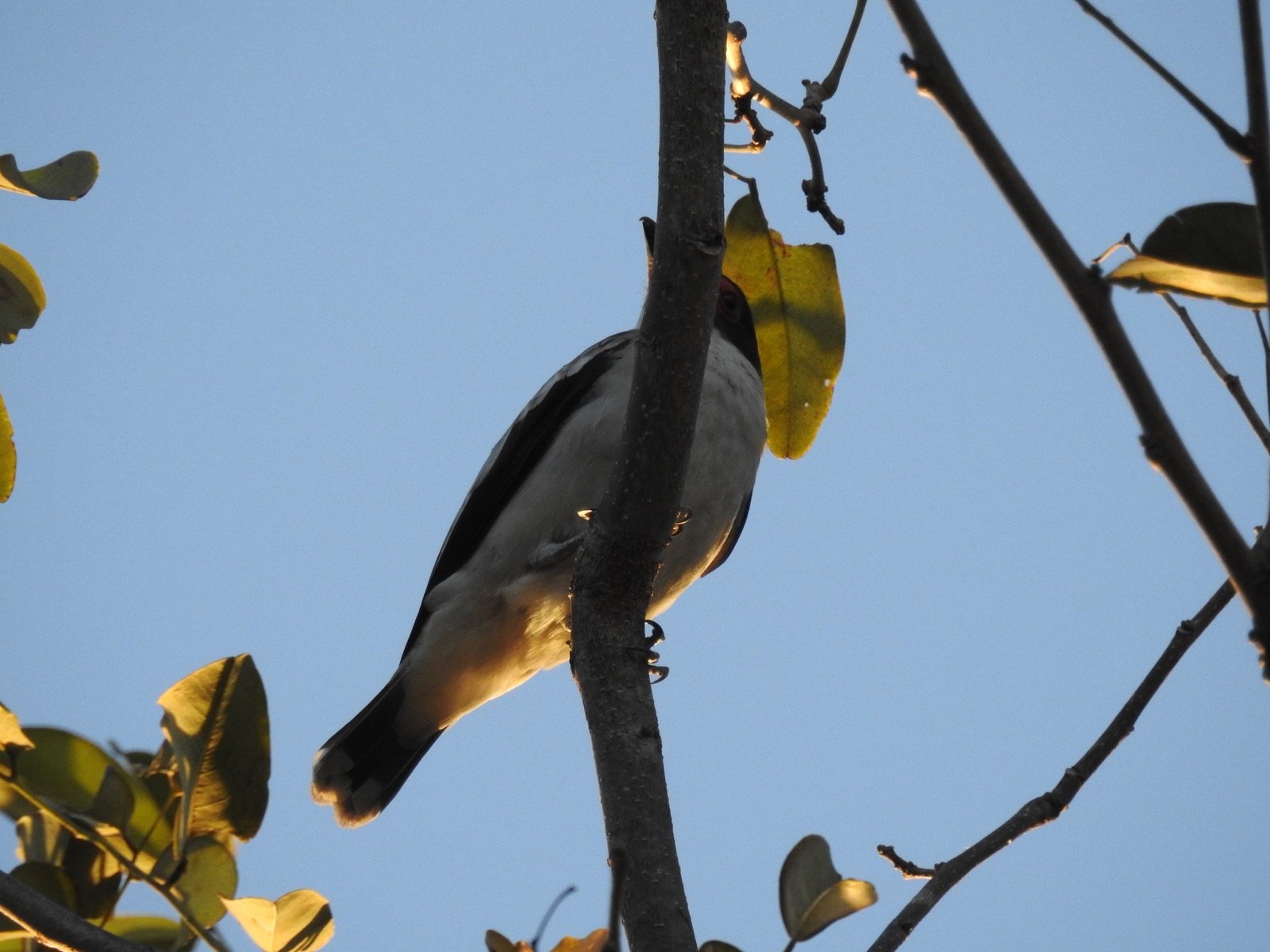
Pale treetop bird with red face skin, common on both slopes
The Masked Tityra is a sturdy, large-headed bird of about 21 cm with bare red skin at the face. Costa Ricans know it as pájaro chancho, the pig bird, for its grunting call.
It is a common resident of lowlands and middle elevations on both slopes, so it is a very reasonable bird to hope for on a first trip. Scan the crowns of tall trees at forest edges and in gardens.
How to find it
Look for pairs perched in exposed treetops, and scan the crowns of tall trees at forest edges and in gardens. Check fruiting trees for white birds with red face skin. Its high, piping whistles are a useful cue for locating it. On a trip we build, a fruiting fig in a lodge garden can bring one in close and low.
How to recognise it
Males are pale grayish white with black on the forecrown and bare rosy red skin around the eye. The bill is red with a black tip, and the tail has a wide black band near the end. Females have the same red face skin but no black on the head. Their head is smoky gray and their upperparts are darker gray with brown streaks. In Costa Rica the bird looks sturdy and large-headed, about 21 cm long, with a banded tail. The base of the bill and the skin in front of the eye are red.
What it sounds like
Behaviour and diet
It eats mostly fruit, plus some invertebrates and occasionally small lizards. In Costa Rica that means figs, fruits of the laurel family, large insects, dragonflies and spiders. It forages alone, in pairs or in small groups, from the mid-story to the canopy, and it does not usually join mixed flocks. It flies out from a perch to pluck its food from foliage, and it often sits still for long periods.
Where it lives
It lives in the canopy and edges of forest, old secondary forest, gallery forest, farmland, coffee plantations and savanna. It is a common resident of lowlands and middle elevations on both slopes, in wet and dry regions. It reaches about 1500 m on the Caribbean side and 1850 m on the Pacific side, rarely 2300 m. It is now seen more often around towns and gardens.
When to see it
Breeding in Costa Rica runs from March to July, and the bird is likely most active and visible then. In the breeding season it forms small groups, mostly of males.
Similar birds
The Black-crowned Tityra is the similar species in Costa Rica, but it is seen far less often. It has no pink in the face and has black or brown on the head, and its call is higher pitched than the Masked's.
Names and lore in Costa Rica
Costa Ricans call it pájaro chancho, the pig bird, and also calandria. One news piece calls it Teresita. The AOCR Spanish name is Tityra Carirroja.
Status and conservation
It is a resident (R) on the AOCR list, rated Least Concern by the IUCN, and common and widespread in Costa Rica.
Photography tips
Its pale plumage blends with the bright sky, so shoot with that contrast in mind. It often sits still for long periods, which allows close views, and it returns to a favorite perch after short flights for food. A canopy tower can give views at about eye level.
How we know this 21 sources, each read on the date shown
- Wikipedia read 2026-11-04
https://en.wikipedia.org/wiki/Masked_tityra - Aves de Costa Rica read 2026-11-04
https://avesdecostarica.com/Tityra-semifasciata.html - Earthlife read 2026-11-04
https://earthlife.net/masked-tityra/ - Wikipedia (Spanish) read 2026-11-04
https://es.wikipedia.org/wiki/Tityra_semifasciata - Project Noah (Aves de Costa Rica text) read 2026-11-04
https://projectnoah.org/spottings/9036628 - AVoCet (Michigan State University) read 2026-11-04
https://avocet.integrativebiology.natsci.msu.edu/recordings/13884 - Aves Ibericas read 2026-11-04
https://www.avesibericas.es/costaricaaves7.htm - Flickr (Costa Rica bird photo) read 2026-11-04
https://www.flickr.com/photos/antpitta/35631611314 - Animalia.bio read 2026-11-04
https://animalia.bio/masked-tityra - Birds of the World (Cornell) read 2026-11-04
https://birdsoftheworld.org/bow/species/mastit1/cur/introduction - Birds for Beer read 2026-11-04
https://birdsforbeer.com/2015/11/25/black-crowned-tityra-at-casa-turire/ - Meadowhawk blog read 2026-11-04
https://meadowhawk.wordpress.com/2023/04/26/costa-rica-a-birding-day-on-the-resort/ - Field Guides Birding Tours read 2026-11-04
https://fieldguides.com/triplists/crh21b.html - San Vito Bird Club read 2026-11-04
https://sanvitobirdclub.org/tag/laughing-falcon/ - Field Guides Birding Tours read 2026-11-04
https://fieldguides.com/triplists/cr217.html - El Jornal CR read 2026-11-04
https://eljornalcr.com/el-lujo-de-fotografiar-a-la-teresita/ - Cloudbridge Nature Reserve read 2026-11-04
https://www.cloudbridge.org/wp-content/uploads/2020/04/Especies-de-Aves-Costa-Rica-13-April-2020.pdf - Ecos del Bosque read 2026-11-04
https://ecosdelbosque.com/fauna/tityra-semifasciata - Birds & Breakfast Costa Rica read 2026-11-04
https://birdsandbreakfast.com/en/masked-tityra/ - La Iguana Golf Course local bird guide read 2026-11-04
https://www.golflaiguana.com/wp-content/uploads/sites/9272/2023/10/Wildlife_page.pdf - Animal Diversity Web / Naturesongs read 2026-11-04
https://www.animaldiversity.org/collections/contributors/naturesongs/mati2/