Family Tityridae
Black-crowned Tityra
Tityra inquisitor
In Spanish: Tityra Coroninegra (Pájaro Chancho)
- Resident
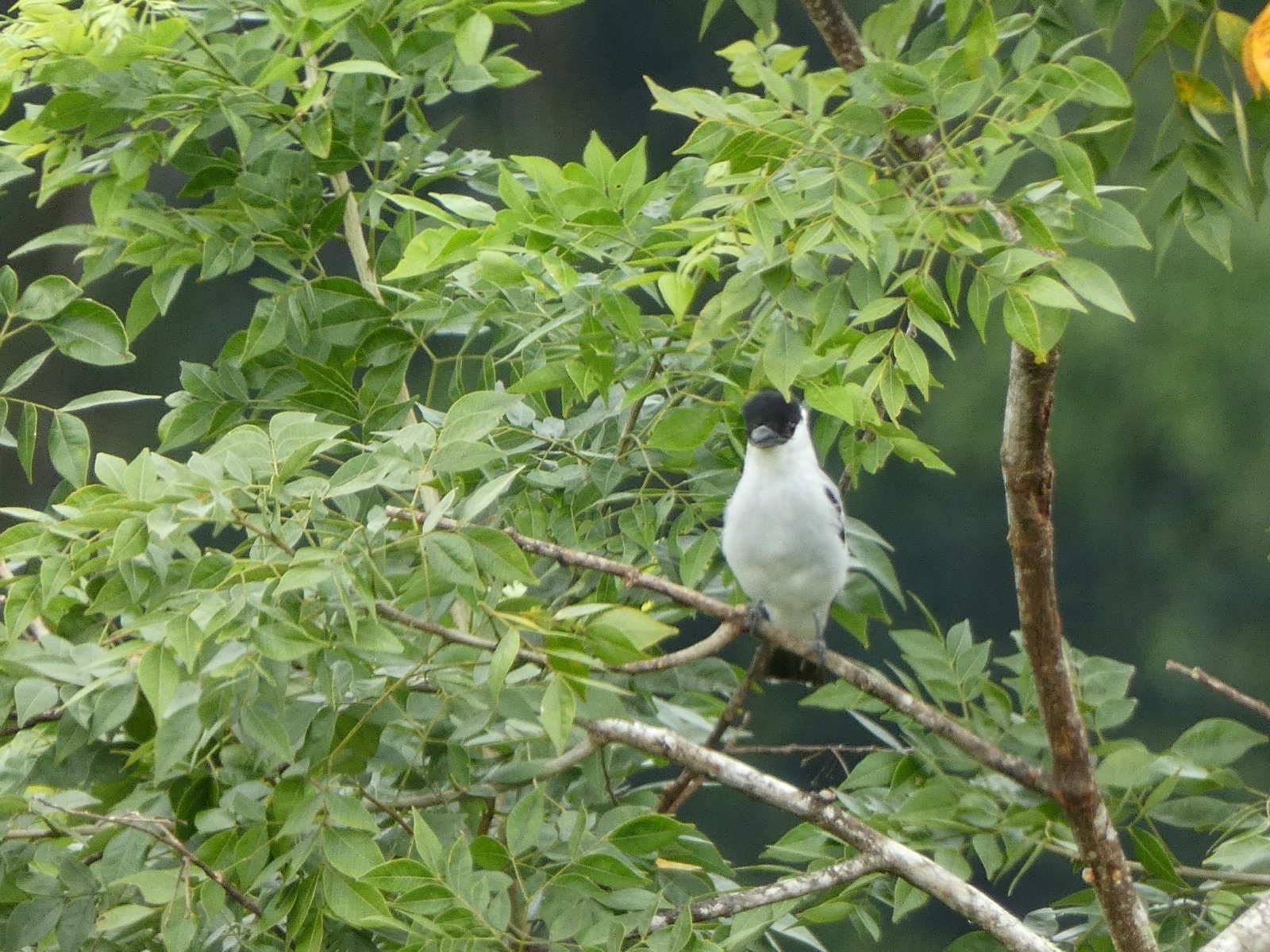
The pale tityra with a black crown and no red on its face or bill.
Costa Rica has only two tityras, and the Black-crowned is the less common one. It is easy to overlook among the many Masked Tityras, so every small white bird in a treetop deserves a second look for a black crown and no red.
It is a resident of the lowlands on both the Caribbean and Pacific slopes. On a trip we build, you meet it by scanning tall treetops and dead branches in open country such as gardens and secondary forest, where it often perches in pairs.
Costa Ricans call it Pájaro Chancho, the pig bird, a nickname it shares with the Masked Tityra.
How to find it
Look for it perched on top of tall trees or dead branches in open areas such as gardens and secondary forest. It is easy to spot there, often in pairs. Scan treetops methodically, as guides on southern lowland tours have done at a river bridge and along a lodge entrance road. Near Turrialba, treat any small, mostly white bird in the treetops as a likely tityra, then check each one for a black crown and no red face. There it sits at lower elevations than the Masked Tityra and is sometimes seen close to it. Garden visits near Turrialba can turn it up.
How to recognise it
The key mark is on the face. Both sexes have a black crown, and it is the only tityra with no red on the face or bill. The Masked Tityra has red face skin and a bill base that is red.
The male has a black cap, a white nape, a pale gray back and white underparts. The tail is white with a black band near the tip, and a white patch on the wing shows in flight.
The female has a rusty or cinnamon face and forehead with a dark crown, and her upperparts are a streaky brownish gray.
It is about 18.5 cm long, smaller than the Masked Tityra, and its bill is very thick. Immatures have a pale face and only a little black on the crown.
Behaviour and diet
You will see it alone or in pairs in the canopy, and in Costa Rica pairs are the usual sight. It does not join mixed flocks, though it may share a fruiting tree with other fruit eaters. It often perches in the open, which is what makes it findable.
It eats mostly small fruits. It also searches foliage for a big insect or caterpillar, then flies out to catch it. It will come to fruit feeders.
It nests in old woodpecker holes or similar tree cavities, 12 to 30 m up. A male photographed at Boca Tapada carried a leaf, probably nesting material, which fits that habit.
Where it lives
In Costa Rica it is a resident of the lowlands on both slopes. It is widespread but fairly uncommon up to about 1,200 m, and it rarely climbs as high as 1,220 m.
Across its range it favors humid lowland forest edges, clearings with scattered tall trees, secondary growth and wooded pastures, and it tends to avoid dense interior forest. That is why gardens, pastures and river banks are better bets than deep woodland.
It has been recorded in the Caribbean lowlands, on the Pacific side and on the Turrialba volcano slopes.
When to see it
Breeding in Costa Rica runs from March to June. Around Turrialba, a male was recorded in March and an immature in early July.
Similar birds
The Masked Tityra is the bird to rule out. It has red facial skin and a red bill with a black tip, while the Black-crowned has a black crown and no red. Immatures can be mistaken for the much more common female Masked Tityra. On a far north tour, two Black-crowned Tityras perched beside a Masked Tityra along a river bank, a rare side-by-side comparison.
Names and lore in Costa Rica
Costa Rican lists give the Spanish name as Tityra Coroninegra, with Pájaro Chancho ("pig bird") in brackets, a nickname also used for the Masked Tityra. One Costa Rican photographer says the bird gets that name because of its particular sound.
Status and conservation
On the AOCR list it is a resident (R), IUCN lists it as Least Concern, and in Costa Rica it is widespread but fairly uncommon.
Photography tips
Perched birds on tall treetops and dead branches in open areas are the best chance, since it often sits exposed, usually in pairs. Check every white bird for the crown and face before you raise the camera.
How we know this 21 sources, each read on the date shown
- Costa Rica Birding Trips read 2026-11-04
https://www.costaricabirdingtrips.com/tityridae/black-crowned-tityra-tityra-inquisitor - Aves de Costa Rica read 2026-11-04
http://www.avesdecostarica.com/Tityra-inquisitor.html - Ecoregistros read 2026-11-04
https://www.ecoregistros.org/sheet/Tityra-inquisitor&idlugar=6024 - Birds for Beer read 2026-11-04
https://birdsforbeer.com/2020/07/29/black-crowned-tityra/ - EcuRed read 2026-11-04
https://www.ecured.cu/Tityra_inquisitor - Aves Ibericas (Arenal, La Selva); also http://www.avesdecostarica.com/Tityra-inquisitor.html (Boca Tapada), https://animalia.bio/black-crowned-tityra (Carara), https://macaulaylibrary.org/asset/612949637 (Laguna del Lagarto Lodge), https://birdsforbeer.com/2020/07/29/black-crowned-tityra/ (Turrialba) read 2026-11-04
https://www.avesibericas.es/costaricaaves7.htm - Wikipedia read 2026-11-04
https://en.wikipedia.org/wiki/Black-crowned_tityra - Birds for Beer read 2026-11-04
https://birdsforbeer.com/2015/11/25/black-crowned-tityra-at-casa-turire/ - Field Guides tour report, Deep South 2024 read 2026-11-04
https://fieldguides.com/triplists/cr124PRINT.html - Field Guides tour report, Far North 2017 read 2026-11-04
https://fieldguides.com/triplists/cr217.html - Field Guides tour report, Rancho Naturalista 2021 read 2026-11-04
https://fieldguides.com/triplists/crh21b.html - Field Guides tour report, Deep South 2023 read 2026-11-04
https://fieldguides.com/triplists/cr123.html - Holistic Birding read 2026-11-04
https://holisticbirding.wordpress.com/black-crowned-tityra-tityra-inquisitor/ - La Carolina Lodge bird list (official Costa Rica list) read 2026-11-04
https://lacarolinalodge.com/wp-content/uploads/2019/10/Lista-de-Aves-LCL.pdf - TikTok @lmatarrita read 2026-11-04
https://www.tiktok.com/@lmatarrita/video/7209736380572814597 - NaturalistaUY (from Wikipedia) read 2026-11-04
https://www.naturalista.uy/taxa/8823-Tityra-inquisitor - Wikipedia read 2026-11-04
https://en.wikipedia.org/wiki/Black-crowned_Tityra - Ecos del Bosque read 2026-11-04
https://ecosdelbosque.com/fauna/tityra-inquisitor - Flickr (Brad Weinert) read 2026-11-04
https://www.flickr.com/photos/herpindiego/7984550258/ - Birds for Beer read 2026-11-04
https://birdsforbeer.com/2017/09/04/angostura-always-a-great-walk/ - Flickr read 2026-11-04
https://www.flickr.com/photos/tick-my_pictures/47967758263/