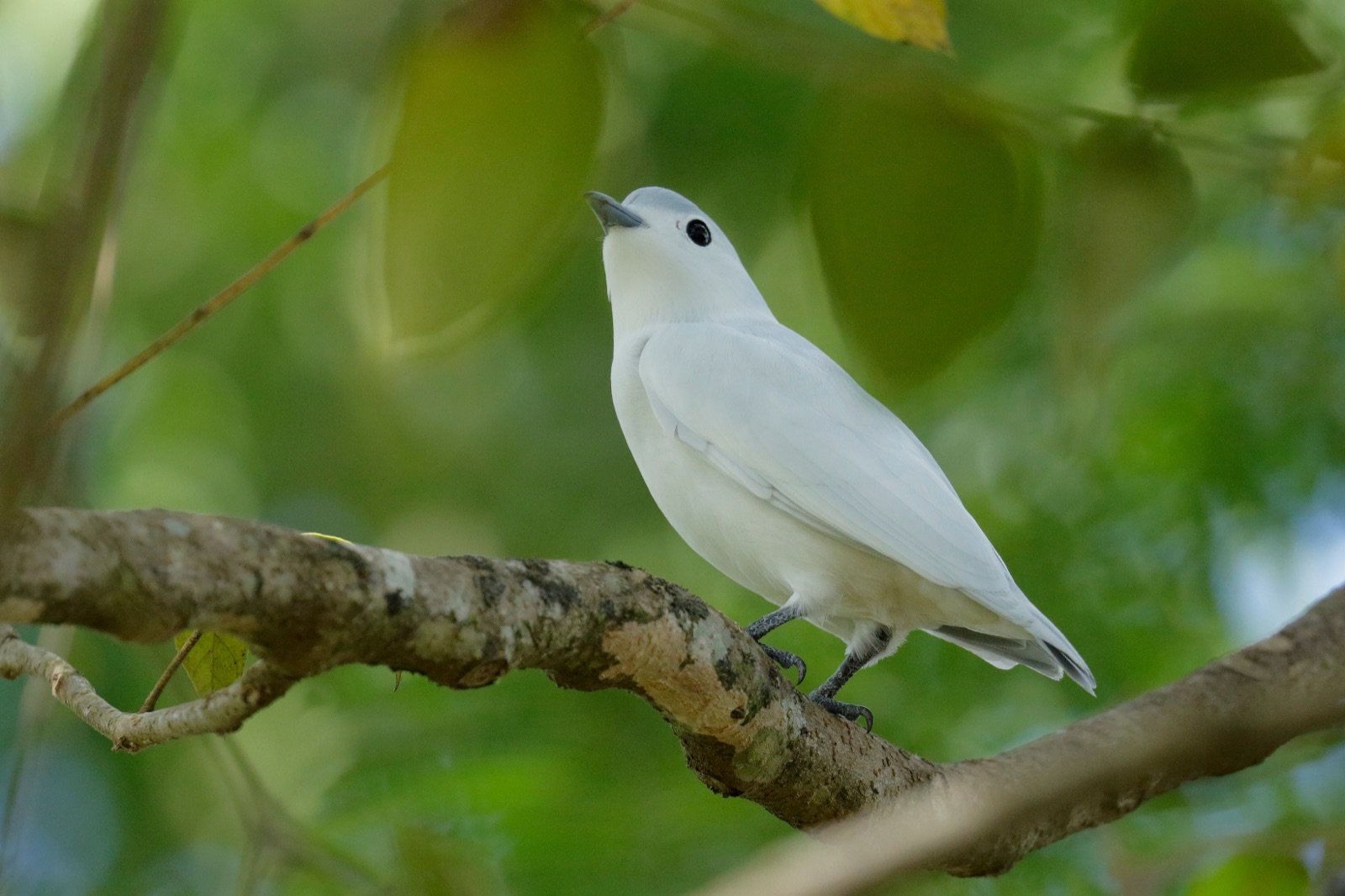
 Snowy Cotinga
Family Cotingidae
Snowy Cotinga
Carpodectes nitidus
In Spanish: Cotinga Blanca
- Resident
- Regional endemic
A white speck high in the Caribbean lowland canopy, found at fruiting trees.
Birders often describe the Snowy Cotinga as a white speck high in green canopy. The male is all white and the female pale gray, so both sexes are easy to recognise once you have one in view.
In Costa Rica it is a bird of the Caribbean lowlands, and it is the most frequently met of the four main Costa Rican cotingas. It still hangs on despite heavy loss of lowland rainforest. One tour company calls it the bird of La Selva.
Finding one is mostly patience at a fruiting tree. On a trip we build, Tortuguero boat trips are a typical way to meet it, and the Sarapiqui area is another place to look.
How to find it
Look for fruiting trees, especially figs and laurel family trees, and scan those branches for a while. Costa Rica has few canopy towers, so fruiting trees are the best option. Views are better when one is nearby, because the bird is usually perched high in an emergent tree. At La Selva, look along the entrance road, around the buildings and along the Sarapiqui River, checking the canopy for white males or light gray females. Patience pays: on a March 2024 tour a group missed it on the entrance road one morning, then had good scope views along the road to the Puerto Viejo River. At Tortuguero it is regularly seen in the forest canopy visible from the canals.
How to recognise it
The male is all white. The female is pale gray: pale bluish gray above and white below.
Both sexes share a medium-sized, dove-like shape, with broad wings and a short tail. The female has dusky wings and tail, and her legs are blackish.
The Snowy has a dark bill and dark eyes, and it is the only bird in its genus with both. That detail matters when you compare it with the Yellow-billed Cotinga.
Against dark rainforest foliage the male can look like a floating snowball. The female is much subtler, camouflaged gray on the branches. Even the chick is cryptic: at a Tirimbina nest its plumage was hard to tell apart from the nest material and nearby branches.
Behaviour and diet
This is a fruit eater, taking fruits, mistletoe berries and figs. It lives in pairs or small groups. In well-forested areas groups of 6 to 8 sometimes forage together, though such groups are the exception.
It is usually seen perched high in an emergent tree, often in plain view, and it can drop down into the foliage when feeding. The bird wanders widely in search of fruit, and researchers think it makes seasonal movements within Costa Rica. Because of this, within a single site it can go from common to rare.
Where it lives
The Snowy Cotinga lives in the canopy of humid lowland forest and in tall secondary growth next to it. Its overall range runs from sea level to about 750 m, and in Costa Rica it only rarely reaches as high as 700 m.
It is often seen in riparian forest, though that may simply be because forest is more common along rivers and the canopy is easier to see there. In Costa Rica it is a bird of the Caribbean lowlands, from the northeastern slope of the Guanacaste mountains south to the Panama border, and it is described as common to rare.
When to see it
Breeding in Costa Rica spans at least January to September, through most of the Caribbean lowland rainy season. A nest was found on 8 January and another on 6 September.
Similar birds
A distant white speck in the canopy may be a Snowy Cotinga or a tityra, and a scope helps tell them apart. The male Yellow-billed Cotinga looks much like the male Snowy, with a yellow bill and a slightly grayer crown. The two are unlikely to overlap, because the Snowy lives in the Caribbean lowlands.
Names and lore in Costa Rica
On the AOCR list it is the Cotinga Blanca. It is also called Cotinga Nivosa, a name used in Costa Rica and Panama. In Honduras and Nicaragua it is called Cotinga Nevada.
Status and conservation
The AOCR list marks it as a resident endemic (R-END), and the IUCN lists it as Least Concern, though the population is thought to be falling and it is considered uncommon in Costa Rica.
Photography tips
Snowy Cotingas are usually seen sitting high in an emergent tree, and looks are better if a fruiting tree is nearby. Put a scope on distant white birds to separate them from tityras.
How we know this 19 sources, each read on the date shown
- Avibase (Wikipedia text) read 2026-11-04
https://avibase.bsc-eoc.org/species.jsp?avibaseid=353F2DD3DE298450 - Bird Watching Costa Rica read 2026-11-04
https://www.birdwatchingcostarica.com/ave/snowy-cotinga/ - Birding Craft read 2026-11-04
https://birdingcraft.com/wordpress/tag/snowy-cotinga/ - Featherscan read 2026-11-04
https://www.featherscan.com/birds/snowy-cotinga - Birding Craft read 2026-11-04
http://birdingcraft.com/wordpress/2012/01/09/is-it-going-to-snow-when-birding-costa-rica/ - Wikipedia read 2026-11-04
https://en.wikipedia.org/wiki/Snowy_cotinga - Cotinga journal (ResearchGate) read 2026-11-04
https://www.researchgate.net/publication/300461086_Observations_on_the_breeding_behaviour_of_Snowy_Cotinga_Carpodectes_nitidus - Wikipedia (Spanish) read 2026-11-04
https://es.wikipedia.org/wiki/Carpodectes_nitidus - Birding Craft read 2026-11-04
http://birdingcraft.com/wordpress/2011/02/28/the-best-sites-for-seeing-cotinga-species-when-birding-costa-rica/ - Wilson Bulletin paper (ResearchGate) read 2026-11-04
https://www.researchgate.net/publication/236176146_Nest_and_eggs_of_the_Snowy_Cotinga_Carpodectes_nitidus_with_some_notes_on_its_nesting_ecology - Birding Craft read 2026-11-04
https://birdingcraft.com/wordpress/tag/costa-rica-birding/page/57/ - YouTube read 2026-11-04
https://www.youtube.com/watch?v=kCw4m80-ZrA - Field Guides trip list read 2026-11-04
https://fieldguides.com/triplists/cos24.html - Wikipedia read 2026-11-04
https://en.wikipedia.org/wiki/Carpodectes_nitidus - Tranquilo Bay blog read 2026-11-04
https://tranquilobay.com/blog/isla-popa-birds-and-frogs - Cornell Birds of the World read 2026-11-04
https://birdsoftheworld.org/bow/species/yebcot1/cur/introduction - Carolina Birds (Cotingidae page) read 2026-11-04
https://carolinabirds.org/HTML/Cotingidae.htm - Birds of the World (public summary) read 2026-11-04
https://www.hbw.com/ibc/species/snowy-cotinga-carpodectes-nitidus - Birding Craft read 2026-11-04
https://birdingcraft.com/wordpress/tag/costa-rica-birds/page/40/