Family Accipitridae
Mississippi Kite
Ictinia mississippiensis
In Spanish: Elanio Colinegro
- Migrant
A graceful gray kite that crosses Costa Rica in migrating flocks.
The Mississippi Kite (Elanio Colinegro) does not settle in Costa Rica. It is a passage migrant that breeds in the southeastern USA and winters in South America, and it crosses the country in spring and fall, in flocks that range from small to large.
You do not look for this bird in one patch of forest. You look up, at the midday sky, where flocks ride thermals along the Caribbean slope. Costa Rica is one of only five places in the world where over a million raptors pass in a season, and this kite is one of the four species that make up about 98% of the migrating raptors counted in Talamanca.
In the southern Caribbean, one birding tour watched dozens of kites crossing the sky near Kèköldi.
How to find it
Look for flocks soaring on midday thermals during migration, because raptor counts in Talamanca peak around midday. Scan the mixed flocks of Broad-winged and Swainson's Hawks and Turkey Vultures, as kites often travel with them. The southern Caribbean is a good place to look, since the mountains close to the sea concentrate the birds. Kèköldi is a spring raptor count site, and the tourism board names it as a key place to watch the migration. Choose your dates within the passage windows above.
How to recognise it
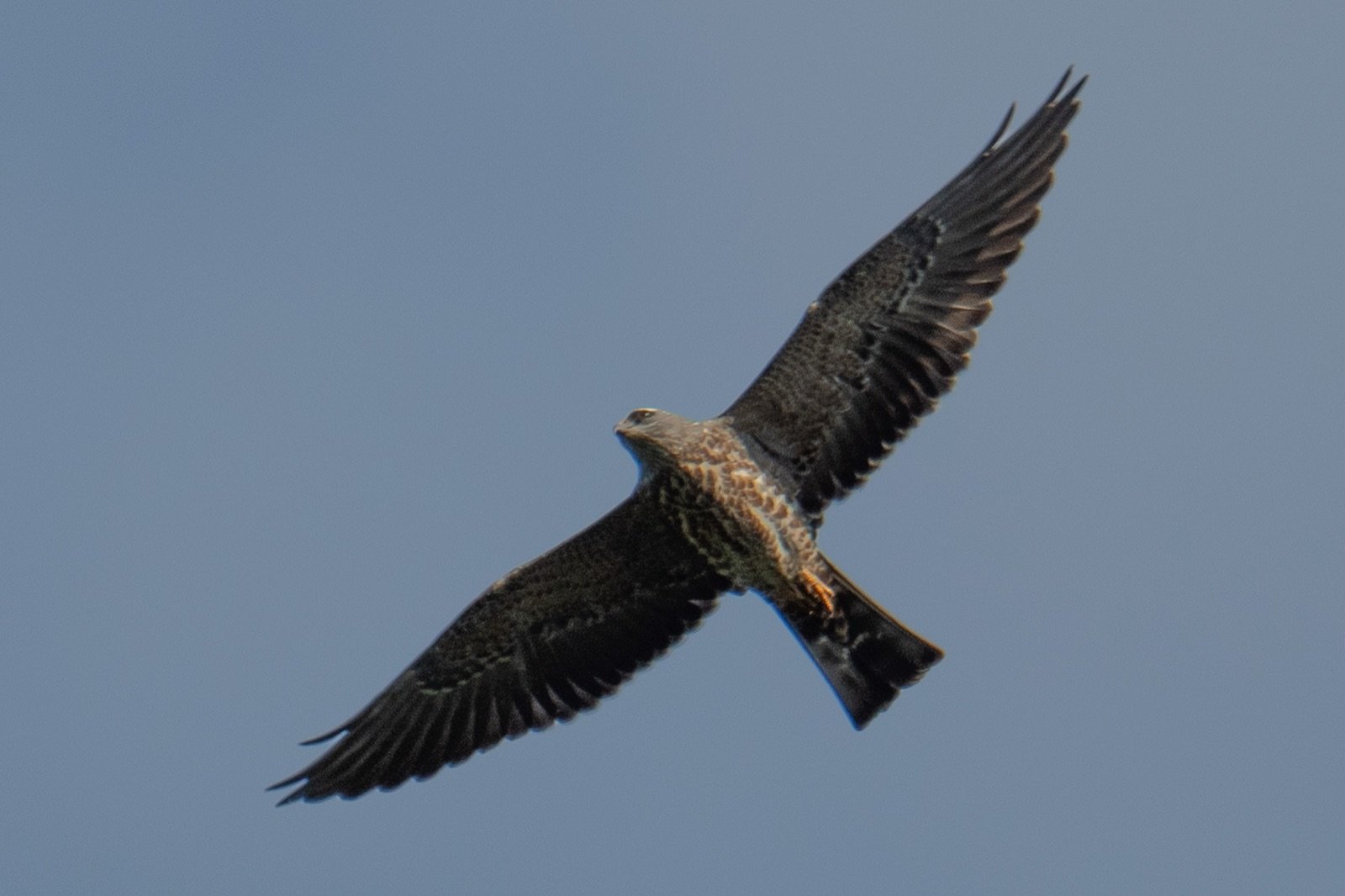
Adults have a light gray head and underparts and a darker gray back. The wings are long and pointed. The tail is long, black and slightly notched.
The eye is red, the bill black and the feet yellowish. The upper side of the secondary flight feathers is white, which shows as a pale patch on the wing, while the other flight feathers are black.
Young birds look like young Plumbeous Kites, but the Mississippi Kite's streaks underneath are brown, not slaty gray.
What it sounds like
Recording: Grant Foster, CC BY 4.0, source, read 4 Nov 2026.
Behaviour and diet
Its flight is graceful and buoyant, and several birds often circle in the same area. Kites flap rarely. On migration they ride thermals, the rising columns of warm air that raptors use to travel while saving energy.
In Costa Rica they often travel in mixed flocks with Broad-winged and Swainson's Hawks and Turkey Vultures. Across its range, migrants usually travel in groups of 20 to 30, though flocks of up to 10,000 have been seen in Argentina.
It feeds mostly on large flying insects such as cicadas and grasshoppers, caught and eaten in flight.
Where it lives
In Costa Rica this is a bird of the sky in transit rather than of one habitat. On its southbound passage it enters the northwestern lowlands and mostly follows the foothills of the Atlantic slope southeast toward Panama.
Raptor migration funnels through the Caribbean slope, and the Talamanca foothills are one key corridor. In the southern Caribbean the Talamanca mountains lie close to the sea, so the aerial passage narrows and migrating birds are concentrated. Spring birds may also use the Pacific slope, which avoids Kèköldi.
When to see it
Fall counts of migrating raptors in Costa Rica run from August to December, and kites move south in that window; tracking data show the first southbound kites gathering in Costa Rica and Panama from 30 August to 6 September. Spring kite counts at Kèköldi in 2010 ran from 26 March to 26 April, and the species was among the latest migrants to pass.
Similar birds
The Plumbeous Kite is the main confusion. The adult Plumbeous is darker gray overall, lacks the white patch on the secondaries and shows rufous on the inner primaries, with bold pale bars across the tail. The adult Mississippi's tail is mostly dark with straight edges when closed, and its flight is more direct and steady. A similar migrant flies with strong, rhythmic wingbeats and glides less than the kite.
Names and lore in Costa Rica
The official Costa Rican Spanish name is Elanio Colinegro, the name used in tourism-board raptor material and trip reports in Costa Rica.
Status and conservation
The AOCR list marks it as a migrant (M), and the IUCN rates the species Least Concern, with a population that declined in the mid-1900s but is now increasing.
Photography tips
Midday thermals bring the flocks up, so that is the time to have the camera ready. Mixed flocks give you a chance to photograph the pale wing patch and straight-edged tail against the sky.
How we know this 12 sources, each read on the date shown
- Bird Watching Costa Rica read 2026-11-04
https://www.birdwatchingcostarica.com/ave/mississippi-kite/ - ResearchGate (Talamanca raptor migration count sites) read 2026-11-04
https://www.researchgate.net/publication/266177516_New_full-season_count_sites_for_raptor_migration_in_Talamanca_Costa_Rica - Cotinga 36 (Hawk Mountain), Spring raptor migration at Talamanca read 2026-11-04
https://hawkmountain.org/download/?dl=1&id=5029 - ResearchGate (Raptor migration in the Neotropics) read 2026-11-04
https://www.researchgate.net/publication/253276155_Raptor_migration_in_the_Neotropics_patterns_processes_and_consequences - HawkWatch International read 2026-11-04
https://hawkwatch.org/raptor-id/raptor-id-fact-sheets/mississippi-kite/ - Wikipedia read 2026-11-04
https://en.wikipedia.org/wiki/Mississippi_kite - Cornell Birds of the World read 2026-11-04
https://birdsoftheworld.org/bow/species/plukit1/cur/introduction - ICT Costa Rica raptor infogram read 2026-11-04
https://www.ict.go.cr/en/documents/infogramas-1/espa%C3%B1ol/2232-aves-rapaces/file.html - Tica Birding Adventure blog read 2026-11-04
http://ticabirdingadventure.blogspot.com/2020/10/aves-caribenas-de-costa-rica-parte-1.html - Ornitologia Neotropical (Bildstein, raptor migration) read 2026-11-04
https://www.hawkmountain.org/download/?dl=1&id=4908 - Hays County migration article read 2026-11-04
https://www.beautifulhayscounty.org/hays-humm/migrations - Audubon Art species archive read 2026-11-04
https://www.audubonart.com/subject/animalia/chordata/aves/accipitriformes/accipitridae/ictinia/mississippi-kite/