Family Icteridae
Nicaraguan Grackle
Quiscalus nicaraguensis
In Spanish: Zanate de Laguna (Totí, Garrapatero)
- Resident
- Regional endemic
A marsh grackle found only in Nicaragua and far northern Costa Rica.
The Nicaraguan Grackle lives only in Nicaragua and the far north of Costa Rica, which makes it a true regional specialty. In Costa Rica it is a resident with local seasonal movements, found in the Río Frío region and in the marshy areas south of Lake Nicaragua.
On a trip we build, guests usually meet it from a boat along the Río Frío and into the marshes beyond, or on boat rides through the Medio Queso wetlands near Los Chiles. Day trips from the Arenal area also run a four-hour boat safari through rainforest, pastures and marsh, with a bilingual guide, starting from Los Chiles.
It is never guaranteed, even in the right place, so a patient scan of the wetland edges pays off.
How to find it
Boat trips out of the Río Frío area are described as one of the most reliable ways to see this grackle, and one tour group had good looks at both males and females on them. Do not expect a guarantee, even in the right area. It needs freshwater marshes, and depending on the time of year it can be locally common or hard to find. Scan wetlands with small bushes. One birding writer found it easier at Medio Queso than in the refuge itself, where it is less common, so a boat trip at Medio Queso is a good way to try. It has also been seen on the road into the refuge, and short-grazed streamsides where cattle stand are worth a look. It does not hang around parking lots or towns away from wetlands, and small grackles seen there are most likely Great-tailed Grackles.
How to recognise it
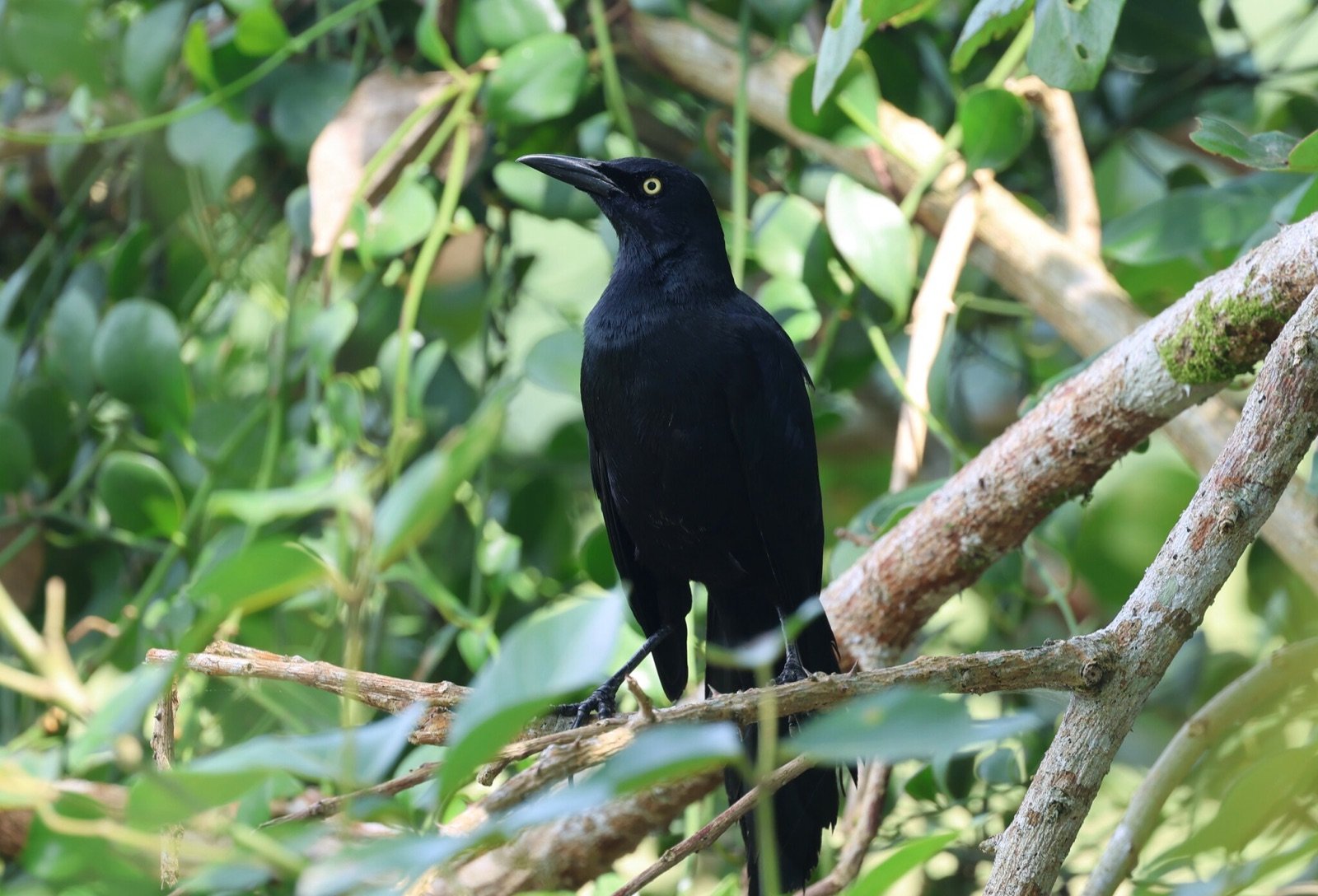
The adult male is all black with a purple, green and blue gloss. Look for these marks:
A long V-shaped tail.
A pale yellow eye.
A black bill and black legs.
Costa Rican guides call it the small version of the common zanate, and the male's folded tail forms an even more striking keel.
The female looks quite different. She is brown above with a pale stripe over the eye. Her face and crown are dark olive-brown, while her brow, throat and breast are pale grayish buff, brightest on the breast. Her belly, flanks and undertail are dark sooty brown. Next to a female Great-tailed Grackle she is much paler below.
Behaviour and diet
This grackle feeds in small groups on the ground, taking seeds and insects. It turns over stones and debris to look underneath, and it often feeds on or around cattle. In Costa Rica it sometimes feeds near cattle with Bronzed Cowbirds, or at the edge of Great-tailed Grackle flocks. It travels in small groups and sometimes in large flocks.
Nests are in colonies in trees overlooking swamps, or hidden in grass clumps in marsh vegetation.
Where it lives
It likes open marshy areas, lake edges, rivers, pastures and flooded scrub. It nests only in marshland, but it feeds in scrub, wet pastures, and along lake shores and riverbanks.
In Costa Rica that means the Río Frío region and the marshy areas south of Lake Nicaragua, such as Las Camelias and San José de Upala. Photo records from Alajuela Province also place it at the Medio Queso wetland near Los Chiles. It is listed in the Huetar Norte conservation area. It is not migratory, though it shifts locally with the seasons and with water levels.
When to see it
A Costa Rican source says breeding runs from March to September. Water level shapes the birding in the refuge: the wet season is typically July to November, when it floods, and the dry season is December to April, when water falls to the main channel.
Similar birds
Great-tailed Grackle shares its range but is bigger, with a longer tail and heavier bill. The male has less green gloss. The female is darker below, with a fainter eyebrow stripe. Small grackles in parking lots or towns away from wetlands are most likely Great-tailed.
Names and lore in Costa Rica
Costa Rican sources list many local names: garrapatero, totí, sanate, zanate, clarinero and zanate de laguna, which is the AOCR name. Spanish sources also say zanatillo or zanate nicaragüense. Around Solentiname in Lake Nicaragua it is known as clarinero or zanate de laguna. Some people loosely call it a "cuervo" (crow), though it is not related to true crows, which belong to the family Corvidae.
Status and conservation
The AOCR lists it as a resident endemic (R-END), and the IUCN rates it Least Concern, though its population is falling.
Photography tips
A tour group photographed these grackles on short-grazed streamsides near the refuge, with cattle legs in the frame, and the birds favoured that grazed edge. The male has a strange display that can be filmed at Medio Queso and in the refuge. A filming guide says patience may be needed to catch it.
How we know this 17 sources, each read on the date shown
- Aves de Costa Rica read 2026-11-04
https://www.avesdecostarica.com/Quiscalus-nicaraguensis.html - Ecoregistros read 2026-11-04
https://www.ecoregistros.org/sheet/Quiscalus-nicaraguensis - Flickr post quoting Costa Rican natural history text read 2026-11-04
https://www.flickr.com/photos/jobando/27219158636 - Field Guides Birding Tours trip list read 2026-11-04
https://fieldguides.com/triplists/cr220.html - Birding Craft read 2026-11-04
https://birdingcraft.com/wordpress/tag/nicaraguan-grackle/ - Birding Craft read 2026-11-04
https://birdingcraft.com/wordpress/2022/12/06/birding-costa-rica-at-cano-negro-in-2023-expectations-and-suggestions/ - WhereNext read 2026-11-04
https://www.wherenext.com/blog/the-best-locations-to-film-birds-in-costa-rica - Birdquest read 2026-11-04
https://www.birdquest-tours.com/birding-tours/costa-rica-ultimate/ - Arenal.net read 2026-11-04
https://www.arenal.net/tours/cano-negro-wild-life-refuge-costa-rica - Birding Craft read 2026-11-04
https://birdingcraft.com/wordpress/tag/cano-negro/ - Wikiwand (Spanish Wikipedia) read 2026-11-04
https://www.wikiwand.com/es/Quiscalus_nicaraguensis - Naturalista Costa Rica (Wikipedia text) read 2026-11-04
https://costarica.inaturalist.org/taxa/9606-Quiscalus-nicaraguensis - Revista Naturalista read 2026-11-04
https://www.revistanaturalista.com/elementor-1359/ - BirdForum Opus read 2026-11-04
https://www.birdforum.net/opus/Nicaraguan_Grackle - thewebsiteofeverything.com (IUCN summary) read 2026-11-04
https://thewebsiteofeverything.com/animals/birds/Passeriformes/Icteridae/Quiscalus-nicaraguensis - Flickr (Natural history text, Huetar Norte) read 2026-11-04
https://www.flickr.com/photos/jobando/38425214520 - Kiwifoto (Wikipedia text) read 2026-11-04
https://www.kiwifoto.com/galleries/birds/nicaraguan_grackle/index.html