 Northern Jacana
Family Jacanidae
Northern Jacana
Jacana spinosa
In Spanish: Jacana Centroamericana (Cirujano, Gallito de Agua, Mulita, Yegüita)
- Resident
The yellow-billed bird that walks on lily pads
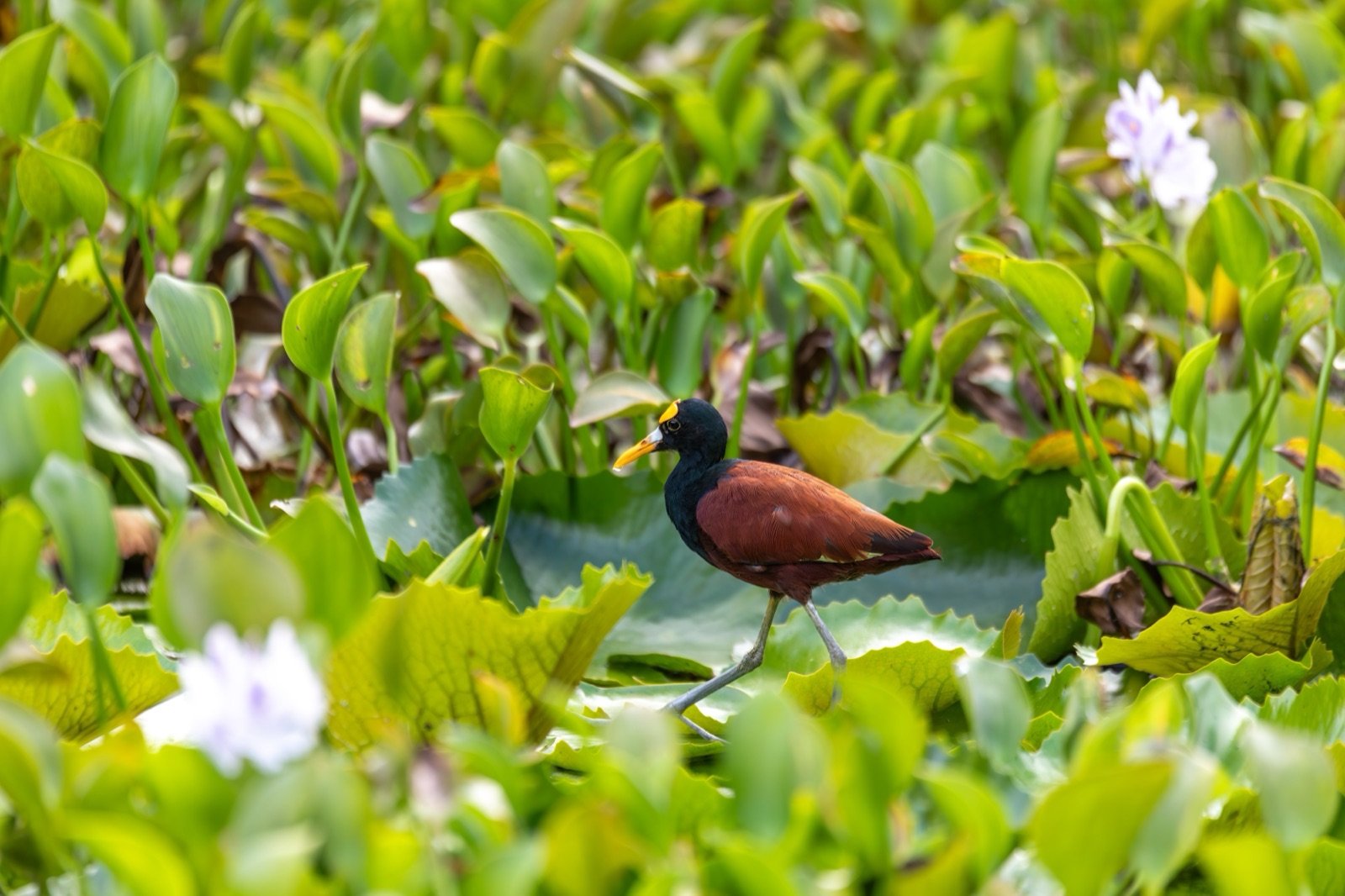
The Northern Jacana (Jacana Centroamericana) seems to stroll on water. Its very long toes and nails spread its weight, so it crosses lily pads and other floating plants without sinking.
It is reported throughout Costa Rica and is a year-round resident of the country's wetlands. It is especially abundant in the Tempisque basin in Guanacaste and around the Río Frío area.
On the boat trips we build to the wetlands of the northern plains, it is one of the birds to look for along the water, with Roseate Spoonbill, Anhinga and Great Blue Heron. Along the Río Frío, you pass Northern Jacanas by the dozen.
Where to see it
How to find it
Scan floating plants such as lily pads at the edges of ponds and marshes, and listen for the calls. Look first in ponds, marshes and lagoons with flowering water plants and sheltered margins. A wildlife photographer found plenty of jacana action at a grassy Guanacaste pond with big patches of floating plants, where birds foraged in mixed groups with other species. Seen from a boat, they were often in pairs, and in the northern wetlands they sat in shallow lagoons near the boat ramps. Tortuguero's waterways are best explored by boat tour. Walking the trails near the Tárcoles River at Carara National Park gives a chance to see jacanas and Boat-billed Herons in the wetlands.
How to recognise it
Adults show a clear pattern of colour blocks:
Black head, neck and breast.
Chestnut-maroon body.
Bright yellow bill with a yellow plate on the forehead.
Pale yellow-green flight feathers with dark tips.
A yellow spur on the leading edge of each wing.
The very long toes are often hidden in the water, so they are easy to miss. Juveniles show a white eyebrow stripe and white between the eye and bill. Females are about twice the weight of males. Chicks are downy with orange, brown, black and white patterns. A pair of binoculars shows the yellow plate and wing spurs well.
What it sounds like
Behaviour and diet
The bird searches the water's edge and floating plants for insects, snails, worms, small fish and seeds. It holds itself upright while feeding to watch for danger. When it walks or flies it opens its wings, which are yellow underneath.
Females are dominant and have several mates, and the male incubates the eggs. A study at Palo Verde National Park looked at how adults defend their young against intruders. Breeding groups are often dense, causing frequent territorial fights. A female's territory covers those of one to four males, and males hold territories much longer than females.
Where it lives
In Costa Rica it lives along ponds, marshes, slow rivers and flooded pastures, and it prefers calm or slow-moving water. Ponds, marshes and lagoons with flowering water plants and margins sheltered by vegetation are the places to look first.
Locally it occurs in smaller numbers along the lowlands of both slopes. It reaches about 1500 m in the central mountains and about 1200 m on the southern Pacific slope. It is most abundant in Guanacaste and the Río Frío area.
When to see it
One site says spoonbills, jacanas and storks are seen in greatest numbers in the wet months, May to November, in the northern wetlands. In Guanacaste it nests in the rainy season, while where water is permanent, such as Turrialba, it breeds almost all year.
Names and lore in Costa Rica
Costa Ricans call it cirujano (surgeon), mulita de agua, gallito de agua or yegüita, while the AOCR list uses Jacana Centroamericana. In 1743 the English naturalist George Edwards called it the 'spur-winged water hen'.
Status and conservation
The AOCR lists it as a resident (R), it lives in Costa Rican wetlands all year, and its IUCN status is Least Concern.
Photography tips
A watchful male often leads small chicks across floating plants, so look for chicks near an adult at pond edges. Birds open their wings, yellow underneath, when they walk or fly, which gives a chance for a showy wing shot.
Trips that find it
- Arenal, the Pacific and the Quetzal Valley16 nightsSee the trip
- Costa Rica Classic Birding, All Inclusive8 nightsSee the trip
- Dancing with Quetzals11 nightsSee the trip
- Northern Volcanoes and Wetlands10 nightsSee the trip
Tell us when you are travelling and our team in Costa Rica builds the trip around the birds you want to see.
Plan my birding tripHow we know this 20 sources, each read on the date shown
- Bird Watching Costa Rica read 2026-11-04
https://www.birdwatchingcostarica.com/ave/northern-jacana/ - The Tico Times read 2026-11-04
https://ticotimes.net/2025/04/10/northern-jacana-birds-walk-costa-rican-waters-with-giant-feet-and-reversed-gender-roles - Animalia.bio read 2026-11-04
https://animalia.bio/northern-jacana?category=3 - ResearchGate (Palo Verde study) read 2026-11-04
https://www.researchgate.net/publication/346719810_Comportamiento_agresivo_de_hembras_de_Jacana_spinosa_en_el_Parque_Nacional_Palo_Verde_Costa_Rica - Caño Negro Lodge read 2026-11-04
https://canonegrolodge.com/northern-jacana-cano-negro-costa-rica/ - World Bird Photos read 2026-11-04
https://www.worldbirdphotos.com/photo/jacana-northern-jacana-spinosa-adult-costa-rica/ - JungleDragon read 2026-11-04
https://www.jungledragon.com/specie/624/northern_jacana.html - Eco Lodges Anywhere read 2026-11-04
https://ecolodgesanywhere.com/costa-rica-birds/ - Linda Murdock Photography read 2026-11-04
http://gustaviatex.com/blog/2019/10/23/costa-rica-finding-the-river-birds - Lindblad Expeditions read 2026-11-04
https://www.expeditions.com/travel-guide/costa-rica-travel-guide/birding-destinations-in-costa-rica - Wildlife Nomads read 2026-11-04
https://www.wildlifenomads.com/blog/birds-of-costa-rica-a-birdwatchers-paradise/ - Aves de Costa Rica read 2026-11-04
https://avesdecostarica.com/Jacana-spinosa.html - Museo Nacional de Costa Rica read 2026-11-04
https://www.museocostarica.go.cr/divulgacion/mulita-de-agua/ - Flickr post quoting a Costa Rican natural history text read 2026-11-04
https://www.flickr.com/photos/jobando/25935444416 - El Jornal read 2026-11-04
https://eljornalcr.com/la-jacana-observada-por-primera-vez-en-acosta/ - Macaulay Library read 2026-11-04
https://macaulaylibrary.org/asset/633042432 - Animalia.bio read 2026-11-04
https://animalia.bio/northern-jacana - Planet of Birds read 2026-11-04
https://planetofbirds.com/charadriiformes-jacanidae-northern-jacana-jacana-spinosa/ - Wikipedia read 2026-11-04
https://en.wikipedia.org/wiki/Northern_jacana - Animal Diversity Web read 2026-11-04
https://animaldiversity.org/accounts/Jacana_spinosa/