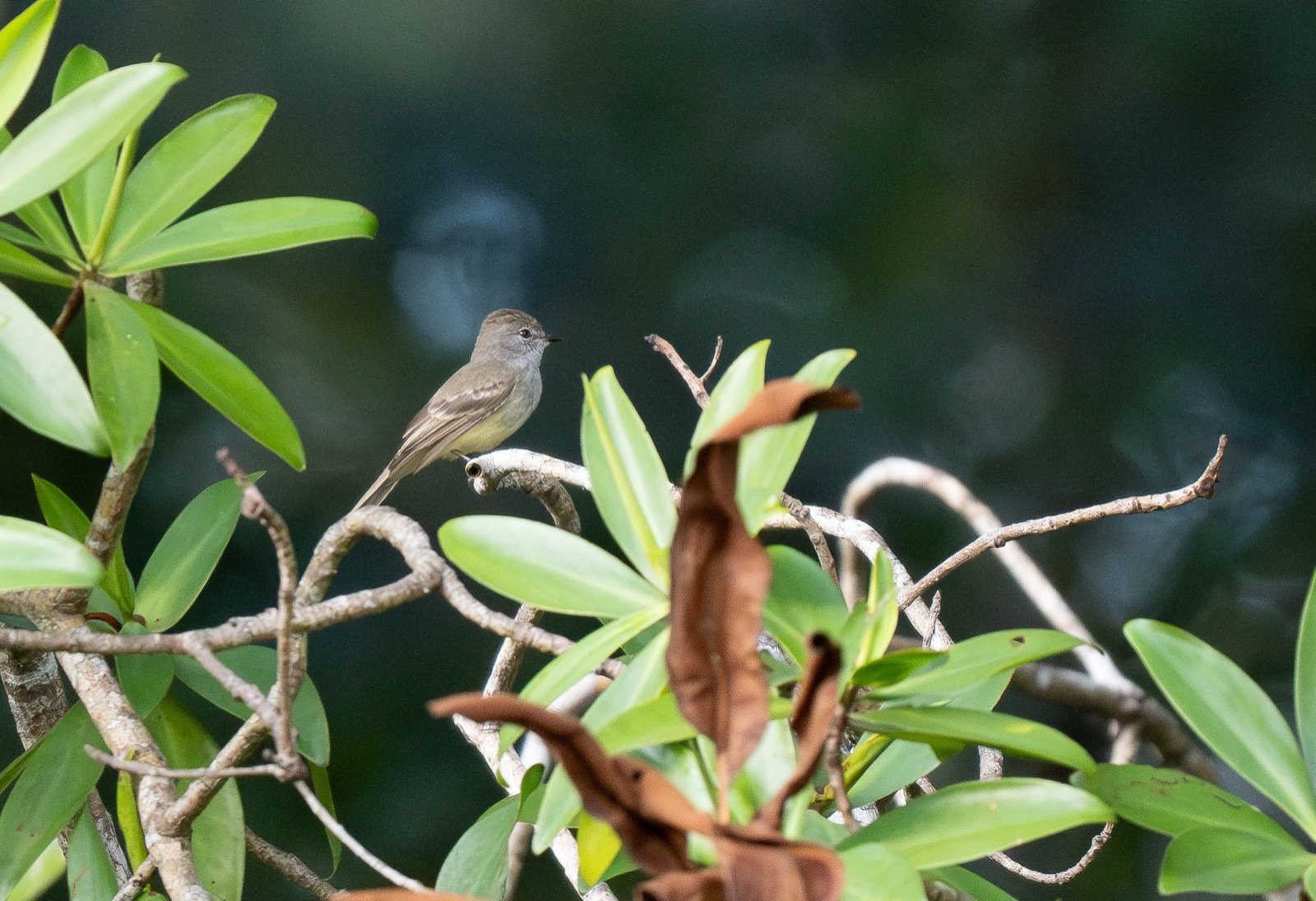
Family Tyrannidae
Northern Scrub-Flycatcher
Sublegatus arenarum
In Spanish: Mosquero Gorgigrís
- Resident
A shy mangrove flycatcher of the Pacific slope with a tiny bill and shaggy crest.
The Northern Scrub-Flycatcher (Mosquero Gorgigrís) is a small, quiet tyrant flycatcher that forages almost unnoticed in scrub and small trees. In Costa Rica it lives on the Pacific slope, around the Gulf of Nicoya and the Golfo Dulce.
It is a bird for patient looking rather than easy ticks. It is described as fairly uncommon in northern Costa Rica and rare in the south, so a mangrove morning on a trip we build is the kind of outing where it can turn up.
There is history here too: the species was first described from a bird collected at Punta Arenas, Costa Rica, so the Costa Rican Pacific coast is where science first met this flycatcher.
How to find it
Because it is shy and forages quietly, search the low vegetation of mangrove edges and low open woodland on the Pacific coast carefully. A Costa Rica bird guide suggests checking tall mangroves and playing a pygmy-owl whistle, which can draw up Panama Flycatcher and this species, and sometimes Mangrove Hummingbird. A mangrove boat trip on the Río Tárcoles near Carara is a common place for visitors to meet it. On a Carara area day, the birds took some searching in the mangroves on the road to Playa Azul, and the author notes these mangrove birds are not abundant. Go expecting to work for it.
How to recognise it
Start with the colours. This flycatcher is olive above with a whitish eyebrow stripe. The throat and upper breast are gray, and the belly is yellow.
The wings are blackish with buff edging and pale bars. They can seem to show three bars, though not always.
The crown is darker than the back and has long feathers that can stand up like a small shaggy crest. Males and females look alike.
The bill is the detail to check. It is very small, and together with the wing bars it helps separate this bird from other tyrant flycatchers.
Behaviour and diet
This bird works the low vegetation without drawing attention. It forages in scrub and small trees, taking arthropods such as ants and caterpillars by hover-gleaning and short sallies.
It also eats some fruit, besides insects found among foliage or caught in flight.
A bird with its crest raised is a good photo subject and a useful identification clue.
Where it lives
It lives in mangroves and open woodland below 500 meters elevation. In Costa Rica that means the Pacific slope, with birds found around the Gulf of Nicoya and the Golfo Dulce.
The mangroves near Caldera border tropical dry forest, so two habitats can be birded together there. Birds have also been seen in mangroves near Tambor Beach on the Nicoya Peninsula, on a path near the Puntarenas to Paquera ferry route, and in edge habitats around Tárcoles.
Similar birds
It looks like a small version of the Myiarchus flycatchers, with a gray head, pale yellow belly and pale wing bars. Check the head and the very small bill. A bird seen away from mangroves may be a Greenish Elaenia instead.
Names and lore in Costa Rica
The official Costa Rican Spanish name is Mosquero Gorgigrís. Elsewhere it has other Spanish names, such as Atrapamoscas Rastrojero in Colombia and Tiranolete de Breñas Norteño in Panama.
Status and conservation
The AOCR list marks it as a resident (R), fairly uncommon in northern Costa Rica and rare in the south, and the IUCN rates it Least Concern because its range is very large.
Photography tips
Look for a bird with its crest raised, which makes a good photo subject. The long crown feathers can rise into a shaggy crest, and it is a useful identification clue as well. Search low vegetation along mangrove edges, where it forages quietly.
How we know this 15 sources, each read on the date shown
- Cornell Birds of the World read 2026-11-04
https://birdsoftheworld.org/bow/species/nosfly1/cur/introduction - Wikipedia read 2026-11-04
https://en.wikipedia.org/wiki/Northern_scrub_flycatcher - Planet of Birds read 2026-11-04
http://www.planetofbirds.com/passeriformes-tyrannidae-northern-scrub-flycatcher-sublegatus-arenarum-2 - Birds of the World read 2026-11-04
https://www.hbw.com/species/northern-scrub-flycatcher-sublegatus-arenarum - Ropero Aventuras read 2026-11-04
https://roperoaventuras.com/2015/12/23/atrapamoscas-rastrojero-sublegatus-arenarum/ - Birding Craft (Costa Rica birding blog) read 2026-11-04
https://birdingcraft.com/wordpress/category/mangroves/feed/ - Birding Craft (Costa Rica birding blog) read 2026-11-04
http://birdingcraft.com/wordpress/2025/04/05/tips-for-birding-costa-rica-around-carara/ - Birding Craft (Costa Rica birding blog) read 2026-11-04
https://birdingcraft.com/wordpress/2017/06/15/northern-scrub-flycatcher-the-mini-myiarchus/ - Birdwatch.info tour itinerary read 2026-11-04
https://www.birdwatch.info/costa-rica/san-jose/costa-rica-birding - Eagle-Eye Tours trip report read 2026-11-04
https://www.eagle-eye.com/blog/costa-rica-sampler-2022-trip-report/ - Eagle-Eye Tours trip report read 2026-11-04
https://www.eagle-eye.com/blog/costa-rica-sampler-trip-report-feb-16-27-2026/ - Birding Craft (Costa Rica birding blog) read 2026-11-04
https://birdingcraft.com/wordpress/tag/white-fronted-parrot/ - Wikipedia (Spanish) via Wikiwand read 2026-11-04
https://www.wikiwand.com/es/articles/Sublegatus_arenarum - Avibase read 2026-11-04
https://avibase.bsc-eoc.org/species.jsp?avibaseid=1C60CF9672E2826D - Birds of the World (Ornithological Note) read 2026-11-04
https://birdsoftheworld.org/bow/ornith-notes/JN100145