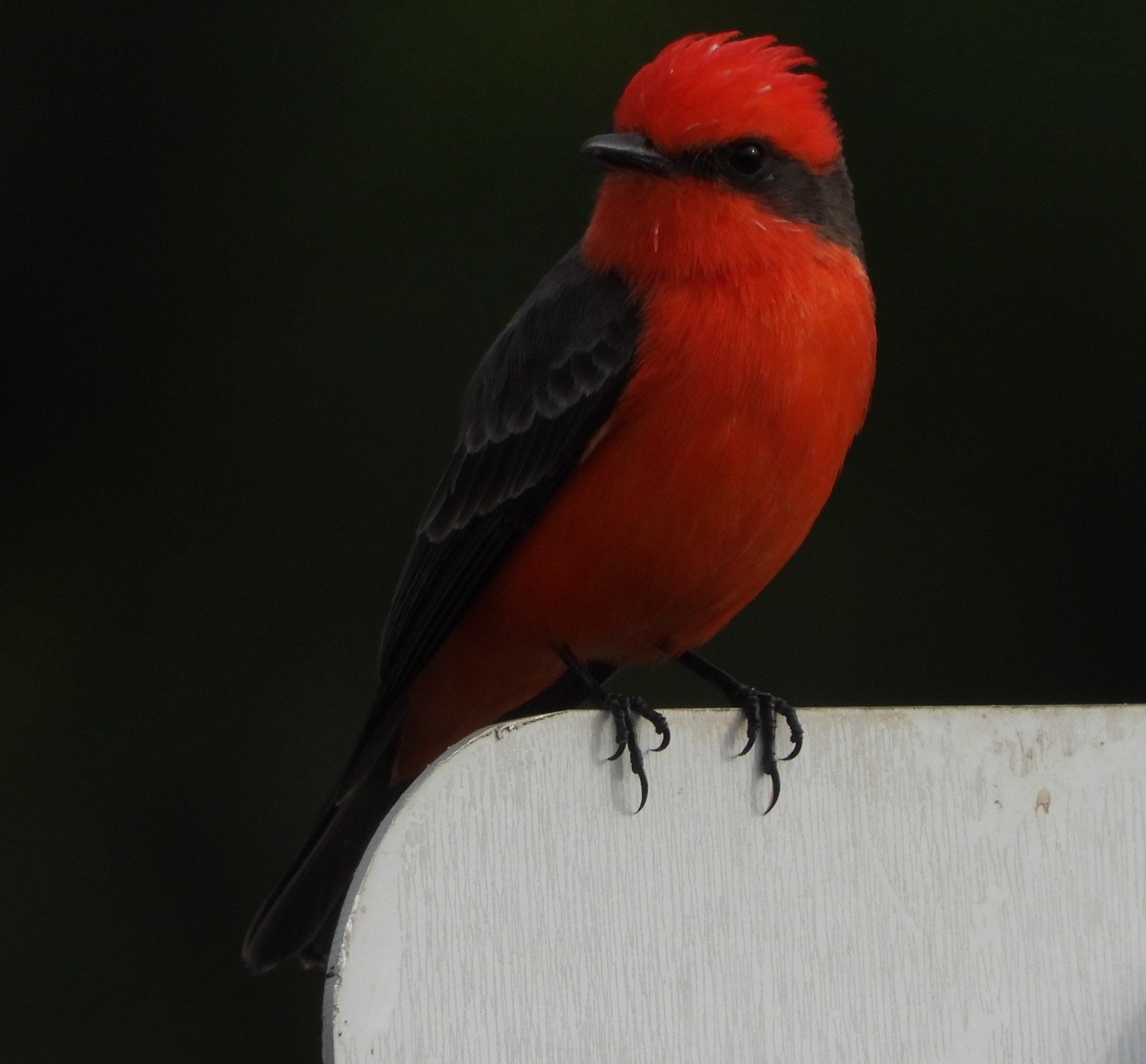
Family Tyrannidae
Vermilion Flycatcher
Pyrocephalus rubinus
In Spanish: Mosquerito Rojo
- A
A small crimson flycatcher, accidental (A) on Costa Rica's official list.
The Vermilion Flycatcher (Mosquerito Rojo) is a bird a beginner can know at a glance: the male is bright red with dark wings, tail and mask. Costa Rica's official bird list added it fairly recently, and a national newspaper counted it among the new species accepted by the AOCR.
In Costa Rica it carries status A, accidental, and the Costa Rican bird committee accepted it backed by a museum voucher. The list shows it in a group with several species coded R, so it is not treated as a regular resident. That makes it a bird to hope for rather than expect.
Knowing its habits helps you notice one if it turns up: open perches, wet edges and the short sallies of a flycatcher.
How to find it
Look for open country with a view. Scan the edges of wetlands and stream corridors, where insects gather. Check fence posts, shrubs and small trees, because the bird returns to the same perch after each insect chase. Low perches within about three metres of the ground are typical. A male in crimson stands out, so a slow scan with binoculars along a water edge is a good start. Listen for the whistled peet-peet-a-weet as well.
How to recognise it
The male is the showstopper: a bright crimson crest, black mask, red throat and underparts, grey back, and black wings and tail. A Costa Rican newspaper singles out his bright crimson plumage as what draws the eye.
It is a small flycatcher, about 13 to 14 cm long and roughly 14 g.
Males and females look very different, so do not search only for red. The female is brownish:
- grayish brown above
- white throat and upper chest
- bright white eyebrow stripe
- darker cheek patch
- reddish orange tint on the belly, a warm salmon-red blush
She is not red like the male.
What it sounds like
Recording: Esteban Villa Restrepo, CC BY-SA 4.0, source, read 4 Nov 2026.
Behaviour and diet
This is a classic sit-and-wait flycatcher. It often sits on open perches within about three metres of the ground, so it is fairly easy to spot. It waits on a shrub, fence post or small tree, flies out to seize an insect in mid-air, and goes back to the same perch. When prey escapes, it switches to a longer, erratic flight to catch it, often with acrobatic turns. It gently dips its tail, much like a phoebe does.
In the breeding season the male performs a flight song display, rising 20 to 30 m above the treetops and seeming to bounce through the sky, flapping and singing. During courtship he brings the female a gift, often a butterfly or another showy insect.
Where it lives
A Costa Rican newspaper describes the bird as living among water plants and along forest edges. More generally, it usually perches fairly low in open areas near water, and it settles in open, scrubby grassland near rivers and streams. Across its whole range it is recorded from sea level up to about 3000 m, and it adapts well to altered land.
Similar birds
The male is hard to confuse, but the female is not red and can slip past. Remember her white eyebrow stripe, darker cheek patch, white throat and the reddish orange wash on her belly. Pair that with the habit of dipping her tail from a low perch near water. Some scientists split the species, and males of the southern migrant birds look very similar to North American ones, so they are hard to tell apart in the field or from photos.
Names and lore in Costa Rica
In Costa Rica the official Spanish name is Mosquerito Rojo. Elsewhere in Central America the same bird is called Mosquero Bermellón (Guatemala, Panama) and Mosquero Rojo (Honduras). Other Spanish names across Latin America include Mosquero Cardenal, Saca-tu-real, Churrinche and Titiribí Pechirrojo.
Status and conservation
The AOCR official list (updated June 2026) gives the Vermilion Flycatcher status A, accidental, and the bird is held at the National Museum under catalog number MNCR-Z7807.
Photography tips
Its habit of returning to the same open perch after each sally lets you wait with your camera pointed at a fence post or small tree. Low perches within about three metres of the ground keep it close.
How we know this 20 sources, each read on the date shown
- La Nación (Costa Rica) read 2026-11-04
https://www.nacion.com/ciencia/aplicaciones-cientificas/gaviotas-pato-y-ciguena-se-unen-al-club-oficial-de-aves-de-costa-rica/3GQALQQLMVHNFIHJR4ZYDIG2CU/story/ - Wikipedia (Spanish) read 2026-11-04
https://es.wikipedia.org/wiki/Pyrocephalus_rubinus - Wikipedia (Asturian) read 2026-11-04
https://ast.wikipedia.org/wiki/Pyrocephalus_rubinus - Wikipedia read 2026-11-04
https://en.wikipedia.org/wiki/Pyrocephalus - All About Birds (Cornell Lab) read 2026-11-04
https://www.allaboutbirds.org/guide/Vermilion_Flycatcher/overview - Optics4Birding read 2026-11-04
https://optics4birding.com/blogs/digiscoping/vermilion-flycatcher - Birds and Blooms read 2026-11-04
https://www.birdsandblooms.com/birding/bird-species/songbirds/vermilion-flycatcher/ - Birds of the World (Cornell) read 2026-11-04
https://birdsoftheworld.org/bow/species/verfly/cur/introduction?lang=es - Audubon Field Guide read 2026-11-04
https://www.audubon.org/field-guide/bird/vermilion-flycatcher - Chipes.org read 2026-11-04
https://chipes.org/portfolio/pyrocephalus-rubinus-vermilion-flycatcher/ - Avibase read 2026-11-04
https://avibase.bsc-eoc.org/species.jsp?avibaseid=1456993D48B01C82&avibaseid=1456993D48B01C82 - AOCR Lista Oficial Online read 2026-11-04
https://listaoficialavesdecostarica.wordpress.com/lista-oficial/lista-oficial-online/ - Bird Watching Academy read 2026-11-04
https://www.birdwatchingacademy.com/blogs/blog/vermilion-flycatcher - Animalia.bio read 2026-11-04
https://animalia.bio/vermilion-flycatcher - CONABIO Campeche biodiversity site read 2026-11-04
https://bio.campeche.gob.mx/especies/pyrocephalus-rubinus-boddaert-1783/ - Lista Oficial de las Aves de Costa Rica (AOCR committee records) read 2026-11-05
https://listaoficialavesdecostarica.wordpress.com/nuevos-registros/ - Avibase read 2026-11-05
https://avibase.bsc-eoc.org/species.jsp?avibaseid=1456993D48B01C82 - Aves del Tolima read 2026-11-05
https://avesdeltolimacom.wordpress.com/2017/01/25/titiribi-pechirrojo-pyrocephalus-rubinus/ - Maine Audubon read 2026-11-05
https://maineaudubon.org/news/rare-bird-alert-vermilion-flycatcher/ - Animal Diversity Web read 2026-11-05
https://animaldiversity.org/accounts/Pyrocephalus_rubinus/