Family Tyrannidae
Nutting's Flycatcher
Myiarchus nuttingi
In Spanish: Copetón de Nutting (Tontillo)
- Resident
A yellow-bellied flycatcher of Guanacaste's dry forest, best named by its voice.
Nutting's Flycatcher is a small Myiarchus of Costa Rica's dry northwest, where Guanacaste's deciduous forest marks the southern end of its range. Costa Ricans know it as Copetón de Nutting, and the AOCR list adds the nickname Tontillo.
It was first described from Hacienda La Palma on the Gulf of Nicoya, so this corner of the country is where the species first met science.
It is also a bird that rewards patience. A Costa Rica birding writer calls the pair of Nutting's and Brown-crested Flycatcher possibly the hardest ID challenge in the country, and says it is best to hear one before naming it with confidence. That makes it a good first lesson in listening as well as looking.
How to find it
Concentrate on the dry northwest and go early. Tour groups have found at least three Nutting's along Guacimo Road, where they describe it as a fairly small Myiarchus restricted to the dry northwest. Watch fence lines and shade trees at forest edges, since the bird often returns to the same exposed perch. On a trip we build, a lodge's entrance road in the dry Pacific lowlands is described as a good site, among motmots, trogons and Brown-crested Flycatcher. Another tour added it on its last day in the dry Pacific lowlands, alongside Cinnamon Hummingbird and Turquoise-browed Motmot. Listen as much as you look, because calls are what settle the identification.
How to recognise it
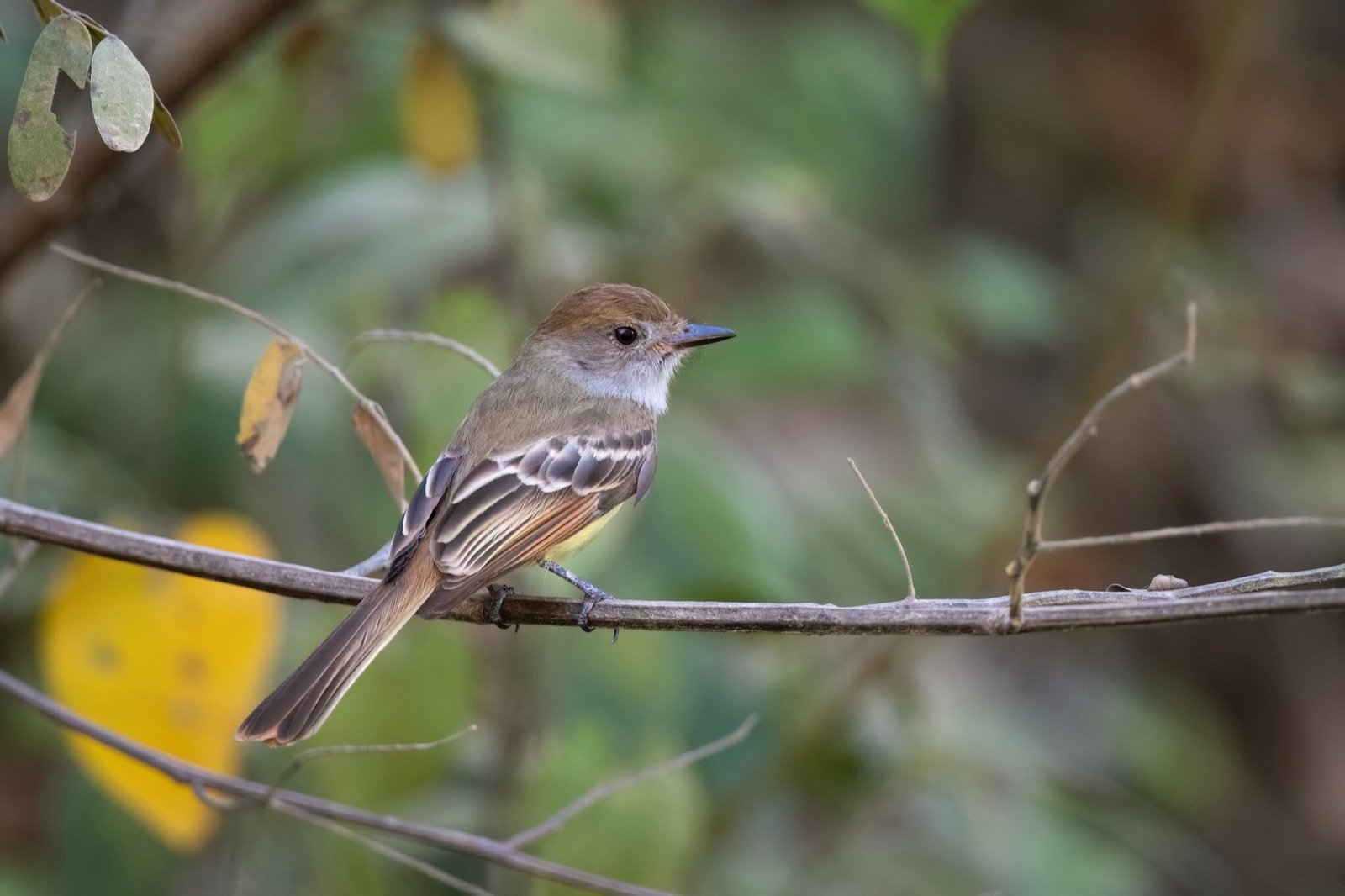
Nutting's is about 18 to 19 cm long. Look for these marks:
A gray-brown crown with a slight crest.
A gray throat and breast, and a yellow belly, which one guide calls pale yellow.
Rufous edging on the wings and tail.
Two pale wing bars.
A dark bill. In Costa Rica, a smaller bill than the local Brown-crested Flycatcher's is the thing to check.
Males and females look alike. Its resemblance to other Myiarchus flycatchers is close, so the combination of dark bill, pale yellow belly, rufous in wings and tail, and the calls is what settles it.
What it sounds like
Recording: rawcomposition, CC0 1.0, source, read 4 Nov 2026.
Behaviour and diet
Nutting's perches in the open and makes short sallies after insects, often returning to the same exposed perch. That habit makes it easier to watch than many flycatchers once you find a favoured post.
It nests in a cavity in a tree or fence post, usually low, within about 1.2 m of the ground. The nest is lined with fur, feathers and snake skin, and the clutch is three to five eggs. These nesting details describe the species in general rather than Costa Rica alone.
Where it lives
In Costa Rica the nominate form lives in the northwest, in Guanacaste Province, on the interior Pacific slope. Here it reaches only about 1,200 m elevation, while across its whole range it goes from sea level up to about 1,800 m.
Costa Rican birds use more humid forest than birds further north. Elsewhere it is found in tropical deciduous forest, gallery forest, thorn forest and arid scrub, both mature and second growth, and across its range it prefers dense, closed-canopy thorn forest.
Similar birds
In Costa Rica it looks almost the same as the Brown-crested Flycatcher, which is a larger version with a bigger bill. Both live in the dry northwest, where Nutting's also overlaps with all the other Myiarchus. One tour group saw a Brown-crested beside a Nutting's, and both were vocal, which helped the ID. Another group named Nutting's mainly by voice.
Names and lore in Costa Rica
Costa Rican lists use the Spanish name Copetón de Nutting, and the AOCR list adds the nickname Tontillo. Mexico also uses Papamoscas Huí, and Nicaragua uses Güis Crestipardo Menor.
Status and conservation
The AOCR list marks it as a resident (R), the IUCN rates it Least Concern, and it is considered uncommon in Costa Rica.
Photography tips
Wires and fence lines can be handy places to look. One Costa Rica birder photographed a Nutting's on a telephone wire in Guanacaste and wished for a more natural perch. A scope helps with birds on high exposed perches, as a tour group found with a Myiarchus sitting in sunlight.
How we know this 16 sources, each read on the date shown
- Wikipedia read 2026-11-04
https://en.wikipedia.org/wiki/Nutting's_flycatcher - Wikipedia (Spanish) read 2026-11-04
https://es.wikipedia.org/wiki/Myiarchus_nuttingi - Cornell Birds of the World read 2026-11-04
https://birdsoftheworld.org/bow/species/nutfly1/cur/introduction - Featherscan read 2026-11-04
https://www.featherscan.com/birds/nutting's-flycatcher - Birdingcraft read 2026-11-04
https://birdingcraft.com/wordpress/category/costa-rica-bird-finding-guide/ - Field Guides trip list, Costa Rica 2016 read 2026-11-04
https://fieldguides.com/triplists/cos16.html - 10,000 Birds read 2026-11-04
https://www.10000birds.com/no-need-to-fear-the-flycatcher-in-costa-rica.htm - Field Guides trip list, Far North 2020 read 2026-11-04
https://fieldguides.com/triplists/cr220.html - Cornell Birds of the World read 2026-11-04
https://birdsoftheworld.org/bow/species/nutfly2/cur/introduction - Birding Craft read 2026-11-04
https://birdingcraft.com/wordpress/2014/04/24/where-to-see-birds-in-guanacaste-costa-rica/ - IUCN Red List read 2026-11-04
https://www.iucnredlist.org/species/22700430/137970575 - Animalia.bio read 2026-11-04
https://animalia.bio/nuttings-flycatcher?taxonomy=1711 - Birding Craft read 2026-11-04
https://birdingcraft.com/wordpress/tag/nuttings-flycatcher/ - Field Guides tour report read 2026-11-04
https://fieldguides.com/triplists/cos20.html - American Birding Association read 2026-11-04
https://www.aba.org/check-list-redux-2025/ - Joe Morlan, Irvine Nutting's Flycatcher page read 2026-11-04
https://fog.ccsf.edu/~jmorlan/nuttings1.htm