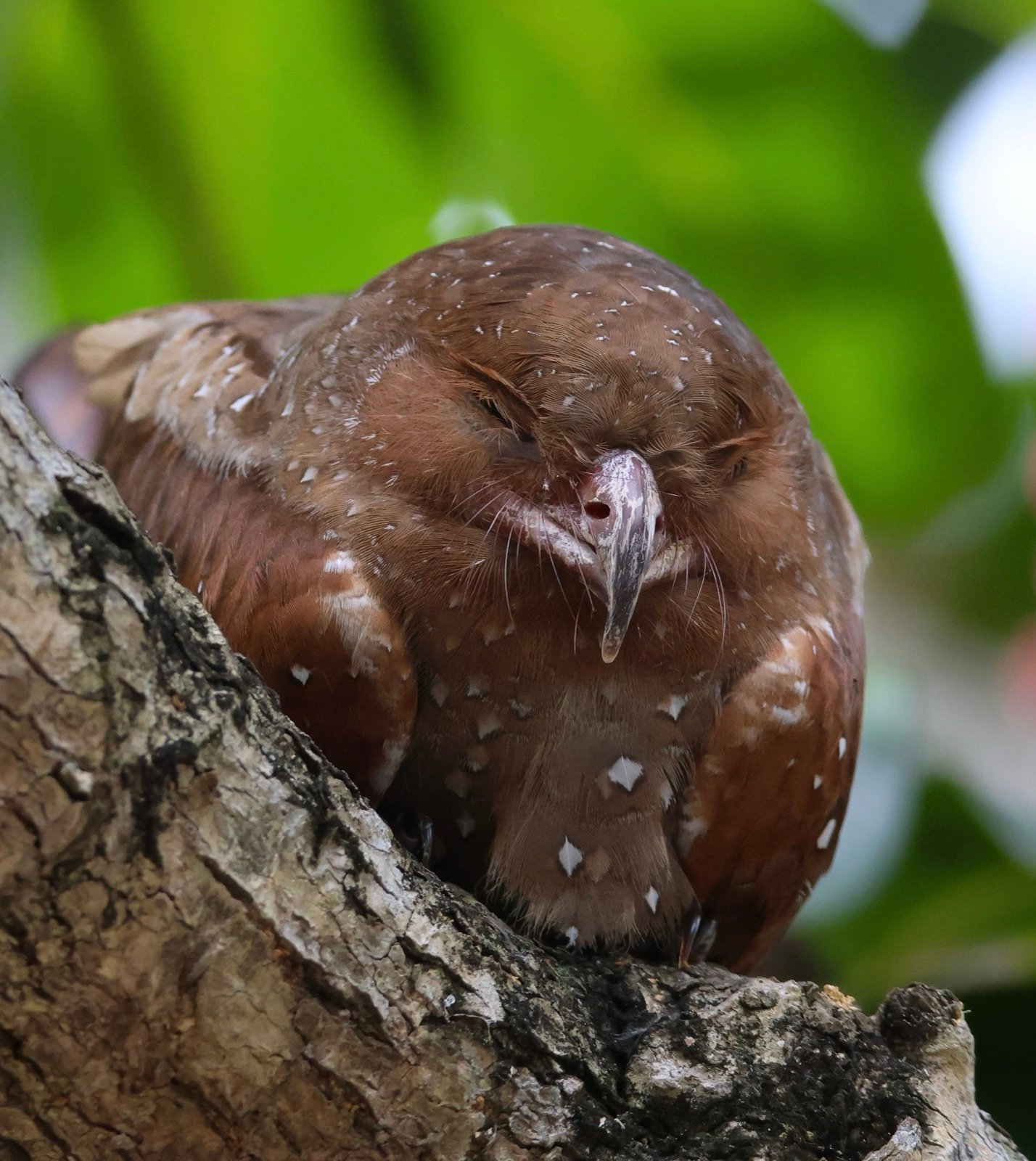
Family Steatornithidae
Oilbird
Steatornis caripensis
In Spanish: Guácharo
- Resident
A rare night-flying fruit eater, a lucky extra and never a target.
The Oilbird, guácharo in Spanish, is the only flying bird in the world that eats fruit and is active at night. In Costa Rica it is only a rare vagrant and not a regular resident, so a trip should not plan around seeing it.
Its normal home is in South America, and Costa Rica lies north of that range. Records here have increased since 2009, which makes it a bird worth knowing about.
On a trip we build, an Oilbird would be a lucky extra and never a target. Its story here is tied to fruiting trees, steep forests and a few patient researchers.
How to find it
Treat this bird as luck, not a target. The Corcovado bird was found as a mixed flock with army ants passed, so following ant-swarm flocks on forest trails is one idea. At Monteverde, birds have been seen eating the fruit of a laurel-family tree that fruits every three years, which may hint at when visits happen. One Costa Rica birder suggests Oilbirds may turn up most years but go unnoticed in the dark of steep cloud forest nights. Breeding sites in Costa Rica are unknown, so there is no cave to visit.
How to recognise it
The Oilbird is a large, slim, nocturnal bird, about 40 to 49 cm long across its range.
Look for these marks:
- Mostly reddish-brown plumage, with white spots on the nape and wings.
- Cinnamon-buff underparts, with white diamond-shaped spots edged in black.
- A stiff, rich brown tail, with white spots on both sides.
- A flattened, strongly hooked bill, ringed by long chestnut bristles.
One Costa Rica birder says it looks a bit like a feathered gargoyle, which suits that hooked bill and bristled face.
What it sounds like
Recording: Jan Ebr & Ivana Ebrová, CC BY 4.0, source, read 4 Nov 2026.
Behaviour and diet
The Oilbird rests by day on cave ledges and goes out at night to find fruit. Adults and chicks eat only fruit pulp.
GPS tracking showed that non-breeding birds roost in caves or rock shelters only about one night in three. On the other nights they roost in forest trees.
The bird seen in Corcovado was resting by day on a low branch, rocking up and down as a mixed flock with army ants passed.
Where it lives
Across its range the Oilbird lives in forest with fruiting trees and needs caves or gorges for breeding and roosting. It occurs from sea level to about 3,400 m.
Its regular range is Guyana, Trinidad, Venezuela, Colombia, Ecuador, Peru, Bolivia and Brazil. Costa Rica lies north of this range, so birds seen here are wanderers. Records here come from very different settings, from Monteverde and Corcovado to the Greater Metropolitan Area.
When to see it
The Monteverde Institute reports that, from the information gathered, the species arrives in Costa Rica between June and September.
Names and lore in Costa Rica
In Spanish the Oilbird is called guácharo, and the name tayo is also used. Both words come from indigenous languages. Costa Rican sources also call it pájaro aceite. In Trinidad it was sometimes called diablotin, French for little devil, which probably refers to its loud cries.
Status and conservation
The Costa Rican list marks the Oilbird as R?,M?, and the Costa Rican Ornithological Association calls it quite rare here, while South American populations are stable and Least Concern with the IUCN.
Photography tips
The Corcovado bird sat clear and exposed by day on a low branch, so scanning forest trails at ant-swarm flocks is the best idea on offer. Steep cloud forest nights are dark, which may explain why Oilbirds go unnoticed.
How we know this 10 sources, each read on the date shown
- Wikipedia read 2026-11-04
https://en.wikipedia.org/wiki/Oilbird - Encyclopedia.com (Grzimek's Animal Life) read 2026-11-04
https://www.encyclopedia.com/environment/encyclopedias-almanacs-transcripts-and-maps/oilbirds-steatornithidae - Cornell Birds of the World read 2026-11-04
https://birdsoftheworld.org/bow/species/oilbir1/cur/introduction - Monteverde Institute blog read 2026-11-04
http://monteverde-institute-blog.org/environmental/guacharo/oilbird - Asociación Ornitológica de Costa Rica read 2026-11-04
https://avesdecostarica.weebly.com/steatornithidae.html - Museo Nacional de Costa Rica read 2026-11-04
https://www.museocostarica.go.cr/nuestro-trabajo/investigaciones/historia-natural/gam/aves/ - Drake Bay Birdwatching read 2026-11-04
https://drakebaybirdwatching.com/oilbird-steathornis-caripensis-in-corcovado-national-park/ - Birdingcraft read 2026-11-04
https://birdingcraft.com/wordpress/2013/12/ - Wikipedia read 2026-11-04
https://en.wikipedia.org/wiki/Guacharo - Panama Birds & Wildlife Photos blog read 2026-11-04
http://panama-wildlife.blogspot.com/2016/05/oilbird-steatornithidae.html