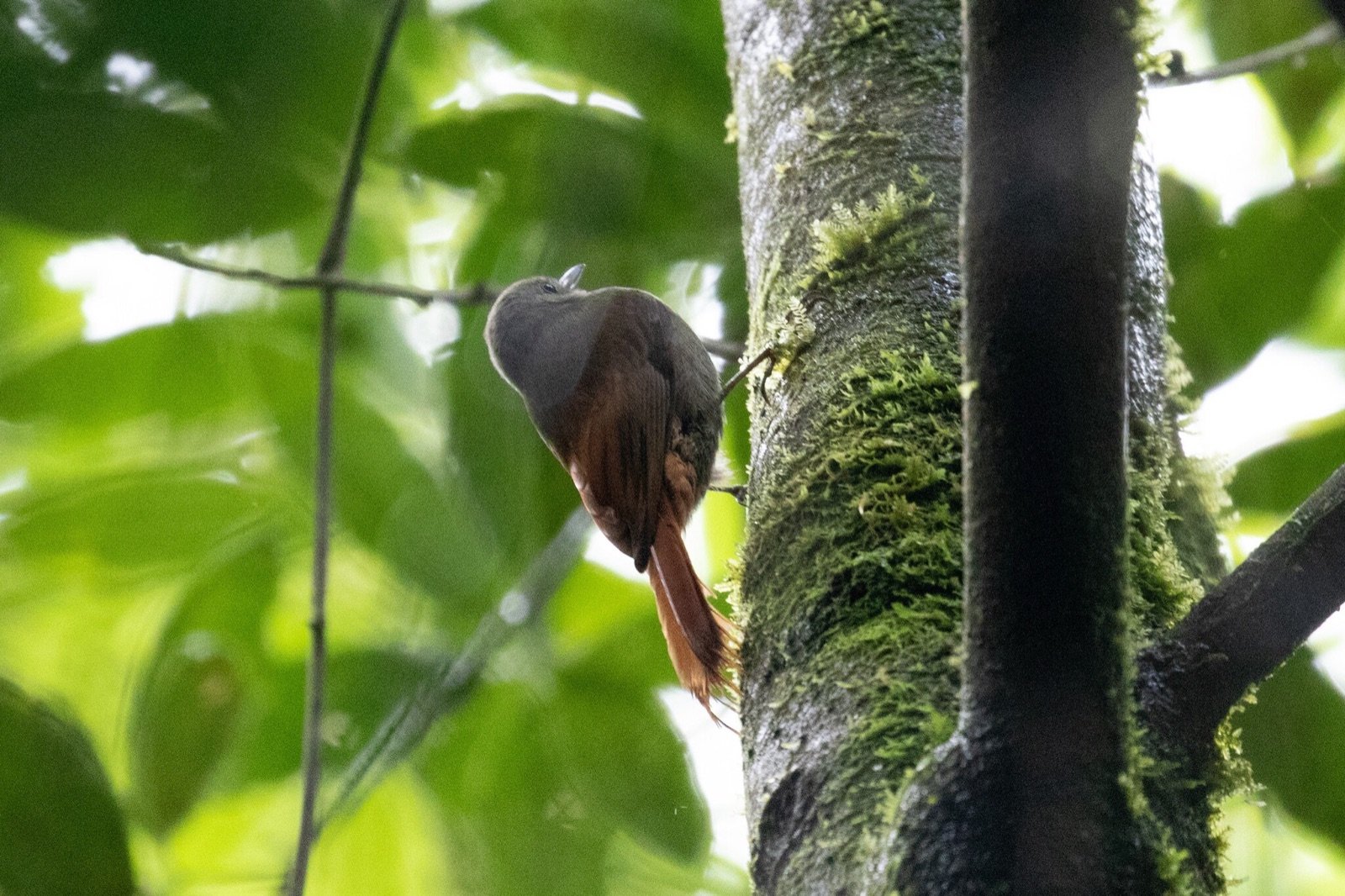
Family Furnariidae
Olivaceous Woodcreeper
Sittasomus griseicapillus
In Spanish: Trepadorcito Aceitunado
- Resident
A small, plain woodcreeper with no streaks, easy to pick out.
The Olivaceous Woodcreeper (Trepadorcito Aceitunado) is the woodcreeper that breaks the pattern: where most of its relatives are streaked or scaly below, this one is plain. In Costa Rica it is the only woodcreeper with a plain gray head and breast.
Birders meet it in foothill and cloud forest, including around Monteverde, often as a single bird working up a trunk.
How to find it
Scan every height of the forest, not just the trunk base, because it often forages quite high. Moist foothill and cloud forest are the best bets. Listen for the fast, rising series of high notes, then look for a small plain bird climbing a fairly open trunk. Check mixed flocks, as it sometimes travels with them.
How to recognise it
This is a small woodcreeper, about 13 to 19.5 cm long, and it looks evenly colored. The head, back and breast are plain olive-green to gray, and the belly is grayish, with no streaks, bars or spots below. The wings and tail are rusty chestnut, which stands out against the quieter body. The bill is small, thin and straight. In flight, a pale yellowish band shows across the middle of the open wing. In Costa Rica a plain gray head and breast is a handy mark, because no other woodcreeper here has it.
What it sounds like
Recording: agujaceratops, CC BY 4.0, source, read 4 Nov 2026.
Behaviour and diet
It is seen alone or in pairs, climbing fairly open trunks and large branches at several forest levels, often quite high. Sometimes it joins mixed flocks, and sometimes it forages alone. It eats insects and other arthropods, plus their larvae and eggs, taken from bark and small holes in trunks, and it may follow army ant swarms to catch fleeing prey. It nests in cavities, using natural holes or old woodpecker holes, and does not dig its own.
Where it lives
Across its wide range it is generally common in many forest and woodland types, including humid, deciduous and mountain forest. It lives mostly below 1500 m, and in smaller numbers up to about 2000 m. In Costa Rica it is fairly common at all levels of moist foothill and cloud forest, and uncommon in dry forest. It has been recorded in Puntarenas province, at Monteverde, and in Guanacaste.
Similar birds
Most woodcreepers have streaks, bars or scaly marks below. This one lacks them, and in Costa Rica its plain gray head and breast set it apart from other woodcreepers.
Names and lore in Costa Rica
In Costa Rica it is called Trepadorcito Aceitunado.
Status and conservation
It is a resident species on the AOCR list (R) and is listed as Least Concern, ranging from Mexico to northeast Argentina.
Photography tips
Look high as well as low, since it climbs at several levels. A bird carrying a caterpillar has been photographed in Costa Rica, so watch for foraging birds on open trunks and larger branches.
How we know this 12 sources, each read on the date shown
- Wikipedia (Spanish), via Wikiwand read 2026-11-04
https://www.wikiwand.com/es/articles/Sittasomus_griseicapillus - Wikipedia read 2026-11-04
https://en.wikipedia.org/wiki/Sittasomus_griseicapillus - Macaulay Library (Cornell Lab) read 2026-11-04
https://macaulaylibrary.org/asset/572280221 - Cloudbridge Nature Reserve bird list read 2026-11-04
https://www.cloudbridge.org/wp-content/uploads/2020/04/Bird-Species-List-Costa-Rica-13-April-2020.pdf - Cornell Neotropical Birds read 2026-11-04
https://neotropical.birds.cornell.edu/Species-Account/nb/species/oliwoo1?__hsfp=3682858442&__hssc=60209138.1.1570838400065&__hstc=60209138.99a265337744294b740e0787aea508c4.1570838400062.1570838400063.1570838400064.1 - Dibird read 2026-11-04
https://dibird.com/species/olivaceous-woodcreeper/ - Birding Craft read 2026-11-04
https://birdingcraft.com/wordpress/2011/11/07/tips-on-woodcreeper-identification-when-birding-costa-rica/ - Field Guides tour report 2016 read 2026-11-04
https://fieldguides.com/triplists/cos16.html - Birdfinders read 2026-11-04
https://www.birdfinders.co.uk/tours/costa-rica.html - BirdQuest tour report 2024 read 2026-11-04
https://www.birdquest-tours.com/birding-tour-reports/costa-rica-classic-2024/ - Listening to Birds blog read 2026-11-04
https://thecanadianwarbler.blogspot.com/2025/03/costa-rica.html - El Ecoturista read 2026-11-04
https://elecoturista.com/internacional/costa-rica-un-destino-ornitologico-top-y-ii-centro-y-norte/