 Osprey
Family Pandionidae
Osprey
Pandion haliaetus
In Spanish: Águila Pescadora (Gavilán Pescador)
- Migrant
A fish-diving raptor that winters on our coasts, rivers and lakes.
The Osprey is a raptor that lives on fish, so you find it where the water is. In Costa Rica it turns up along both the Pacific and Caribbean coasts, and it also uses rivers and lakes inland.
Most Ospreys here are migrants. Birds that breed in the north come south for the warm months, from September to April, and some seem to return to the same spot year after year.
It is a good bird for a beginner because you can watch it from a distance as it flies over the water, dives and carries its catch to a perch. On a trip we build, a boat on the Tárcoles River on the Central Pacific coast is one place guests meet it.
How to find it
Look near open water with plenty of fish. A boat on a lake or river is a good vantage point, and Tárcoles River boat tours from the village of Tárcoles are among the places guests see it, alongside Common Black Hawk, herons and Scarlet Macaw. Scan treetops and other high perches along the shore for perched birds. Listen for whistling or chirping calls overhead, and watch for the flight shape and heavy wingbeats. Over coastal waters, watch for a bird that fishes and then carries its catch to a high perch.
How to recognise it
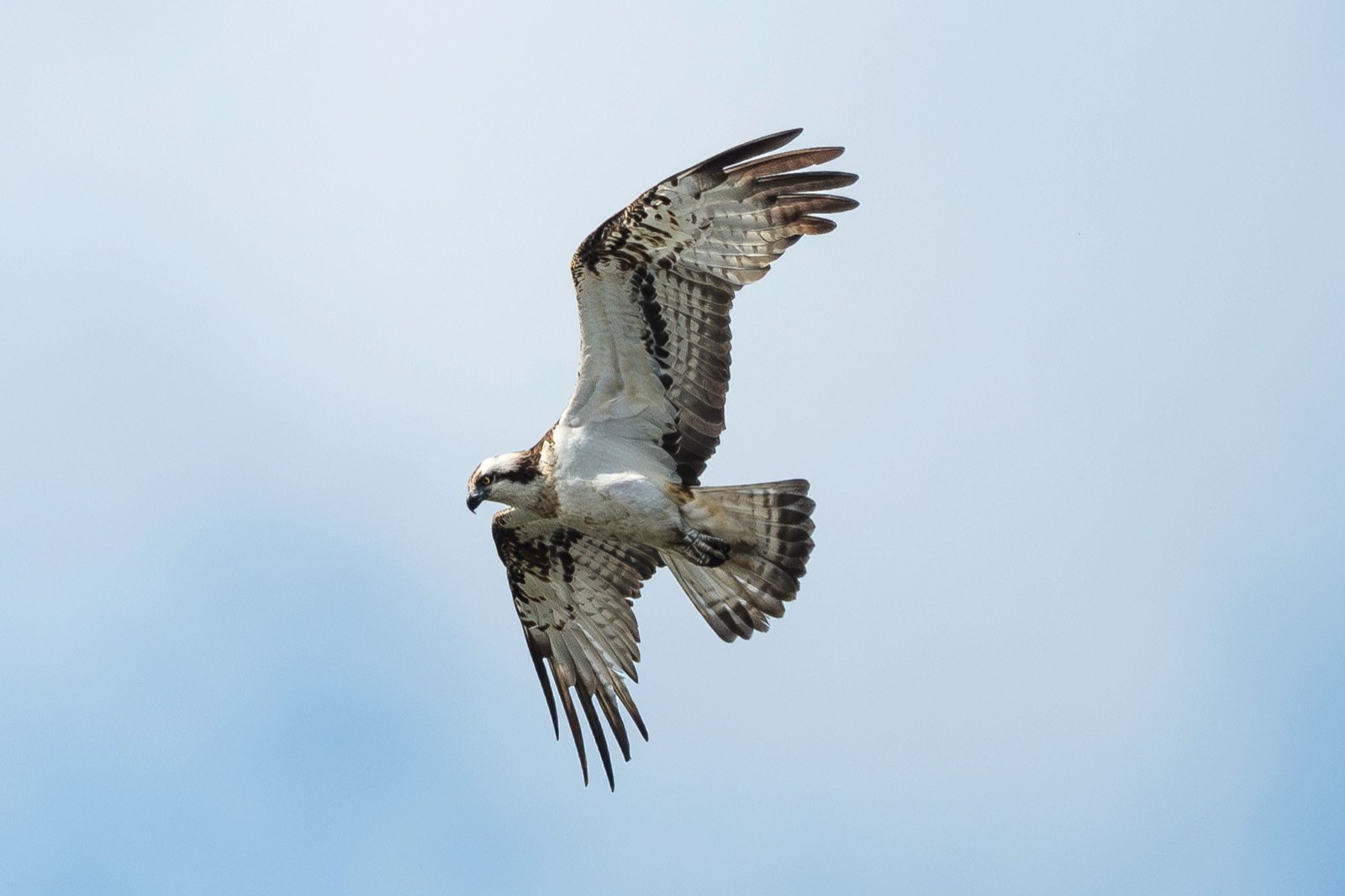
Start with the head and body: a white head with a dark mask through the eye, brown upperparts and white underparts. These marks separate it from other hawks.
Then look at the wings. In flight they are long, arched and bent at the wrist, with drooping hands, which gives a gull-like, boomerang shape. From far away a flying Osprey can look like a gull, but its large, broad raptor wings tell it apart.
The feet are the other story. Tiny spines under the toes and very long talons help it hold slippery fish. It can also swing one toe around to grip with two toes in front and two behind, which helps with a struggling catch.
What it sounds like
Recording: Peter Abrahamsen, CC BY 4.0, source, read 4 Nov 2026.
Behaviour and diet
The Osprey hunts by flying 10 to 30 meters over the water. When it spots a fish it dives feet first, sometimes going fully under, grabs the fish with both feet and carries it to a perch, usually a raised branch. Watching for these feeding perches near water gives you a stationary bird to look at. Heavy wingbeats and that distinctive flight shape give it away as it patrols. A Costa Rica naturalist on the Pacific coast says he often sees Ospreys fishing there, and enjoys watching them do it.
Where it lives
Ospreys live near fresh or salt water where fish are plentiful, such as lakes, rivers, tropical coastal waters and lagoons. In Costa Rica they occur along both the Pacific and Caribbean coasts and also use rivers and lakes inland. They have been seen eating freshwater fish at Lake Arenal and Río Cañas, fishing off Pacific beaches, at the mouth of the Tárcoles River and near Turrialba in Cartago province, where local birders say it shows up regularly.
When to see it
In Costa Rica it is a migrant and winter resident, here from September to April. Fall passage is mainly in September and October, and spring passage is in March and April, with migrants moving mostly along both coasts.
Similar birds
From far away a flying Osprey can look like a gull. Its large, broad raptor wings tell it apart, and the white head with a dark eye mask, brown back and white underparts help separate it from other hawks.
Names and lore in Costa Rica
Costa Ricans use the Spanish name Águila Pescadora, and the AOCR list adds Gavilán Pescador as an alternate name. Elsewhere the species is also called halieto and guincho.
Status and conservation
The AOCR list marks the Osprey as M, a migrant, and it is not in a threatened category in Costa Rica.
Photography tips
Watch for the feeding perches. After a catch the Osprey carries the fish in its feet to a perch, usually a raised branch, and that gives you a stationary bird to photograph. Over coastal waters, look for birds fishing and follow them to their perch. A boat on a lake or river gets you closer to shoreline treetops.
How we know this 14 sources, each read on the date shown
- Tico Times read 2026-11-04
https://ticotimes.net/2023/03/29/costa-rica-wildlife-exploring-the-unique-characteristics-of-the-osprey - Costa Rica Photos read 2026-11-04
http://www.costaricaphotos.com/birds/sea-birds/6081-osprey - Mundo Águila read 2026-11-04
https://mundoaguila.com/blog/aguilas/osprey-costa-rica/ - All About Birds, Cornell Lab read 2026-11-04
https://www.allaboutbirds.org/guide/Osprey/overview - Earthlife.net read 2026-11-04
https://earthlife.net/ospreys/ - Ecos del Bosque read 2026-11-04
https://ecosdelbosque.com/fauna/pandion-haliaetus - San Diego Natural History Museum read 2026-11-04
https://www.sdnhm.org/oceanoasis/fieldguide/pand-hal-sp.html - El Herrerillo read 2026-11-04
https://www.herrerillo.com/2017/02/aguila-pescadora-pandion-haliaetus.html - Birds Colombia (Wikipedia text) read 2026-11-04
https://birdscolombia.com/2017/12/05/aguila-pescadora-osprey-pandion-haliaetus/ - Gio Tours read 2026-11-04
https://www.giotours.com/tarcoles-river-boat-tour-with-crocodile-man-tours/ - Two Weeks in Costa Rica read 2026-11-04
https://www.twoweeksincostarica.com/crocodile-safari-boat-tour/ - ResearchGate (Osprey in San José parks) read 2026-11-04
https://www.researchgate.net/publication/361517663_Using_citizen_science_Report_of_observations_of_Osprey_Pandion_haliaetus_in_two_urban_parks_in_San_Jose_Costa_Rica - Birds of the World (Cornell) read 2026-11-04
https://birdsoftheworld.org/bow/species/osprey/cur/multimedia?media=photos - Aves de Perú read 2026-11-04
https://avesdeperu.org/pandionidae/aguila-pescadora-pandion-haliaetus/