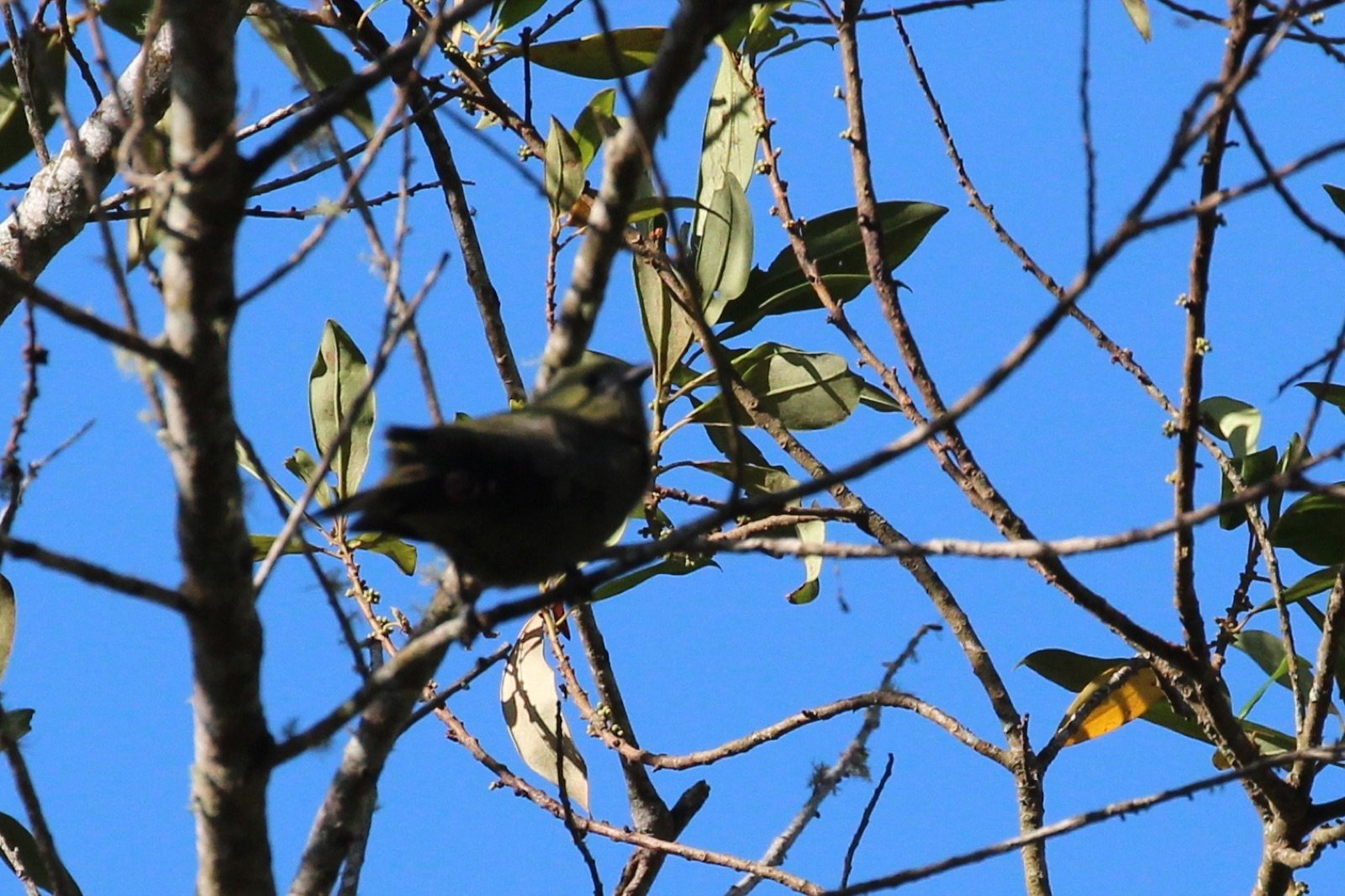
Family Thraupidae
Palm Tanager
Thraupis palmarum
In Spanish: Tangara Palmera (Viudita de la Costa)
- Resident
A plain, squeaky tanager of palms, gardens and feeders, common to about 1500 m
The Palm Tanager is a fairly common resident across Costa Rica, from the lowlands up to about 1500 m, and rarely higher. It is especially abundant along the Caribbean coast, among coconut palms.
It is a good first tanager for a beginner. It is plain, smoky olive-gray rather than showy, so where it sits and how it sounds give it away: in palms, noisily, often in pairs. On a trip we build, it turns up in gardens, along forest edges and at feeders, where it eats almost anything and is far from shy.
How to find it
Look around palm trees, open shrubby areas, gardens and forest edges. Listen for the noisy squeaks, which help you locate the bird in dense foliage. In the driest areas where it lives, palm clusters are where it is easiest to find. Fruiting trees are worth watching, since small groups gather there. It also joins mixed-species flocks, so check them when one passes. Feeders are another good bet, because it is among the common birds at Costa Rican feeders.
How to recognise it
The Palm Tanager is a rather plain bird. Look for these marks:
Smoky olive-gray plumage.
Blackish flight feathers.
A long blackish tail edged in green.
A pale olive-yellow wing band, which shows best in flight.
It measures about 19 cm and weighs about 36 g. The sexes look alike, and young birds are duller. A photographer in Costa Rica notes that the plain colours blend well into dry or dead branches, while against a blue sky the subtle colours show well. Because the plumage is so understated, shape, tail and wing pattern matter more than any bright patch.
What it sounds like
Behaviour and diet
Pairs stay together all year. Palm Tanagers are social, restless and unwary, usually in pairs or small flocks, sometimes with other species. They eat fruit, especially figs and Cecropia catkins, and also search foliage, including palm fronds, for insects and spiders, often hanging down to peer under large leaves. In Costa Rica the nest is a cup of dry leaf strips and palm fibre, sometimes with moss, usually hidden in the crown of a palm, 6 to 30 m up. The species has also been seen rubbing ants on its feathers, which may help control parasites.
Where it lives
The Palm Tanager likes open country with scattered trees, especially palms. That includes oil palm and coconut plantations, pastures, parks and gardens. In Costa Rica it is fairly common nationwide from the lowlands up to about 1500 m. The exception is the dry northwest, where it is rare and local. It is especially abundant along the Caribbean coast, though across most of the country it is less numerous than the Blue-gray Tanager. Across its wider range it lives in dry and humid regions and also uses secondary forest, forest edges and farmland.
When to see it
In Costa Rica it breeds between March and June.
Similar birds
The Blue-gray Tanager, called Viuda or Viudita in Costa Rica, is a close relative that is usually more numerous, and it is more likely to settle in towns and cities. Two less common look-alikes are the Plain-colored Tanager and the Sulphur-rumped Tanager. The Plain-colored has a smaller bill and a bit of black on the face, and in good light shows a buffy wash on the belly and vent. The Palm Tanager is the one found around palms.
Names and lore in Costa Rica
The AOCR list pairs the Spanish name Tangara Palmera with the nickname Viudita de la Costa. The related Blue-gray Tanager is called Viudita or Viuda. Spanish-language sources say the name tángara palmera is used in Costa Rica, Ecuador, Nicaragua and Panama.
Status and conservation
The AOCR list marks it as a resident (R), and the IUCN lists it as Least Concern because it has a large range and a stable population.
Photography tips
Watch fruiting trees, where small groups gather, and check forest edges and clearings, where the birds often forage. Against a blue sky the subtle colours show well, so try to shoot from below when the bird perches in an open palm crown.
How we know this 18 sources, each read on the date shown
- Ecos del Bosque read 2026-11-04
https://ecosdelbosque.com/fauna/thraupis-palmarum - EcuRed read 2026-11-04
https://www.ecured.cu/Thraupis_palmatum - Diversidad y un poco de todo read 2026-11-04
https://www.diversidadyunpocodetodo.com/tangara-palmera-tangara-palmarum/ - PlanetScott read 2026-11-04
https://www.planetscott.com/speciesdetail/9270/palm-tanager-thraupis-palmarum - Wikimedia Commons read 2026-11-04
https://commons.wikimedia.org/wiki/File:Thraupis_palmarum_-near_Rancho_Naturalista,_Cordillera_de_Talamanca,_Costa_Rica-8.jpg - Birdfact read 2026-11-04
https://www.birdfact.com/birds/palm-tanager - Birda read 2026-11-04
https://app.birda.org/species-guide/37203/Palm_Tanager - Valery Schollaert read 2026-11-04
https://valeryschollaert.wordpress.com/tangara-des-palmiers-thraupis-palmarum/ - Birds & Breakfast Costa Rica read 2026-11-04
https://birdsandbreakfast.com/en/palm-tanager/ - Wikipedia (Spanish) read 2026-11-04
https://es.wikipedia.org/wiki/Thraupis_palmarum - Birdingcraft read 2026-11-04
https://birdingcraft.com/wordpress/2009/03/27/common-costa-rican-birds-palm-tanager/ - Birds Colombia read 2026-11-04
https://birdscolombia.com/2016/08/19/azulejo-palmero-thraupis-palmarum/ - Cornell Birds of the World read 2026-11-04
https://birdsoftheworld.org/bow/species/paltan1/cur/introduction - Birdingcraft read 2026-11-04
https://birdingcraft.com/wordpress/tag/palm-tanager/ - Aves Ibericas, Aves Costa Rica read 2026-11-04
https://www.avesibericas.es/costaricaaves9.htm - Costa Rica Focus read 2026-11-04
https://www.costaricafocus.com/best-places-to-see-tanagers-in-costa-rica/ - Animalia read 2026-11-04
https://animalia.bio/palm-tanager - Birding Craft read 2026-11-04
https://birdingcraft.com/wordpress/tag/plain-colored-tanager/
