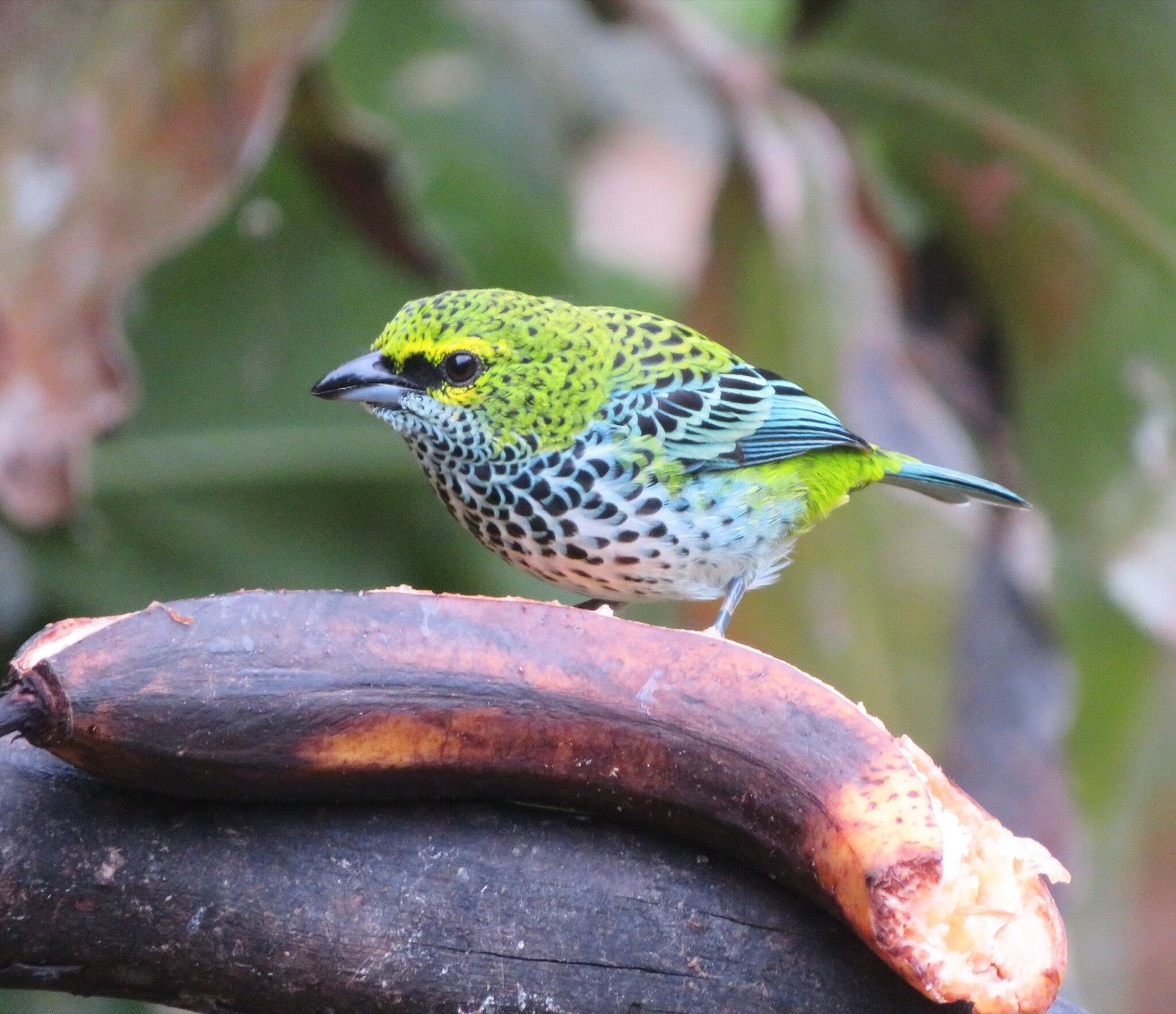
Family Thraupidae
Speckled Tanager
Ixothraupis guttata
In Spanish: Tangara Moteada (Cebra)
- Resident
A small green tanager spotted with black, found in foothill fruit flocks.
The Speckled Tanager is a small tanager, about 13 cm long, with green upperparts spotted in black and a yellow face. In Costa Rica no other tanager has black spotting on both the upperparts and the underparts, which makes it a good one to learn.
It is a resident, uncommon to fairly common in the Caribbean foothills from the Cordillera de Tilarán southward, and it is also found on the Pacific side. It usually travels in pairs or small groups of 3 to 6 birds, often inside mixed flocks of fruit-eating birds.
On a trip we build, a fruiting tree or a forest-edge balcony in the foothills is where a whole flock can come into view at once.
How to find it
Look in the canopy and along the edges of foothill forest, and check mixed fruit-eating flocks. Groups of 3 to 6 are typical, so when you find one bird, scan the neighbouring branches for its companions. Fruiting trees in the foothills draw it in with other tanagers. Feeders can bring it close too, and balcony birding at forest-edge stations gives good views of mixed tanager flocks.
How to recognise it
Look for these marks:
Green upperparts with black spots.
A yellow face with a black line running from the eye to the gape.
Black wings and tail edged with green.
White underparts spotted with black.
It is a small tanager, about 13 cm long and about 18 g in weight. Males and females look alike, so there are not two plumages to sort out. In Costa Rica the double spotting, on the back and on the belly, separates it from other green tanagers.
Behaviour and diet
This is a social bird. In Costa Rica it goes in pairs or small groups of 3 to 6 birds and is often seen in mixed flocks of fruit-eating birds. Across its range it is often seen with Bay-headed Tanagers and honeycreepers, and it is rarely found alone.
It forages busily in the high canopy, flitting among the trees. The nest in Costa Rica is a tidy cup placed in foliage 3 to 8 m up, holding 2 white eggs with heavy brown spotting.
Where it lives
In Costa Rica it lives in the upper levels of humid forest, and it also uses nearby secondary growth and clearings with scattered trees and shrubs. It is often seen in the middle levels or canopy, and in vegetation next to human settlements.
It is found mainly at 400 to 1000 m on the Caribbean slope and 300 to 1400 m on the Pacific slope, somewhat higher near the Panama border. The Costa Rican subspecies lives on the Caribbean slope of Costa Rica and western Panama.
When to see it
Breeding in Costa Rica runs from April to June.
Similar birds
The similar Spotted Tanager has a green head, while the Speckled Tanager has a yellow head. The Spotted Tanager lives in South America and does not overlap with it in Costa Rica. Among Costa Rican green tanagers, black spotting on both back and belly is the clearest mark.
Names and lore in Costa Rica
Costa Rican sources list the names Cebra, Zebra and Tangara Moteada. Cebra means zebra, which fits its striped and spotted pattern. Tangara Moteada is also the name used in Panama, while Colombia uses Tangará Pecosa and Tángara Goteada, and Venezuela uses Tángara Pintada.
Status and conservation
It is a resident on the AOCR list (R), rated Least Concern by the IUCN and described as locally common in montane cloud forest in Costa Rica and Panama.
Photography tips
It is common at foothill sites on the Caribbean side and in parts of the southern Pacific zone, but it can forage high in trees and live in dense forest, so photos can take effort. Balcony birding at forest-edge stations gives good views of tanager mixed flocks, and the balcony at Pocosol Station works well for tanagers.
How we know this 18 sources, each read on the date shown
- Wikipedia read 2026-11-04
https://en.wikipedia.org/wiki/Speckled_tanager - Aves de Costa Rica read 2026-11-04
https://avesdecostarica.com/Tangara-guttata.html - Diversidad y un poco de todo read 2026-11-04
https://www.diversidadyunpocodetodo.com/tangara-pintoja-tangara-guttata/ - Wikipedia (Spanish) read 2026-11-04
https://es.wikipedia.org/wiki/Ixothraupis_guttata - Howler Magazine read 2026-11-04
https://howlermag.com/es/speckled-tanager-profile/ - Flickr (photo caption) read 2026-11-04
https://www.flickr.com/photos/antpitta/37222016312 - BirdForum gallery read 2026-11-04
https://www.birdforum.net/gallery/speckled-tanager.692775/ - EcoRegistros read 2026-11-04
https://www.ecoregistros.org/sheet/Ixothraupis-guttata - Carolina Birds (Birds of the World summary) read 2026-11-04
https://carolinabirds.org/HTML/Thraupidae_Tangara.htm - Cloudbridge Nature Reserve bird list read 2026-11-04
https://www.cloudbridge.org/wp-content/uploads/2020/04/Bird-Species-List-Costa-Rica-13-April-2020.pdf - Avibase read 2026-11-04
https://avibase.bsc-eoc.org/species.jsp?avibaseid=14DFDF9F8B96A971 - Birding Craft read 2026-11-04
https://birdingcraft.com/wordpress/category/caribbean-foothills/ - Eagle-Eye Tours read 2026-11-04
https://www.eagle-eye.com/blog/costa-rica-caribbean-mountains-to-coast-2025-trip-report-oct-1-12/ - Field Guides read 2026-11-04
https://fieldguides.com/triplists/cos18.html - Tropical Birding read 2026-11-04
https://tropicalbirding.com/product/comprehensive-costa-rica-birding-from-border-to-border/ - American Bird Conservancy read 2026-11-04
https://abcbirds.org/birds/speckled-tanager/ - Birds Colombia read 2026-11-04
https://birdscolombia.com/2019/09/15/tangara-pecosa-speckled-tanager-ixothraupis-guttata/ - Lifer Tours read 2026-11-04
https://www.lifertours.com/single-post/easier-to-photograph-in-costa-rica-5-fantastic-tanagers