Family Parulidae
Palm Warbler
Setophaga palmarum
In Spanish: Reinita Coronicastaña
- Migrant
A tail-bobbing, ground-feeding warbler that is a true rarity here.
The Palm Warbler, Reinita Coronicastaña in Costa Rica, is a small warbler that bobs its tail nonstop. On the official Costa Rican bird list it carries the status M: a migrant that visits from elsewhere and does not breed in the country.
It is also a genuine rarity. A Costa Rican field guide calls it a rare winter migrant, and one birding writer calls it a serious mega rarity that shows up about every year or two. A local birder says finding one is like winning the lottery.
So think of it as a bonus bird to hope for, and a good reason to look carefully at every low, tail-wagging warbler on the ground.
How to find it
Look in open, low places such as lawns, gardens, beach scrub and the edges of wet areas, and scan the ground as well as the branches. A tail that bobs nonstop is the first clue to follow. The La Fortuna bird was first noticed by a dry chip note when the observer pished, and was then seen flying up from the ground. Listen for that note. Check for the yellowish rump and undertail coverts when it flies. Few of these birds can be chased, so treat any sighting as a happy surprise.
How to recognise it
Palm Warblers are small, with adults about 12 to 14 cm long, and drab overall.
The most striking marks are a yellowish rump and yellowish undertail coverts. Look for both when the bird flits away from you.
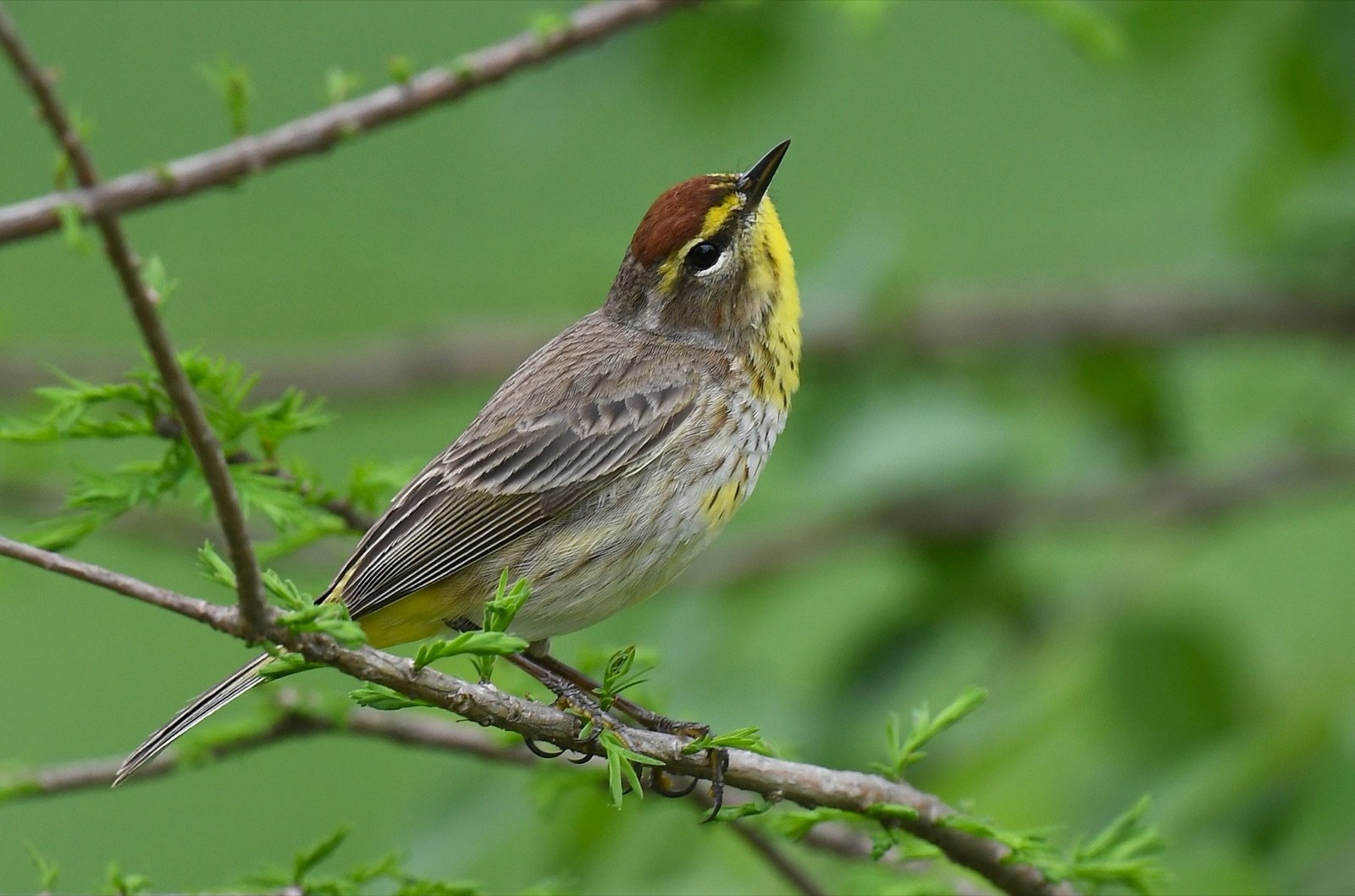
In fall and winter the crown is dark, the underparts are whitish with yellow flanks, and the eyebrow stripe is pale brown. Breeding adults look quite different, with a chestnut cap and a yellow eyebrow, throat and breast.
Two forms exist. The Western form is paler and drabber, with whitish underparts and fine brown streaks. The Eastern form has fully yellow underparts and broader chestnut streaks.
What it sounds like
Recording: Guy Babineau, CC BY 4.0, source, read 4 Nov 2026.
Behaviour and diet
The habit that gives the bird away is the tail. Palm Warblers bob their tails constantly, and this is a good clue to identification. They spend much time on the ground or in very low plants.
They feed on the ground more than most warblers and sometimes fly up to catch insects. In Costa Rica, a bird found in La Fortuna fed on the ground and then flew up into the trees, wagging its tail as it went.
Where it lives
A Costa Rican field guide lists the habitat as open beach scrub, gardens, lawns and nearby scrubby woodland. Across its winter range the species uses open habitats and is seen mostly along marshes and wet areas, usually feeding on the ground.
Records here come from Cerro de la Muerte, a high mountain area, and from the Turrialba area and La Fortuna. On its northern breeding grounds it nests in boreal bogs and fens, far from Costa Rica.
When to see it
Records from the Turrialba area date from January and February of 2016, and a bird was photographed at Cerro de la Muerte in March 2016.
Similar birds
Kirtland's, Prairie and Palm Warblers are the only Setophaga warblers that bob their tails nonstop, which makes the Prairie Warbler (Reinita Galana) the closest lookalike for this habit. A Spanish source notes that a perched Prairie Warbler also wags its tail quickly. Use the call, the yellowish rump and undertail coverts, and the drab overall look to separate them.
Names and lore in Costa Rica
In Costa Rica the bird is called Reinita Coronicastaña. Other countries use different Spanish names, such as reinita palmera in Colombia, reinita coronirrufa in Nicaragua and reinita del palmar in Panama.
Status and conservation
The official Costa Rican bird list gives the Palm Warbler the status M, a migrant that does not breed in the country, and the IUCN rates the species Least Concern.
Photography tips
Start with sound. The La Fortuna bird was first noticed by a dry chip note when the observer pished, and was then seen flying up from the ground and wagging its tail. Watch low ground at the edge of trees, where the bird may fly up and show its tail bobbing.
How we know this 12 sources, each read on the date shown
- Lista Oficial de las Aves de Costa Rica (AOCR) read 2026-11-04
https://listaoficialavesdecostarica.wordpress.com/lista-oficial/lista-oficial-online/ - World Bird Photos read 2026-11-04
https://www.worldbirdphotos.com/photo/warbler-palm-setophaga-palm-arum-costa-rica/ - Wikipedia (Spanish) read 2026-11-04
https://es.wikipedia.org/wiki/Setophaga_palmarum - Cornell Birds of the World read 2026-11-04
https://birdsoftheworld.org/bow/species/palwar/cur/systematics - Wikipedia read 2026-11-04
https://en.wikipedia.org/wiki/Palm_warbler - iNaturalist (Wikipedia text) read 2026-11-04
https://www.inaturalist.org/taxa/145242-Setophaga-palmarum - Birds of North America read 2026-11-04
https://www.birds-of-north-america.net/Palm_Warbler.html - Birds of Costa Rica (field guide text) read 2026-11-04
https://dokumen.pub/birds-of-costa-rica-9780691243351.html - Birds for Beer read 2026-11-04
https://birdsforbeer.com/2018/05/26/from-costa-rica-to-minnesota-12-migrant-warblers/ - 10,000 Birds read 2026-11-04
https://www.10000birds.com/rare-birds-in-costa-rica-from-a-local-birding-perspective.htm - Birdingcraft read 2026-11-04
https://birdingcraft.com/wordpress/2020/01/27/two-megas-in-30-minutes-at-la-fortuna/ - Ecoregistros read 2026-11-04
https://www.ecoregistros.org/ficha/Setophaga-palmarum