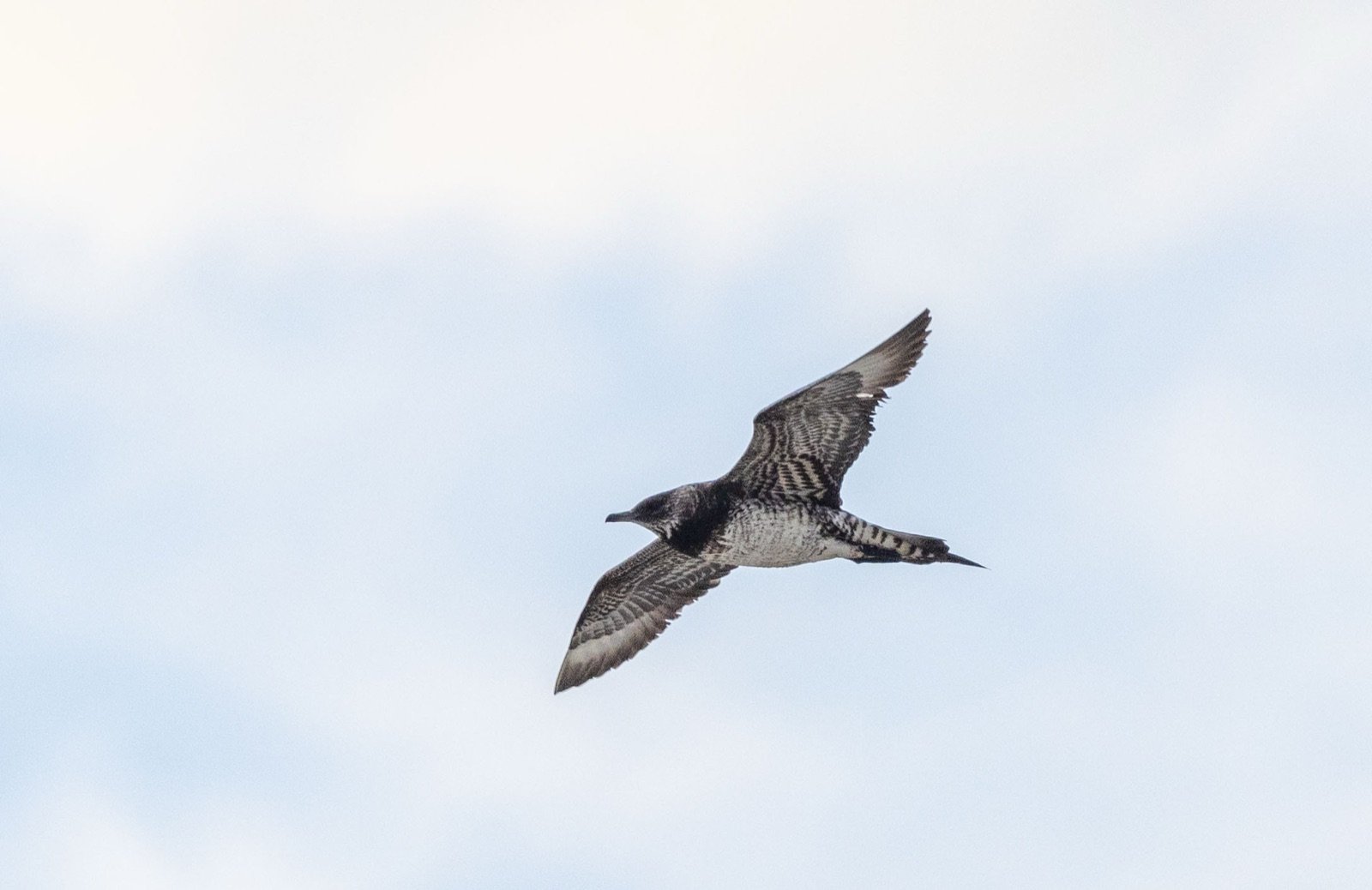
Family Stercorariidae
Parasitic Jaeger
Stercorarius parasiticus
In Spanish: Págalo Parásito
- Migrant
A sea pirate that passes the Pacific coast, chasing gulls and terns.
The Parasitic Jaeger (Págalo Parásito) makes its living by chasing gulls and terns until they drop or cough up their catch, then stealing it. The habit is called kleptoparasitism, and it is the clearest clue when you scan the water.
In Costa Rica it is a passage migrant, not a breeding bird. It breeds on Arctic tundra and spends the northern winter at sea in the Southern Hemisphere, so in Costa Rica it is only a passage migrant. It is reported mainly along the Pacific coast, where it usually appears in small groups.
On a trip we build, the best chances come from the water: the Puntarenas to Paquera ferry, or a boat outing off the Nicoya Peninsula.
How to find it
Of the three jaeger species, this is the one most likely to be seen from shore, so scan tidal waters and the gull and tern flocks near the coast for a fast, sharp-winged bird giving chase. The Puntarenas to Paquera ferry crosses the Gulf of Nicoya in about an hour, and birders treat it as a mini pelagic trip, with a jaeger one of the birds they may see from the top deck. On one return crossing a Parasitic Jaeger turned up near the end of the trip, though a blogger called it a tough bird to see even when expected. Sea birding here is recent, and local guides from Cabuya and Cabo Blanco, and others around Bahía Herradura and the South Pacific, now run boat outings. Look rather than listen, since it is mostly silent at sea.
How to recognise it
Plumage varies by morph.
Light-morph adults: brown back, mostly white underparts, black cap, yellowish neck.
Dark-morph adults: dark brown all over.
All morphs: a white flash at the base of the primaries, a useful mark when the bird banks over the water.
Breeding adults have two pointed central tail feathers that stick out past the rest of the tail. They are short, straight and pointed. Young birds show only a very short tail point, so the tail helps less with them.
Think of a fast, powerful, sharp-winged bird. Compared with Long-tailed Jaeger it is bulkier, shorter-winged and less tern-like, and its flight is more falcon-like.
What it sounds like
Recording: Syd Cannings, CC BY 4.0, source, read 4 Nov 2026.
Behaviour and diet
This is a pirate. It chases gulls and terns until they drop or cough up their catch, then steals it. Spanish-language sources call it the most acrobatic and aggressive of the jaegers toward other seabirds.
Outside the breeding season it can spend all its time at sea, usually over the continental shelf. That is why a sub-adult perched on the dock at Puntarenas, as birders arrived for the ferry, was such an unexpected sight before the boat even left.
Where it lives
Away from its Arctic breeding grounds this is a bird of open water, usually over the continental shelf. In Costa Rica it is reported mainly along the Pacific coast, where it usually appears in small groups.
Our information points to the Gulf of Nicoya, the southern tip of the Nicoya Peninsula and the waters offshore. Jaegers have also been recorded on the Caribbean coast of Costa Rica, so the Pacific is the focus but perhaps not the only possibility. Spanish-language sources describe it as the most coastal of the three jaegers.
When to see it
A birder's blog reports it in Puntarenas during the summer months, but that is one observer's note, not a pattern. Jaegers have also been recorded on the Caribbean coast in March.
Similar birds
It is easily confused with Pomarine and Long-tailed Jaegers. Pomarine is much bigger and bulkier with a thick bill. Adult Long-tailed has longer tail feathers, is paler gray above and lacks the breast band. Adults are easiest to separate by the tail: Parasitic is short, straight and pointed, Pomarine twisted and spoon-shaped, Long-tailed has streamers about as long as its body. Young jaegers are very hard to separate.
Names and lore in Costa Rica
Besides the AOCR name Págalo Parásito, a Spanish name used in other Latin American countries is Salteador Chico, though it is listed for Argentina, Chile and Uruguay rather than specifically for Costa Rica.
Status and conservation
The AOCR lists it as a migrant (M), and in Costa Rica it is a passage migrant that does not breed.
Photography tips
Scan gull and tern flocks near shore, where the chases happen, and keep the camera ready on the top deck of the ferry. A dark-morph adult once flew low over the water among the first birds of a Pacific pelagic day, so low passes are worth anticipating. Pomarine Jaeger is a sporadic visitor off both coasts and most frequent from December to February off the Pacific, so a jaeger seen then may well be a Pomarine.
How we know this 14 sources, each read on the date shown
- Bird Watching Costa Rica read 2026-11-04
https://www.birdwatchingcostarica.com/ave/parasitic-jaeger/ - iNaturalist (Wikipedia text) read 2026-11-04
https://www.inaturalist.org/taxa/4489-Stercorarius-parasiticus - USGS Patuxent Identification Tips read 2026-11-04
https://www.mbr-pwrc.usgs.gov/id/htmid/h0370id.html - Cornell Lab All About Birds read 2026-11-04
https://www.allaboutbirds.org/guide/Parasitic_Jaeger/overview - Birds of Hawaii read 2026-11-04
https://www.birdsofhawaii.info/p/parasitic-jaeger.html - 10,000 Birds read 2026-11-04
https://www.10000birds.com/mini-pelagic-birding-in-costa-rica-at-puntarenas.htm - Birding for Conservation read 2026-11-04
https://www.birdingforconservation.com/2019/03/cabuya-pelagic/ - Birdingcraft read 2026-11-04
https://birdingcraft.com/wordpress/tag/pelagic-birding/ - Birdwatching in Costa Rica read 2026-11-04
https://birdwatchingincostarica.com/aves-oceanicas-en-costa-rica-un-pais-de-mar-un-tesoro-por-descubrir/ - Chugach Regional Resources Commission read 2026-11-04
https://crrcalaska.org/bird/parasitic-jaeger/ - Peru Aves read 2026-11-04
https://www.peruaves.org/stercorariidae/parasitic-jaeger-stercorarius-parasiticus/ - Marine Ornithology (via ResearchGate) read 2026-11-04
https://www.researchgate.net/publication/259892878_Caribbean_records_of_Long-tailed_Jaeger_Stercorarius_longicaudus_from_Costa_Rica - Focus On Nature Tours read 2026-11-05
http://focusonnature.com/BirdListCostaRica.htm - Boletín de Investigaciones Marinas y Costeras (Colombia) read 2026-11-05
http://www.scielo.org.co/scielo.php?script=sci_arttext&pid=S0122-97612004000100013