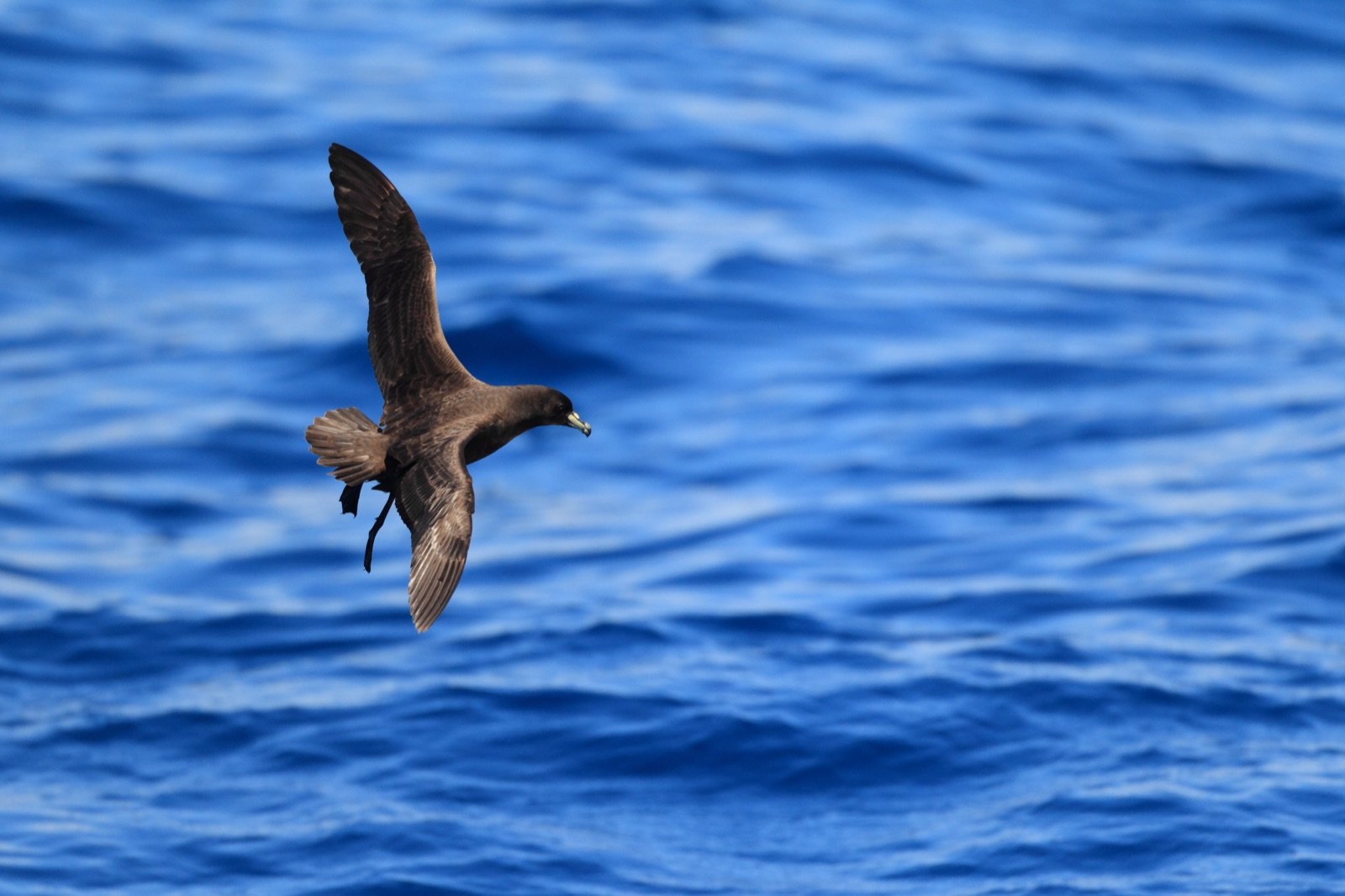
 Parkinson's Petrel
Family Procellariidae
Parkinson’s Petrel
Procellaria parkinsoni
In Spanish: Petrel de Parkinson
- Migrant
A rare, sooty black petrel from New Zealand, met on deep-water boat trips.
Parkinson's Petrel (Petrel de Parkinson) is an ocean bird that nests in New Zealand and spends the non-breeding period in the waters of Central and South America, including Costa Rica's seas. The Costa Rican list marks it as a migrant (M).
You will not meet it from the beach. Visitors find it on offshore boat trips from the Pacific coast, often outings run with a local university seabird researcher, and one Costa Rican site calls it one of the rarest birds in Costa Rican waters.
For a beginning birder this is a bird for a special day at sea, when a dark, slim petrel may glide past near dolphins.
How to find it
Going out into deep water on a boat trip is the way to find it. A pelagic outing gives a real chance at rarities, and Parkinson's Petrel is named among them. Costa Rica has no regularly scheduled pelagic trips, but birders can arrange a deal with a fishing boat to reach deep water. Check every group of dolphins and whales, since most petrels seen in Pacific surveys were with them. The Puntarenas to Paquera ferry is a short, easy way to sample sea birds, but it is not a likely place for this rare deep-water petrel.
How to recognise it
Look for these marks:
Adults are all sooty black.
The bill is pale yellowish, with a greyer top and tip.
The eyes are dark brown.
The legs and feet are blackish.
It is about 46 cm long, smaller and slimmer than a White-chinned Petrel.
A 1975 sighting off Costa Rica's Pacific coast was told apart from shearwaters by a heavy horn-coloured, dark-tipped bill, dark underwing linings and a different style of flight. Those clues still help: check the bill first, then the underwings, then how the bird moves over the waves.
Behaviour and diet
Parkinson's Petrel mostly feeds at night. It is often alone at sea, but may feed in small groups with marine mammals.
In Pacific surveys, about three quarters of the petrels seen were with dolphins, mostly melon-headed whales and false killer whales. It avoids busy mixed feeding flocks, so do not expect it in the middle of a noisy scrum of other seabirds.
Where it lives
This is a seabird of the open ocean. Across its range it is reported off the Pacific coasts of Panama, Costa Rica, Guatemala and Mexico, and around the Galapagos.
In Costa Rica it belongs to deep water off the Pacific side, where it spends the months away from its New Zealand nesting grounds.
When to see it
An older study of Costa Rican waters found most known sightings near Central America came in March or April, and the authors suggested the bird may visit these waters regularly in those months. Recent pelagic trips also logged national record counts, including 26 birds on 8 July, during an intense El Niño year.
Similar birds
It is very like the Westland Petrel, but has a slightly smaller bill and narrower wings. Spectacled Petrel is another rare Procellaria on the Costa Rica list, but Parkinson's is the regular one of the two. Any bird that looks like a Parkinson's Petrel in the region should be photographed and checked carefully.
Names and lore in Costa Rica
The Spanish name on the Costa Rican list is Petrel de Parkinson. Other Spanish names in use elsewhere include Pardela de Parkinson and Fardela de Parkinson, and in English it is also called Black Petrel. It is named for Sydney Parkinson, the artist who made the first illustration of it on James Cook's first Pacific voyage in 1768.
Status and conservation
It is a migrant (M) on the AOCR list and is considered Vulnerable to extinction.
Photography tips
Photographs are useful because the bird looks so close to the Westland Petrel, which has a slightly bigger bill and broader wings. Good shots of the bill and wings let you check the identification afterwards.
How we know this 15 sources, each read on the date shown
- Wikipedia, List of birds of Costa Rica read 2026-11-04
https://en.wikipedia.org/wiki/List_of_birds_of_Costa_Rica - Birdwatching in Costa Rica read 2026-11-04
https://birdwatchingincostarica.com/aves-oceanicas-en-costa-rica-un-pais-de-mar-un-tesoro-por-descubrir/ - Oiseaux-Birds read 2026-11-04
https://www.oiseaux-birds.com/card-black-petrel.html - New Information on Costa Rican Waterbirds (ResearchGate) read 2026-11-04
https://www.researchgate.net/publication/269579522_New_Information_on_Costa_Rican_Waterbirds - American Birding Association read 2026-11-04
https://www.aba.org/intense-el-nino-sends-humboldt-current-seabirds-to-central-america/ - Birding Craft read 2026-11-04
https://birdingcraft.com/wordpress/tag/pelagic-birding/ - 10,000 Birds read 2026-11-04
https://www.10000birds.com/mini-pelagic-birding-in-costa-rica-at-puntarenas.htm - Towels Packed read 2026-11-04
https://towelspacked.wordpress.com/2024/05/02/costa-rica-pelagic/ - Avibase read 2026-11-04
https://avibase.bsc-eoc.org/species.jsp?avibaseid=DB67DB1FF087F469 - ACAP read 2026-11-04
https://acap.aq/latest-news/acap-listed-black-petrels-and-pink-footed-shearwaters-occur-in-the-waters-of-costa-rica - ResearchGate (Chile longline study) read 2026-11-04
https://www.researchgate.net/publication/241722097_The_black_petrel_Procellaria_parkinsoni_in_pelagic_waters_off_northern_Chile_A_southern_extension_to_the_known_distribution_and_interactions_with_the_pelagic_longline_fishery - Kern Audubon Society read 2026-11-04
https://www.kernaudubonsociety.org/bird-of-the-week-parkinsons-petrel/ - ACAP working group paper read 2026-11-04
https://www.acap.aq/working-groups/joint-pacswg9-sbwg13-meeting/joint-sbwg13-pacswg9-meeting-documents/5132-joint-sbwg13-pacswg9-doc-06/file - NZ Ministry for Primary Industries (AEBAR 2025) read 2026-11-04
https://www.mpi.govt.nz/dmsdocument/70354-Petrels - ResearchGate (Spear, Ainley and Howell) read 2026-11-04
https://www.researchgate.net/publication/242130644_Parkinson's_Petrel_Distribution_and_Foraging_Ecology_in_the_Eastern_Pacific_Aspects_of_an_Exclusive_Feeding_Relationship_with_Dolphins