Family Procellariidae
Spectacled Petrel
Procellaria conspicillata
In Spanish: Petrel de Anteojos
- A
A black South Atlantic petrel with white spectacles, recorded once off Tortuguero.
The Spectacled Petrel (Petrel de Anteojos) is not a bird you plan a trip around. The Costa Rican bird list marks it as category A, an accidental visitor, so it is neither a resident nor a regional endemic.
Its home is far away. It breeds only on Inaccessible Island in the Tristan da Cunha group, in the South Atlantic. Costa Rica's only story for it is a Caribbean one: a dazed bird was found in the waters off Tortuguero in late February 2022, a new species for the country and far from its usual range.
For a beginning birder, that makes it a piece of Costa Rican birding lore rather than a target, and a reminder that a boat trip can always hold a surprise.
How to find it
There is no reliable place to look for this bird in Costa Rica, because the one record is a one-off. Most Costa Rican records of ocean birds in general come from the Pacific side, where birds follow migration routes or tropical storms, so offshore Pacific waters are the likeliest place for any rare petrel. Even so, the single record for this petrel came from the Caribbean off Tortuguero, a site that has drawn other lost seabirds before. On a boat trip on either coast, scan any dark petrel for a pale bill and white patches around the eyes. Treat any sighting as a happy surprise.
How to recognise it
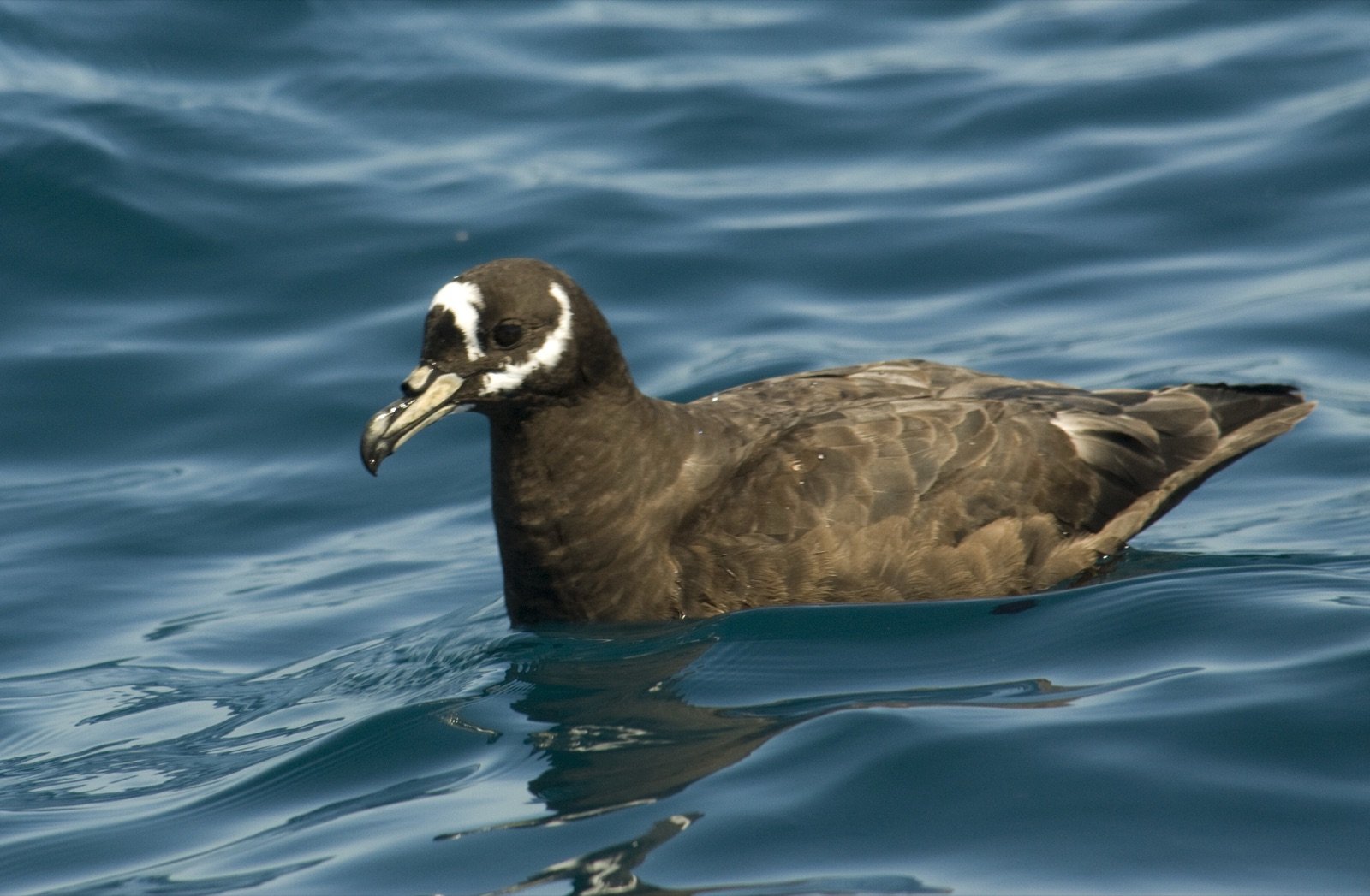
This is a large, mostly black petrel, about 55 cm (22 in) long. Look for three things:
An all black body.
A pale bill.
Bold white bands on the head that make the "spectacles" and give the bird its name.
Those white patches around the eyes are its mark, and the species is easy to identify at sea once you see them. It is also one of the largest petrels that nests in burrows, which gives a sense of the solid bird you are looking for.
Behaviour and diet
The Spectacled Petrel is attracted to fishing boats and scavenges scraps thrown overboard. It often feeds beside the more common White-chinned Petrel. Satellite tracking showed that most birds stay in the southwest Atlantic. They are strictly oceanic and come to land only to nest, and they tend to follow fishing vessels. Breeding birds are active at the colony from September to March.
Where it lives
Away from Costa Rica, this is a seabird of the South Atlantic. It breeds only on Inaccessible Island in the Tristan da Cunha group, nesting in burrows, and most birds stay in the southwest Atlantic.
In Costa Rica it is not a resident. The only record is from the Caribbean, in the sea off Tortuguero, far from its usual range. The writer who reported it suggests the deep southern Caribbean may act as a trap for lost seabirds, since storms may carry them there or they may find no way out of the deep offshore waters.
When to see it
The only Costa Rican record is from late February 2022, during the Caribbean dry-ish winter, and it remains a one-time vagrant.
Similar birds
Worldwide, this petrel can be mistaken only for two relatives: the Black Petrel and the White-chinned Petrel. The White-chinned is the closer match, because some of its birds also show pale head patches. The Spectacled's white eye patches and a differing head pattern separate them. The two were long treated as one species, and the Spectacled was described as a separate species in 1844.
Names and lore in Costa Rica
The Costa Rican list name is Petrel de Anteojos. Other Spanish names used elsewhere include Pardela de Anteojos and Petrel Mentón Blanco de Tristán da Cunha. In English it is also called Ringeye.
Status and conservation
The Costa Rican bird list marks the Spectacled Petrel as category A, an accidental visitor, while worldwide the IUCN has listed it as Vulnerable since 2007.
Photography tips
The bird is attracted to fishing boats and scavenges scraps thrown overboard, often beside the more common White-chinned Petrel. On a boat trip, note the pale bill and the white head bands, and record details of the head pattern to separate it from its lookalike.
How we know this 10 sources, each read on the date shown
- Wikipedia, List of birds of Costa Rica read 2026-11-04
https://en.wikipedia.org/wiki/List_of_birds_of_Costa_Rica - Birdwatching in Costa Rica read 2026-11-04
https://birdwatchingincostarica.com/aves-oceanicas-en-costa-rica-un-pais-de-mar-un-tesoro-por-descubrir/ - Cornell Birds of the World read 2026-11-04
https://birdsoftheworld.org/bow/species/spepet1/cur/introduction - Wikipedia read 2026-11-04
https://en.wikipedia.org/wiki/Spectacled_petrel - EcoRegistros read 2026-11-04
https://www.ecoregistros.org/sheet/Procellaria-conspicillata - 10,000 Birds read 2026-11-04
https://www.10000birds.com/spectacled-petrel-surprise-new-species-for-costa-rica.htm - ACAP species assessment read 2026-11-04
https://www.acap.aq/acap-species/302-spectacled-petrel/file - Planet of Birds read 2026-11-04
https://planetofbirds.com/procellariiformes-procellariidae-spectacled-petrel-procellaria-conspicillata/ - ResearchGate (Costa Rican bird note PDF) read 2026-11-05
https://www.researchgate.net/publication/387668234_Observacion_de_la_polluela_nortena_Porzana_carolina_Rallidae_en_un_patio_en_San_Jose_Costa_Rica - Avibase, Tortuguero National Park checklist read 2026-11-05
https://avibase.bsc-eoc.org/checklist.jsp?region=CRli03&list=howardmoore