 Tahiti Petrel
Family Procellariidae
Tahiti Petrel
Pseudobulweria rostrata
In Spanish: Petrel de Tahiti
- Migrant
A rare Pacific seabird, looked for on blue-water trips offshore.
The Tahiti Petrel (Petrel de Tahiti) is not a bird you meet from a trail or a garden. It breeds on Pacific islands far from Costa Rica, and the AOCR list marks it as M. The way to look for it is by boat, out over deep water.
The first Tahiti Petrel record accepted for North America was based on photos taken off Costa Rica in 2009. In recent years the species has been found regularly off Costa Rica, Guatemala and Oaxaca, Mexico.
For a beginning birder this is a bird to plan a boat day around. A blue-water trip offers a real chance at this rarity, along with storm-petrels and shearwaters.
How to find it
Pelagic boat trips are the best bet for a Tahiti Petrel in Costa Rica. Choose a blue-water trip that goes into deeper water rather than one that stays near shore. One visiting birder's two-trip weekend shows the pattern: the first trip stayed closer to shore, and the second went farther out for rarer species, where a Tahiti Petrel was photographed. The Puntarenas to Paquera ferry crosses the Gulf of Nicoya and is an easy, quick way to see some seabirds, but it is not reliable for gadfly petrels such as this one. Birders could not have seen the first Costa Rican bird from the mainland.
How to recognise it
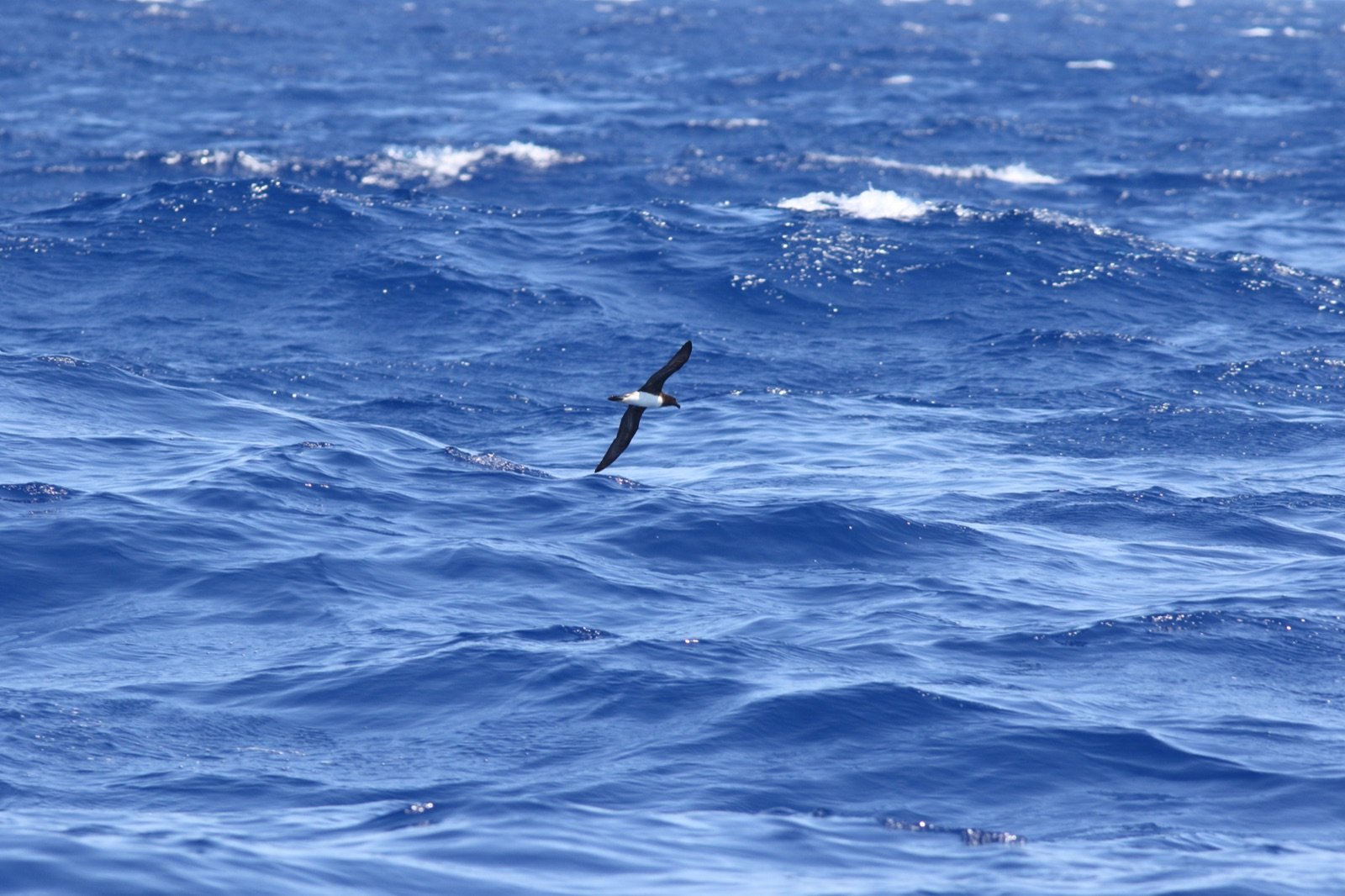
The Tahiti Petrel is a medium-sized seabird. Look for these marks together:
Mostly dark brown plumage, with a darker hood.
A paler rump.
A white belly.
A black, stout bill, very thick.
A wedge-shaped tail.
Long, pointed wings.
On a rolling boat, check the white belly against the dark upperparts first, then the heavy bill. Together these marks help separate it from the all-dark seabirds you may see offshore. Its flight is straight-winged and unhurried, which is a useful clue in itself.
Behaviour and diet
Its flight is leisurely, more so than most petrels. It glides efficiently on long, pointed wings, in a languid way like an albatross.
Birds have been seen grabbing prey from the water surface rather than diving. The petrels sometimes feed alongside other seabirds and pilot whales, so a gathering of seabirds or a visit from whales is worth a second look.
Where it lives
At sea the Tahiti Petrel prefers warm surface water above 25°C. Birds that breed in the south-west and central Pacific and eastern Polynesia spend the non-breeding season in tropical Pacific waters, including waters off the east-central Pacific coast of Mexico and Central America.
In Costa Rica that means the open Pacific, well offshore. The species nests in burrows and crevices on forested mountain slopes of Pacific islands, far from here.
When to see it
Off Middle America, from Mexico to Panama, the Tahiti Petrel is regular but uncommon, mainly from March to November. A survey off Costa Rica's Pacific coast notes that most Central American records come from April and May, and its authors saw scattered birds in September 2009, documented with photos.
Similar birds
The Phoenix Petrel looks very similar but has a bounding, active flight. The Tahiti Petrel is longer-winged, has a very thick bill, and glides like an albatross. Up close, the Phoenix Petrel has a larger bill, a paler tail and no white line on the underwing. The Atlantic Petrel is sometimes confused with it because it also has a white belly. On Costa Rican pelagic trips, Wedge-tailed Shearwaters are common, dark and come in three colour phases, so rule them out too.
Names and lore in Costa Rica
The Spanish name on the Costa Rican list is Petrel de Tahiti. Other Spanish names in use elsewhere include Petrel de Tahití, Petrel de Isla Tahiti and Fardela de Tahití.
Status and conservation
The AOCR list marks the Tahiti Petrel as M, and the IUCN lists it as Near Threatened.
Photography tips
Seabird observers have long struggled to separate Tahiti from Phoenix Petrel at sea, so photograph the bill, tail and underwing whenever you can. Photos are what documented the 2009 Costa Rican birds.
How we know this 17 sources, each read on the date shown
- Wikipedia read 2026-11-04
https://en.wikipedia.org/wiki/Tahiti_petrel - Birda species guide read 2026-11-04
https://app.birda.org/species-guide/7493/Tahiti_Petrel - DiBird read 2026-11-04
https://dibird.com/species/tahiti-petrel/ - Birdfinding.info read 2026-11-04
https://birdfinding.info/tahiti-petrel/ - Birding Craft read 2026-11-04
https://birdingcraft.com/wordpress/tag/pelagic-birding/ - NZ Birds Online read 2026-11-04
https://www.nzbirdsonline.org.nz/species/tahiti-petrel - Audubon read 2026-11-04
https://www.audubon.org/news/lost-sea-hard-flying-birds-can-be-mega-rarities-and-mysteries - Avibase read 2026-11-04
https://avibase.bsc-eoc.org/species.jsp?avibaseid=FCFBB7D9A628EF5D - Birding Manuel Antonio read 2026-11-04
https://manuelantoniobirding.wordpress.com/category/pelagic-birding/ - Towels Packed blog read 2026-11-04
https://towelspacked.wordpress.com/2024/05/02/costa-rica-pelagic/ - Wikipedia read 2026-11-04
https://en.wikipedia.org/wiki/Tahiti_Petrel - Birding Craft read 2026-11-04
https://birdingcraft.com/wordpress/2010/11/16/pelagic-day-trip-off-the-pacific-coast-of-costa-rica/ - PLOS ONE via PMC read 2026-11-04
https://www.ncbi.nlm.nih.gov/pmc/articles/PMC9045628/ - Observation frequency and seasonality of marine birds off the Pacific coast of Costa Rica read 2026-11-05
https://www.researchgate.net/publication/297895427_Observation_frequency_and_seasonality_of_marine_birds_off_the_Pacific_coast_of_Costa_Rica - Fifty-Second Supplement to the AOU Check-List (Auk) read 2026-11-05
https://academic.oup.com/auk/article/128/3/600/5148618 - AOS Classification Committee proposal read 2026-11-05
https://americanornithology.org/wp-content/uploads/2020/04/2020-D-updated.pdf - Marine Ornithology read 2026-11-05
http://www.marineornithology.org/PDF/53_1/53_1_1-11.pdf