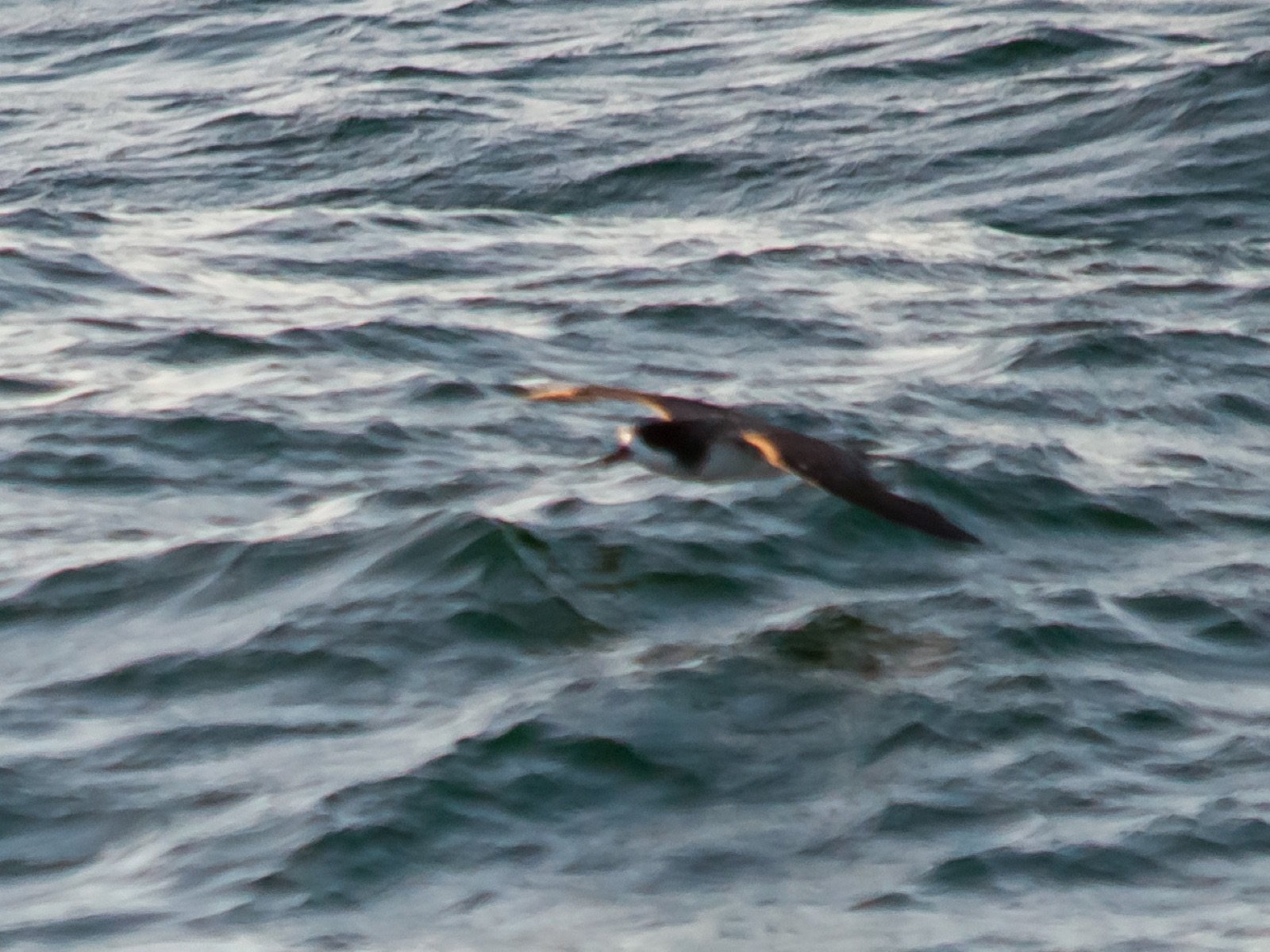
Family Procellariidae
Galapagos Petrel
Pterodroma phaeopygia
In Spanish: Petrel Lomioscuro
- A
A rare, Critically Endangered seabird of Costa Rica's far offshore Pacific waters.
The Galapagos Petrel (Petrel Lomioscuro) is not a bird you find from the beach. In Costa Rica it is rarely seen, and only in Pacific offshore (pelagic) waters, because it nests in the Galapagos and not here.
Satellite tracking of breeding petrels from the Galapagos showed they range into the waters of Colombia, Costa Rica and Peru, as well as Ecuador. That is why a boat that goes far enough out can, with luck, meet one.
For a beginning birder this is a long shot worth holding onto. The two best chances are a boat trip to Cocos Island and the pelagic seabird flocks that gather with tuna and dolphins.
How to find it
Choose a boat trip that reaches or goes beyond the continental shelf, since that is where this petrel should be watched for. The Cocos Island trip is the best bet because the bird tends to stay well offshore. The long overnight crossing also lets you watch for it at night, when it may feed. The second good chance is the pelagic flocks that gather with tuna and dolphins. Keep scanning those flocks rather than expecting a bird on its own. Sightings in Central American waters remain rare, so expect a lucky find, not a reliable target.
How to recognise it
It is a medium-sized seabird, about 43 cm long with a wingspan of about 91 cm. These details describe the species across its whole range, not only birds seen off Costa Rica.
Look for these marks:
- Gray upperparts.
- A faint dark M pattern across the back.
- A white face and throat.
- White underparts all the way down.
At sea it looks nearly identical to the Hawaiian Petrel, so a distant bird deserves a careful look.
Behaviour and diet
It is mostly solitary at sea, but it does join mixed seabird flocks at dolphin feeding frenzies, so those flocks are the place to look. It spends most of its life over open ocean.
Outside the breeding season it ranges widely across the Pacific, from about 10° N to 20° S, and from the South American coast to roughly 120° W. On its Galapagos home waters it can be seen offshore all year.
Where it lives
This is a bird of open ocean. In Costa Rica it is found only in Pacific offshore waters, which sit at the northern edge of its range. It tends to stay well offshore.
On land it belongs to the Galapagos. Its breeding season starts in late April, when birds go to the humid highlands to nest, between 300 and 900 metres above sea level. Nests are in burrows or natural cavities on slopes. Pairs return to the same site and mate each year, laying two to four eggs. Those details apply to the Galapagos, not to anywhere in Costa Rica.
When to see it
A South American source describes it as a non-breeding visitor to northern offshore waters from September through February, though this is not specific to Costa Rica.
Similar birds
The great challenge is the Hawaiian Petrel, which looks nearly identical at sea. The two were once treated as a single species. The gray back with its faint dark M and the all-white face, throat and underparts are the starting point.
Names and lore in Costa Rica
The AOCR list uses Petrel Lomioscuro, and some Costa Rican lists also give Petrel de Galápagos. Other Spanish names include petrel hawaiano, fardela gris parda and petrel ecuatoriano. In the Galapagos, locals call it patapegada, which means web-footed one.
Status and conservation
The AOCR list gives it status A, an accidental or very rare record in Costa Rica, and the IUCN lists the species as Critically Endangered.
Photography tips
Dolphin and tuna feeding flocks are the place to look, because this mostly solitary bird joins mixed seabird flocks there. Keep your attention on the whole flock, not just the closest birds.
How we know this 16 sources, each read on the date shown
- 10,000 Birds read 2026-11-04
https://www.10000birds.com/critically-endangered-birds-in-costa-rica-how-to-see-them-how-to-help-them.htm - USGS publication abstract read 2026-11-04
https://pubs.usgs.gov/publication/70275373 - Peru Aves read 2026-11-04
https://www.peruaves.org/procellariidae/galapagos-petrel-pterodroma-phaeopygia/ - Galapagos Conservation Trust read 2026-11-04
https://galapagosconservation.org.uk/species/galapagos-petrel/ - PLOS ONE (PMC) read 2026-11-04
https://www.ncbi.nlm.nih.gov/pmc/articles/PMC4436216/ - Birdwatching in Costa Rica read 2026-11-04
https://birdwatchingincostarica.com/bird-lists/ - Center for Biological Diversity read 2026-11-04
https://www.biologicaldiversity.org/species/birds/Galapagos_petrel/natural_history.html - Birdwatching in Costa Rica read 2026-11-04
https://birdwatchingincostarica.com/aves-oceanicas-en-costa-rica-un-pais-de-mar-un-tesoro-por-descubrir/ - American Bird Conservancy read 2026-11-04
https://abcbirds.org/birds/galapagos-petrel/ - Wikipedia read 2026-11-04
https://en.wikipedia.org/wiki/Pterodroma_phaeopygia - Young and Zook 2016, Observation frequency and seasonality of marine birds off the Pacific coast of Costa Rica (ResearchGate) read 2026-11-05
https://www.researchgate.net/publication/297895427_Observation_frequency_and_seasonality_of_marine_birds_off_the_Pacific_coast_of_Costa_Rica - Zeledonia 29(1), July 2025 (Wenzel and Arias) read 2026-11-05
https://www.zeledonia.com/uploads/7/0/1/0/70104897/zeledonia29.1.pdf - Sergio Arias, Universidad de Costa Rica (Academia.edu) read 2026-11-05
https://ucr.academia.edu/SergeArias - ResearchGate figure page citing Vallely and Dyer 2018 read 2026-11-05
https://www.researchgate.net/figure/Study-area-off-the-Pacific-coast-of-Costa-Rica-Dark-gray-lines-indicate-tracks-where_fig1_297895427 - NaturaLista Colombia (from Wikipedia) read 2026-11-05
https://colombia.inaturalist.org/taxa/4041-Pterodroma-phaeopygia - bioRxiv, Galapagos Petrel genome paper read 2026-11-05
https://www.biorxiv.org/content/10.1101/2025.07.21.665997.full.pdf