Family Sulidae
Peruvian Booby
Sula variegata
In Spanish: Piquero Peruano
- A
A rare seabird from Peru's cold coast, found among Blue-footed Boobies.
The Peruvian Booby (Piquero Peruano, Sula variegata) belongs to the cold Humboldt Current far to the south, so a sighting in Costa Rica is a genuine surprise. It was long absent from the country's list, and the first accepted record came only in 2023.
It turns up in El Niño years, and 2026 has been exceptional for sightings across Central America. A high count of 14 was logged in Costa Rica that year, while Panama had as many as 165 at one location.
On a trip we build, the search means a ferry crossing or a short boat ride on the Gulf of Nicoya and a careful look through the boobies on a rocky island. It is a lovely lesson in scanning a flock.
How to find it
Start at Puntarenas, described as the most accessible and reliable place in Costa Rica for vagrant seabirds. Many pelagic species there are easier to see from the Puntarenas to Paquera ferry, which crosses one of the richest estuarine gulfs in Central America. Costa Rica's first Peruvian Booby was seen from that ferry. Local birders have also taken short boat trips to Isla Guayabos, where three or four Peruvian Boobies stayed among about a hundred Blue-footed Boobies. Check any pale-headed booby in a flock of them. Landing on the island is restricted, so you watch from boats that circle it.
How to recognise it
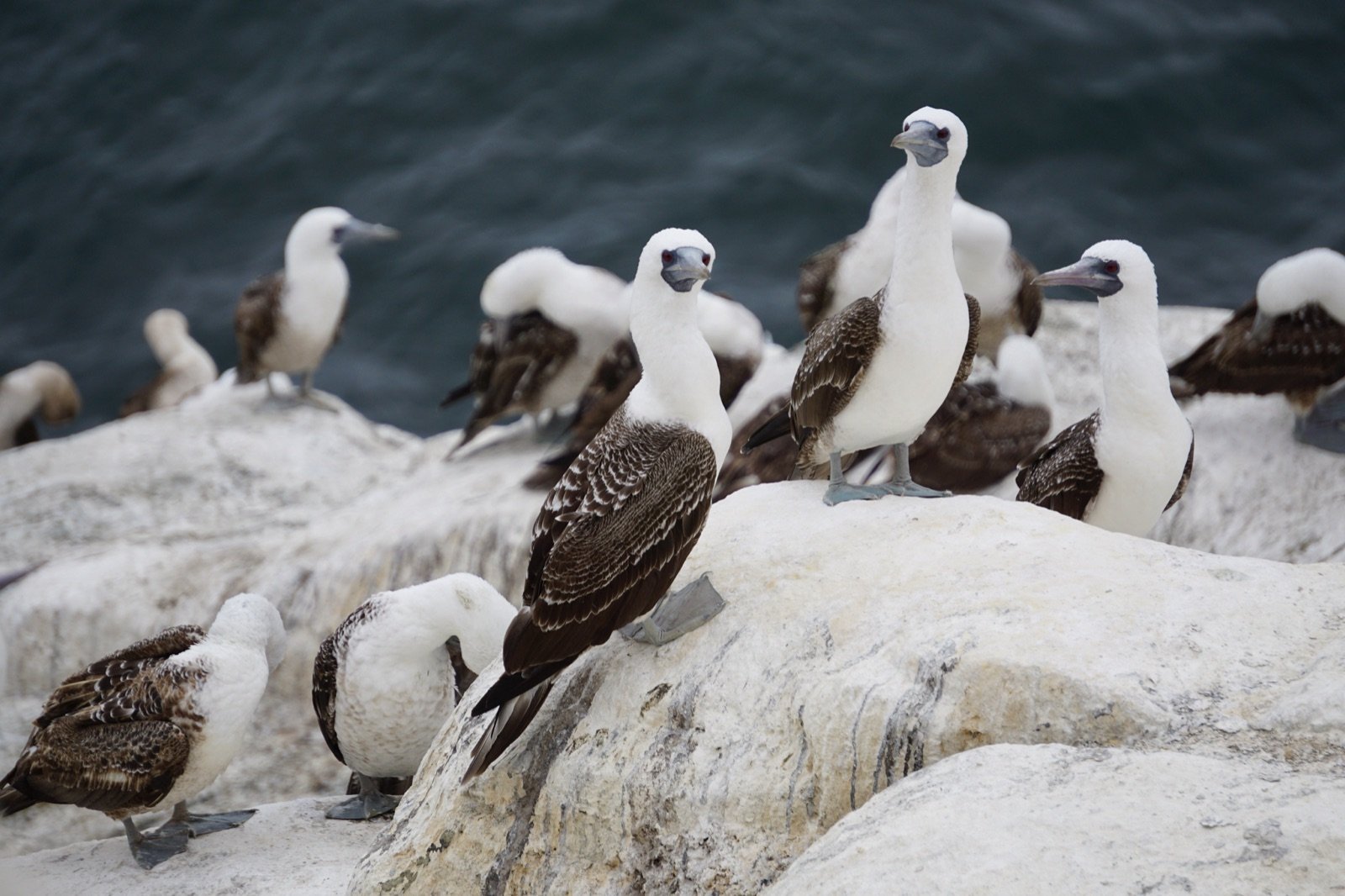
Adults are about 70 cm long and follow a simple pattern, so learn it in parts.
Head and neck: white, and very white indeed.
Chest and belly: white.
Wings and tail: dark brown, with pale speckling on the wings.
Bill: gray, dark gray in some descriptions.
Legs and feet: short and gray to bluish.
Eye: dark iris, and gray feet at all ages, unlike the Blue-footed Booby.
Juveniles have a sooty gray head, neck and back with white specks. In the Gulf of Nicoya, a booby that was not dark enough for a Brown Booby, with a dusky head and white tail, turned out to be a Blue-footed Booby. The black and white Peruvian looked quite different.
Behaviour and diet
The Peruvian Booby is a social seabird that nests in large colonies. Its main food is the Peruvian anchoveta, and it feeds in flocks. Large groups fly low over the water and dive together in a feeding frenzy. Flight is strong and direct, with quick flaps and short glides. In Costa Rica it is often found among Blue-footed Boobies, usually loafing, so the flock is the place to look closely.
Where it lives
This is a marine bird of the cold Humboldt (Peruvian) Current. It breeds on the coast from northern Peru to central Chile and wanders north to coastal Ecuador when not breeding. Colonies can be pure booby or mixed with Guanay Cormorants and Peruvian Pelicans.
In Costa Rica it is a visitor from far away, seen at sea and on offshore rocks. In 2023 birds were seen off the Osa Peninsula and around the Gulf of Nicoya, including Isla Guayabo near Puntarenas.
When to see it
It turns up in Costa Rica in El Niño years: the first accepted record was in 2023, and by August 2026 a few had been seen along other parts of the coast. In June 2023 a birder at Puntarenas found one with a bright white head and dark back.
Similar birds
The Blue-footed Booby is the main bird to sort out, and it is where you will usually find the Peruvian. A very white head helps separate the two. Peruvian Boobies also hybridize with Blue-footed Boobies at times, so odd-looking birds can occur. Brown Boobies are much darker headed and are the most common booby in Costa Rica.
Names and lore in Costa Rica
Spanish names in use include Piquero Peruano, plain Piquero, Piquero Variado and Bobo Peruano. Costa Rica's own list gives the common name as Piquero peruano.
Status and conservation
It is category A on the AOCR list and remains a rare vagrant in Costa Rica, while the IUCN lists the species as Least Concern.
Photography tips
Boat trips that circle Isla Guayabo give the best chance to photograph boobies on the rocks, since landing is restricted. Scan the whole flock for the bright white head, which stands out against the dark back.
How we know this 23 sources, each read on the date shown
- Smithsonian Ocean read 2026-11-04
https://ocean.si.edu/ocean-life/seabirds/meet-booby-family - Antipode Peru read 2026-11-04
https://antipode-peru.com/en-guide-the-peruvian-booby - Animal Diversity Web read 2026-11-04
https://animaldiversity.org/accounts/Sula_variegata/ - DiBird read 2026-11-04
https://dibird.com/species/peruvian-booby/ - American Birding Association read 2026-11-04
https://www.aba.org/intense-el-nino-sends-humboldt-current-seabirds-to-central-america/ - Birding Craft read 2026-11-04
https://birdingcraft.com/wordpress/2022/04/13/puntarenas-costa-rica-a-hotspot-that-merits-a-bird-observatory/ - Birding Craft read 2026-11-04
https://birdingcraft.com/wordpress/tag/costa-rica-pelagic-birds/ - ArgentiNat read 2026-11-04
https://www.argentinat.org/taxa/3796 - Aves de Costa Rica read 2026-11-04
https://avesdecostarica.com/Sula-variegata.html - International Parks read 2026-11-04
https://www.internationalparks.org/costa-rica/Isla%20Guayabo - Birding Craft read 2026-11-04
https://birdingcraft.com/wordpress/tag/peruvian-booby-in-costa-rica/ - Aves de Chile read 2026-11-04
https://www.avesdechile.cl/024.htm - EcoRegistros read 2026-11-04
https://www.ecoregistros.org/ficha/Sula-variegata&idlugar=7822 - Lista Oficial de las Aves de Costa Rica read 2026-11-05
https://listaoficialavesdecostarica.wordpress.com/ - Birding Craft read 2026-11-05
https://birdingcraft.com/wordpress/2023/06/25/the-el-nino-birds-have-arrived-in-costa-rica/ - Birding Craft read 2026-11-05
http://birdingcraft.com/wordpress/tag/puntarenas-seawatching/ - Birding Craft read 2026-11-05
https://birdingcraft.com/wordpress/tag/planning-a-birding-trip-to-costa-rica/ - Birding Craft read 2026-11-05
https://birdingcraft.com/wordpress/2015/09/04/more-ferry-birding-in-costa-rica/ - Tico Times read 2026-11-05
https://ticotimes.net/2026/11/04/el-nino-gulf-of-nicoya-fishermen-catch-decline - Peru Aves read 2026-11-05
https://www.peruaves.org/sulidae/peruvian-booby-sula-variegata/ - Ministerio del Medio Ambiente de Chile read 2026-11-05
https://clasificacionespecies.mma.gob.cl/wp-content/uploads/2019/10/Sula_variegata_14RCE_FINAL.pdf - Aves de Perú read 2026-11-05
https://avesdeperu.org/sulidae/piquero-peruano-sula-variegata/ - ResearchGate, Gulf of Nicoya fisheries paper read 2026-11-05
https://www.researchgate.net/publication/333055217_The_Gulf_of_Nicoya_Costa_Rica_Fisheries_System_Two_Decades_of_Change