Family Anhingidae
Anhinga
Anhinga anhinga
In Spanish: Aninga (Pato Aguja)
- Resident
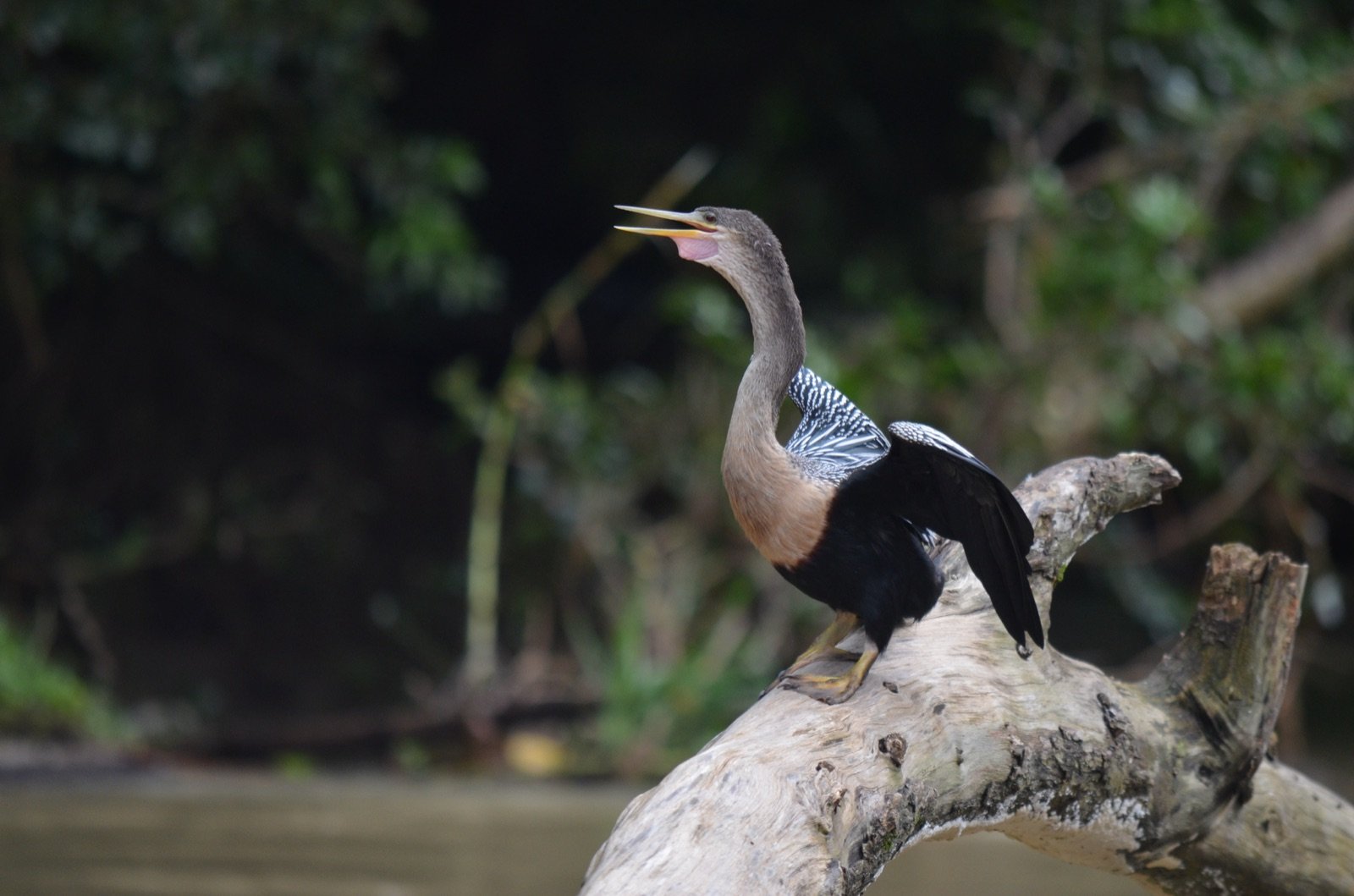
The snake bird of Costa Rica's lowland canals, wings spread to dry.
The Anhinga is one of the easiest waterbirds to enjoy once you know where to look: perched on a branch at the water's edge, wings held wide to dry in the sun. It is a featured bird of the Tortuguero canals on the northeast Caribbean side, where one site calls it the most popular bird of the national park.
In the northern lowlands near the Nicaraguan border, on a trip we build, it is one of the birds we look for from the boat, alongside Roseate Spoonbill, Northern Jacana, Neotropic Cormorant and Great Blue Heron, in a wetland with more than 350 species.
Costa Ricans know it as Aninga or Pato Aguja, and anglers of the canals would know it as the bird that sunbathes on a log after the hunt.
Where to see it
How to find it
Boat trips are the usual way to see wetland birds in the northern lowlands, where boats drift along the Río Frío and anhingas perch on branches to dry their wings in the sun. Look for them on logs and branches at the water's edge, especially in the afternoon when they dry their wings. They are common on submerged branches near lagoon margins. At Tortuguero, boat trips on the canals show them on branches and logs in sunlight. The Río Tortuguero Trail, the gateway to the canal sector of the park, also offers many water birds.
How to recognise it
Adult male:
- Black, with silvery white streaks on the back and wings.
- A long S-shaped neck.
- A dagger-like yellow-orange bill, straight and pointed with no hooked tip.
- A long, wide tail.
Female: like the male, but with a pale buff or light brown head, neck and upper chest, a chestnut lower breast and a browner back. Females and juveniles have buffy-brown heads and necks, and from a distance they can look all black.
During breeding the facial skin turns bright blue-green. At other times it is brownish.
Next to the Neotropic Cormorant, the cormorant of Costa Rica's lowland waters, the Anhinga is larger, with a much longer neck, tail and bill.
What it sounds like
Recording: Jeffrey Harris, CC BY 4.0, source, read 4 Nov 2026.
Behaviour and diet
After swimming, the Anhinga perches with its wings spread to dry. Its feathers are not waterproofed, so drying and warming in the sun is essential.
It hunts by swimming fully underwater and spearing fish or amphibians with a quick thrust of its bent neck, then surfaces to swallow the catch. The prey list is wide: fish, reptiles, amphibians and aquatic invertebrates.
Anhingas are also sometimes seen soaring high on thermals, wings and necks fully extended, often alongside vultures.
Where it lives
The Anhinga lives in warm, shallow freshwater such as ponds, swamps and lakes. In Costa Rica the sites where it is found are lowland wetlands and canals.
A Costa Rican guide describes it as a resident, widespread in the Caribbean and Pacific lowlands, at salt and fresh water sites that have trees or logs to perch on. It is the only member of its family in the country.
When to see it
At the northern wetlands, water recedes in the drier season and anhingas and cormorants gather in large numbers. Palo Verde wetlands are best in the dry season, December to April, when waterbirds gather. Breeding runs from May to February, with a peak from September to November.
Similar birds
It resembles a cormorant, but the Anhinga has a longer, wider tail, a straight pointed bill with no hooked tip, and it can glide in flight. Costa Rican photo guides contrast its pointed bill and broad tail with the hooked bill and stubby tail of cormorants. The Neotropic Cormorant has a shorter neck and tail, lacks the silvery wing patches and swims higher in the water, not with the body submerged.
Names and lore in Costa Rica
Costa Rican sources call it Pato Aguja, which means needle duck, from its long, sharp, needle-like bill. The AOCR name is Aninga, a name used in Guatemala, Costa Rica and Panama that comes from a Tupi word. It is also called the snake bird, because when it swims with its body submerged only the neck and head show, like a snake gliding over the surface.
Status and conservation
The AOCR list marks it as a resident (R), and globally it is rated Least Concern because it is frequently seen across a very large range.
Photography tips
Boat trips on the Tortuguero canals show it on branches and logs in sunlight, and drying its wings on a canal log gives a classic pose. Palo Verde is described as a bird photographer's paradise in the dry season, with boat tours available. Afternoon is the time when they dry their wings.
Trips that find it
- Arenal, the Pacific and the Quetzal Valley16 nightsSee the trip
- Costa Rica Classic Birding, All Inclusive8 nightsSee the trip
- Dancing with Quetzals11 nightsSee the trip
- Northern Volcanoes and Wetlands10 nightsSee the trip
Tell us when you are travelling and our team in Costa Rica builds the trip around the birds you want to see.
Plan my birding tripHow we know this 24 sources, each read on the date shown
- SINAC (Tortuguero National Park) read 2026-11-04
https://www.sinac.go.cr/EN-US/ac/acto/pnt/Pages/default.aspx - Go Visit Costa Rica read 2026-11-04
https://www.govisitcostarica.com/region/city.asp?cID=81 - Audley Travel read 2026-11-04
https://www.audleytravel.com/us/costa-rica/places-to-go/cano-negro - Pura Aventura read 2026-11-04
https://pura-aventura.com/costa-rica/travel-advice/the-9-best-wildlife-spots-in-costa-rica - C-Ludik read 2026-11-04
https://c-ludik.fr/en/north-and-central-america/costa-rica-en/cano-negro-refuge-teeth-feathers-along-water/ - Wild Photography read 2026-11-04
https://www.wildphotography.com/article/cano-negro-costa-rica-photography-guide - Wikipedia read 2026-11-04
https://en.wikipedia.org/wiki/Anhinga - New World Encyclopedia read 2026-11-04
https://www.newworldencyclopedia.org/entry/Anhinga - Cornell Birds of the World read 2026-11-04
https://birdsoftheworld.org/bow/species/anhing/cur/sounds - All About Birds, Cornell Lab of Ornithology read 2026-11-04
https://www.allaboutbirds.org/guide/Anhinga/species-compare/ - All About Birds, Cornell Lab of Ornithology read 2026-11-04
https://www.allaboutbirds.org/guide/Neotropic_Cormorant/species-compare/ - Nicoya Peninsula Costa Rica wildlife guide read 2026-11-04
https://nicoyapeninsula.com/wildlife/waterbirds/ - Tico Times read 2026-11-04
https://ticotimes.net/2024/12/01/meet-the-anhinga-a-unique-wetland-bird-found-in-costa-rica - CHIPES read 2026-11-04
https://chipes.org/portfolio/anhinga-anhinga-anhinga/ - Tortuguero Info read 2026-11-04
https://www.tortugueroinfo.com/aninga_tortuguero.html - Aves de Costa Rica read 2026-11-04
http://www.avesdecostarica.com/Anhinga-anhinga.html - El Jornal CR read 2026-11-04
https://eljornalcr.com/el-pato-aguja-nos-sorprende-con-sus-poses-y-nados/ - Enjoy Costa Rica read 2026-11-04
https://www.enjoycostarica.com/what-to-do-in-costa-rica/birding-in-costa-rica/ - Lindblad Expeditions read 2026-11-04
https://www.expeditions.com/travel-guide/costa-rica-travel-guide/birding-destinations-in-costa-rica - SINAC read 2026-11-04
https://www.sinac.go.cr/en-us/ac/acto/pnt/pages/default.aspx - Viator read 2026-11-04
https://www.viator.com/blog/Where-to-Go-Bird-Watching-in-Costa-Rica/l17684 - Costa Rica Guide read 2026-11-04
https://costa-rica-guide.com/photos/wildlife-reserves/cano-negro-photos/attachment/anhinga-2/ - Hotel Rivel read 2026-11-04
https://hotelrivel.online/el-pato-aguja-anhinga-anhinga-anhinga/ - Copa de Árbol read 2026-11-04
https://www.copadearbol.com/the-top-10-birding-destinations-in-costa-rica/