Family Bucconidae
Pied Puffbird
Notharchus tectus
In Spanish: Buco Pinto
- Resident
Small, still black and white puffbird of Caribbean lowland edges
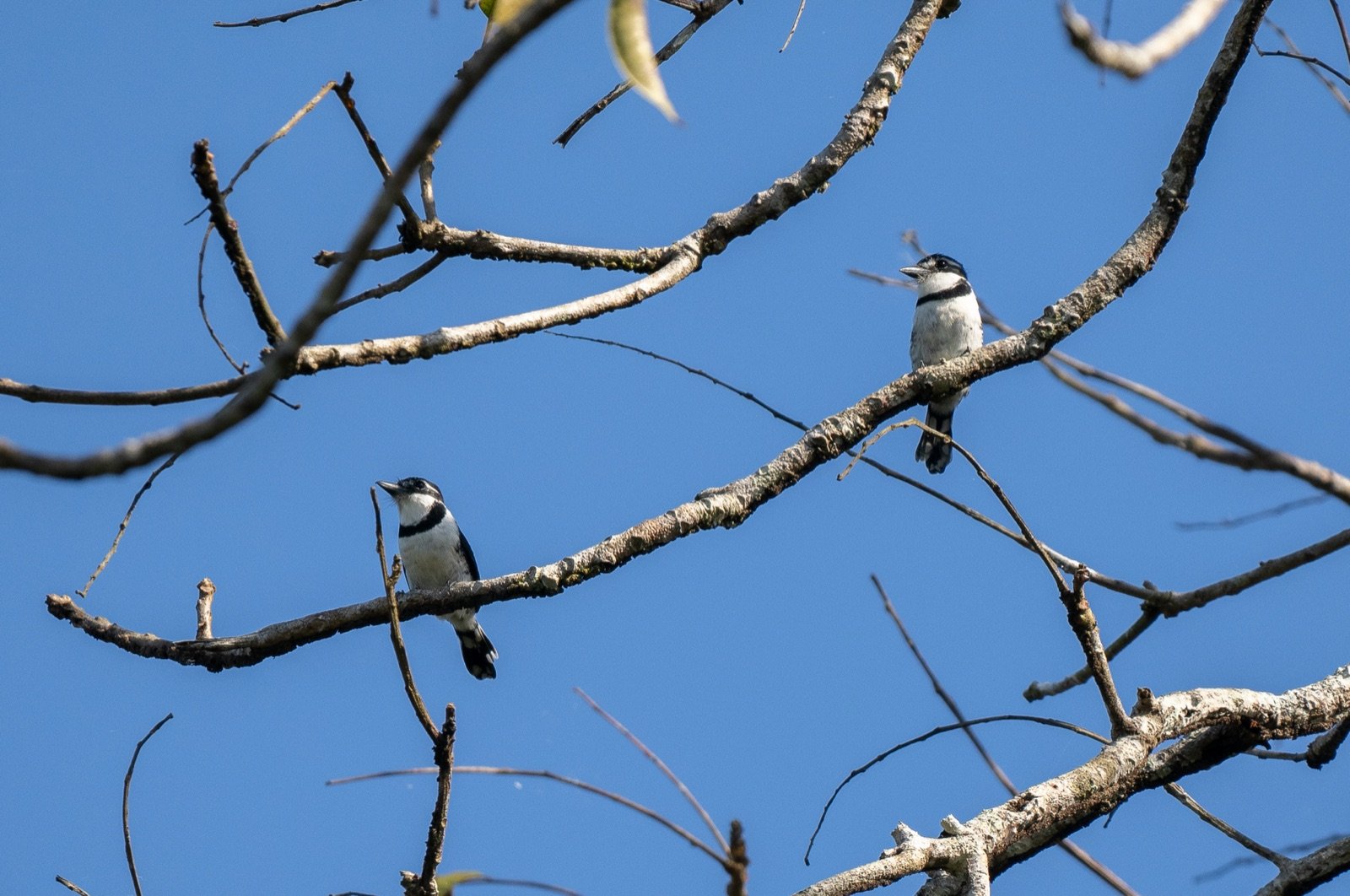
The Pied Puffbird, Buco Pinto in Costa Rican Spanish, is a small black and white bird that perches in the open, high in the canopy. It is a Caribbean lowland specialty that rarely occurs above 300 m.
It sits so still for such long spells that birders easily overlook it. Finding one is as much about listening and scanning treetops as it is about walking.
On a trip we build around the Caribbean lowlands, a scope and a patient look at the tallest tree along a forest edge are what turn a hard bird into a good sighting.
How to find it
Scan the tops of tall trees along forest edges and in open areas with scattered trees, where it sits exposed on high perches. Listen as well as look. One Costa Rican guide often finds it at a rainforest edge, calling from a very tall tree, usually after a whistling call. If it stays silent, noticing it takes a lot of luck. Check small birds on high branches carefully, because a bird you take for a Blue-gray Tanager may be a Pied Puffbird. Dead branches in the open deserve a second look, and a scope helps: guides at La Selva have set one up so a whole group could see a bird perched back from the trail.
How to recognise it
Think of a small, stocky bird, about 15 cm long, mostly glossy black above and white below.
Field marks:
- a black band across the upper breast
- a black bill
- a white forehead
- a black line through the eye
- a crown flecked with white
One guide describes a black head with white freckles and a thin white eye-line, with a breast band narrower than on its larger lookalike. Young birds are brownish-black above, with buff spots on the forehead or wing coverts, instead of the clean black of adults.
Seen on a high branch it can pass for a small Blue-gray Tanager, but the puffbird is chunkier and black and white.
Behaviour and diet
The Pied Puffbird perches in the open, usually high in the canopy, and makes short flights out to catch insects and other arthropods. Like other puffbirds it waits motionless for long periods, and a birding writer calls this lethargic habit the reason the small bird is so easily missed. It sometimes perches on dead branches in the open. Across its range it is seen alone, in pairs, or in small groups of up to about six, and it nests in holes dug into termite nests in trees.
Where it lives
In Costa Rica it seems to avoid mature primary forest and is found in more open country, up to about 300 m elevation. Across its range it uses forest canopy and edges, and second growth with scattered tall trees. In Costa Rica it seems to prefer the edges of lowland forest on the Caribbean slope, and it is not usually found on the other side of the mountains. Elsewhere in its range it reaches about 1,000 m, which is not the Costa Rican picture. Birders have also logged it at Palo Verde National Park and around Escuela Las Nubes.
When to see it
La Selva has no true dry season: rain falls in every month, with a modest lull from August to early November and somewhat wetter conditions from December to March.
Similar birds
The White-necked Puffbird is the bird most likely to be confused with it. It is also black and white and found in the canopy, but it is much bigger, a pigeon-sized lookalike, while the Pied is the miniature one. The White-necked has a white forehead patch, and its voice is a quiet, even-pitched, prolonged trill, unlike the Pied's descending trills.
Names and lore in Costa Rica
Costa Rican Spanish uses Buco Pinto. Other Spanish names across its range include Buco Pío, Chacurú de Pecho Blanco and Juancito Negro.
Status and conservation
It is a resident (R) on the AOCR list and rated Least Concern, though it is called uncommon in Costa Rica.
Photography tips
Check small birds on high branches carefully, since the puffbird can look like a tanager. A spotting scope is the tool: at La Selva a group used one to view a puffbird on a limb set back from the trail.
How we know this 20 sources, each read on the date shown
- Bird Watching Costa Rica read 2026-11-04
https://www.birdwatchingcostarica.com/ave/pied-puffbird/ - Birda read 2026-11-04
https://app.birda.org/species-guide/10894/Pied_Puffbird - Damisela read 2026-11-04
http://www.damisela.com/zoo/ave/otros/pic/bucconidae/notharchus/tectus/index.htm - Animalia.bio read 2026-11-04
https://animalia.bio/pied-puffbird - Avibase read 2026-11-04
https://avibase.bsc-eoc.org/species.jsp?avibaseid=70D5AC76A370FD48 - Flickr (Tropical Birding trip note) read 2026-11-04
https://www.flickr.com/photos/nigelje/29515046787 - Wikipedia read 2026-11-04
https://en.wikipedia.org/wiki/Pied_puffbird - Birding Craft read 2026-11-04
https://birdingcraft.com/wordpress/tag/pied-puffbird/ - Wikipedia read 2026-11-04
https://en.wikipedia.org/wiki/Pied_Puffbird - Cornell Birds of the World read 2026-11-04
https://birdsoftheworld.org/bow/species/whnpuf2/cur/introduction - The World Birds read 2026-11-04
https://theworldbirds.org/HTML/Pici_Puffbird.htm - Wikipedia (Spanish) read 2026-11-04
https://es.wikipedia.org/wiki/Notharchus_tectus - Birding Craft read 2026-11-04
https://birdingcraft.com/wordpress/tag/caribbean-lowland-birds/ - Birding Craft read 2026-11-04
https://birdingcraft.com/wordpress/tag/caribbean-lowlands/ - 10,000 Birds read 2026-11-04
https://www.10000birds.com/caribbean-lowland-birding-at-ara-ambigua-lodge-costa-rica.htm - Birding Craft read 2026-11-04
https://birdingcraft.com/wordpress/2023/07/30/costa-rica-birding-tips-southern-caribbean-zone-2023/ - Birding Club of Costa Rica read 2026-11-04
https://birdingclubcr.org/bccr-adventures-new/caribbean-lowlands.html - Eagle-Eye Tours read 2026-11-04
https://www.eagle-eye.com/tour/costa-rica-caribbean-birding-tour/ - Costa Rica Focus read 2026-11-04
https://www.costaricafocus.com/lodging/la-selva-biological-station/ - Wing and Song read 2026-11-04
https://wingandsong.wordpress.com/2009/01/31/birding-the-caribbean-lowlands-in-costa-rica/